
‘ISRO is planning to build a Bharatiya Antariksh Station by 2030. So, our goal is to create a vehicle that can supply modules to the Bharatiya Antariksh Station and bring the products back.’

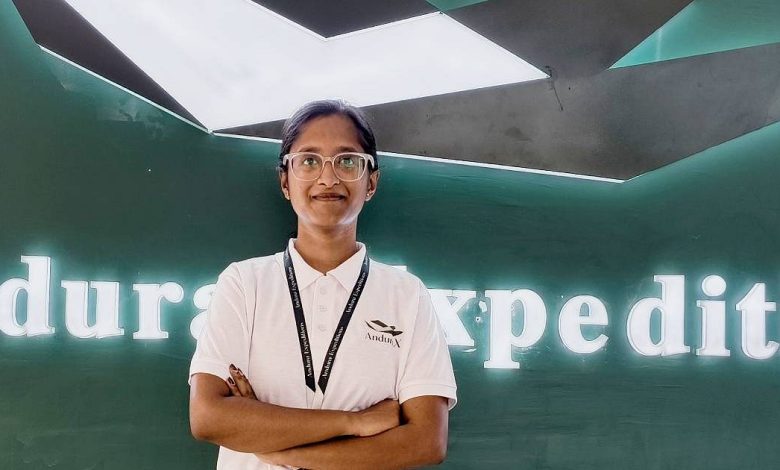
IMAGE: Sree Supranayi. All photographs: Kind courtesy Sree Supranayi
There is not a child who has not dreamt of becoming an astronaut and visiting the moon.
25-year-old Sree Supranayi also grew up listening to her mother’s stories of a civilisation on the moon and dreamt of becoming an astronaut.
Her mother told her, by the time she was 25, she could go to the moon on summer vacations.
But at 25, she is planning to send vehicles to space.
Today, she dreams of making space a manufacturing hub!
Here is the inspiring story of space entrepreneur Sree Supranayi.
Key Points
- Sree Supranayi co-founded AnduraX to develop reusable spaceplanes supporting manufacturing, research and cargo missions in orbit.
- The startup aims to make space-based manufacturing commercially viable by leveraging microgravity to produce purer materials and larger protein crystals.
- After struggling to attract investors, the company secured initial family support alongside government grants including Nidhi Prayas, MeitY TIDE and SISFS.
- AnduraX successfully completed its first high-altitude balloon drop experiment in May 2026, validating key guidance, navigation and control technologies.
- The company targets demonstration missions by 2028, cargo operations for the Bharatiya Antariksh Station by 2030, and eventually human spaceflight capabilities.

IMAGE: Computer-generated illustration of the ARES spaceplane.
I grew up imagining space and wanting to go to space
I grew up listening to my mother’s stories about a civilisation that flourished on moon.
She told me by the time I turned 25 I could go to the moon on summer vacations!
So, I grew up imagining space and wanting to go to space.
I couldn’t be an astronaut due to certain physical constraints and barriers.
As my family has always been into entrepreneurship, they wanted me to be in the real estate business they were in.
But I had another dream, and that was to travel to space and look at the earth, the planets, and the stars from there! Perhaps every child has this fascination to float in space and jump on to the moon!
I studied aerospace engineering to pursue my dream.
I also read about the journeys of Sunita Williams, Dr Abdul Kalam, etc and got inspired.
But my true inspiration was my father and the philosophy he followed; that whatever you do, you do it with absolute dedication. I try to follow what my father showed me by example, quite diligently.
Becoming a space entrepreneur
After studying aerospace engineering, I thought if I worked on something that would take others to space, I could chart out a common journey for everyone.
After my studies, I worked in a startup that built reusable launch vehicles.
That was where I met Nirvik Choudhary who also had the same interest and passion about what we could do in space.
The two things that both were of us were interested were industrialisation of space and defence technology.
And we talked a lot about space as a manufacturing hub for certain industries.
Soon, we realised only if we joined hands, we would be able to realise our dream.
The result was, we co-founded our start up in June 2024 and named it AnduraX.
No, the name has nothing to do with SpaceX!
Andura is taken from the word Endurance, and X stands for Expeditions to space.

IMAGE: Another view of the computer-generated illustration of the ARES spaceplane.
The biggest challenge faced as a start-up was to get funding
The journey of all entrepreneurs is full of challenges. So was ours.
The main challenge was to get funding.
When we spoke about manufacturing in space and industrialisation of space, all of them said what we were talking about was very futuristic, it was sci-fi.
Imagine this was happening in 2024, just two years ago!
Because people did not understand what we were talking about, nobody was willing to invest in our idea.
Eventually, it was our family that came forward to support us with initial funding.
Then, we got government fundings like Nidhi Prayas, Meity TIDE and SISFS.
So, it was with the family and government funding that our journey as space entrepreneurs began.
Even after two years, it is not easy at all. It takes a lot of effort to convince people to invest in an idea like ours.
The next challenge is getting the components. Since the space ecosystem is still evolving, we have to import most of the components and it is very time consuming.
Why manufacture in space?
This is the question I encounter all the time but I’m always excited to answer it.
There is gravity on earth but in space, there is no gravity.
If I were to say it is easier to understand and process a drug’s chemical composition in space, will you believe me?
But it is so.
While making drugs, you make something called protein crystals. If you make them in space, these protein crystals will be bigger in size, and purer in composition.
So, it reduces a lot of time in discovering new drugs.
If the research for a cure for cancer, HIV, Parkinson’s and many other diseases is done in space, it will be faster than the research done on earth.
Have you seen astronauts drop a drop of water in space? Have you noticed its size? The same water drop will be very, very small when dropped on earth.
In space, it spreads out.
Similarly, while doing research on drugs, the protein crystals on earth will be small in size while in space, they are very big. Because the crystals are very big in space, it is easier to look into them and understand them better.
The most important part is, the crystals are purer in space. The purer the material is, the faster the discovery.
Space as a manufacturing hub is not a new idea
In fact, manufacturing has been going on in at the International Space Stations on an experiment level for the past 20 years.
Now, they have started scaling up to manufacturing level.
As you do not need humans for most experiments, fully automated research modules can be put in our space vehicle we plan to make.
This vehicle will stay in space while the automated module will do the manufacturing. Once it is over, the vehicle can come back.
We are building such a space vehicle that can go to space and come back with the manufactured products after a certain period.
Since some advanced experiments need human intervention, we are building a bigger vehicle which can carry the modules to a space station, and deliver them to the humans in the station where they can work on it. Once it is done, the same vehicle can bring them back.
This is more of a delivery service vehicle that will go to a space station and come back.
ISRO is planning to build a Bharatiya Antariksh Station by 2030. So, our goal is to create a vehicle that can supply modules to the Bharatiya Antariksh Station and bring the products back.
Currently, SpaceX has one such vehicle, Russia has one. Boeing also has one vehicle.
First private company that is building a reusable spaceplane
The challenges faced by the current vehicles are while coming back from space to earth, they experience high shock and the re-entry is very rough. This affects the crystals that are created in space.
Next problem is, because they land in the ocean, the recovery process is very time consuming.
What we are doing is, we are designing a vehicle like a spaceplane. Because it is like a plane, it can land very smoothly.
This vehicle will not land on water, instead it will land in a runway, just like an aeroplane.
This is nothing new. We had this technology 20 years ago under the space shuttle.
Our design is similar to the space shuttle but with have some changes as technology has advanced a lot today.
Another important factor is, we do not need humans to control it.
We are building a fully automatic vehicle that will land by itself on land smoothly.
And we are the first private company in India that is building such a re-usable spaceplane.

IMAGE: The high-altitude balloon ADM launch.
AnduraX Spaceplane Mission
On the 27th of May 2026 we conducted our first experiment. And it was successful.
The experiment we conducted was a high-altitude balloon drop test, called the ADM-01 or ARES Drop Mission 01.
We did the test in Vijayawada where took our Guidance Navigation and Control (GNC) architecture module to a very high altitude, close to stratospheric altitudes by a balloon.
Then the balloon dropped it. We recovered it and also gathered all the data we needed to.
The test’s primary objective was to generate critical flight data to support the development of AnduraX’s Guidance, Navigation and Control (GNC) architecture vehicle with return capability.
This test was an important step towards building spaceplanes.
Bharatiya Antariksh Station
Eventually, our aim is to take humans in the spaceplane.
In 2028, we plan to send a small variant of the final vehicle, ARES, to space. This demonstrator vehicle will re-enter and come back.
In 2030, our final ARES product will be ready to go space carrying 100 kg and come back.
In 2032, we will come up with a bigger variant that can carry up to 5-and-a-half tonnes.
We plan to carry cargo supply for the Bharatiya Antariksh Station.
Russia and China are using the spaceplane technology for defence applications.
In the USA, Boeing has been using spaceplanes for defence applications for the last 10 years.
In fact, our idea and passion for our start up started from the thought that India also should have such a capability.

IMAGE: Sree Supranayi with her team.
Making space this next industry hub is the vision
Now comes the idea of manufacturing in space. While this vehicle is in space for 90 days, you can do all the manufacturing activities.
Other than pharma, the other industry that will benefit will be semiconductors as they can develop purer chips in space.
Next is, you can make better fibre optics advanced materials. When you make alloys needed for fibre optics on earth, they are harder while when made in space, it mixes better.
What we envisage is, all these industries have greater scope to move into space and make their manufacturing easier.
The main advantage for manufacturing in space is, since there is no gravity, there is no sedimentation. So, you get purer and bigger crystals.
The vision of AnduraX is making space the next industry hub, or industrialisation of space.
Feature Presentation: Ashish Narsale/Rediff