
Topline
Here comes a classic crescent moon-and-meteors week. Tuesday, July 14, sees a new moon — when our natural satellite is roughly between Earth and the sun — after which it will emerge into the post-sunset evening sky close to bright star Regulus, then Venus. It’s a great week to spot “Earthshine,” a special kind of light on the moon’s surface, with the naked eye, just as the annual Perseid meteor shower — one of the year’s celestial highlights — begins. Here’s everything you need to know about stargazing and skywatching July 13-19, 2026.
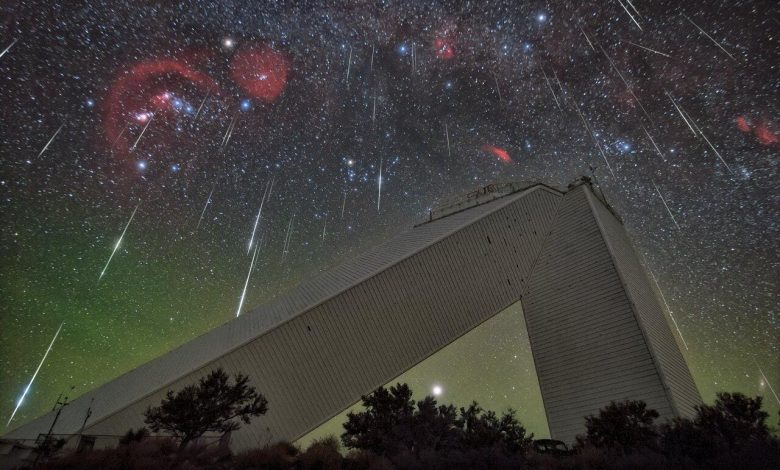
A meteor shower puts on a dazzling show above the U.S. National Science Foundation Kitt Peak National Observatory, a Program of NSF NOIRLab outside of Tucson, AZ. The annual Perseid meteor shower begins this week. It runs from July 17 to Aug. 24, but all eyes will be on the night of Aug. 12-13, when it reaches its peak under a perfectly dark, moonless sky.
KPNO/NOIRLab/NSF/AURA/R. Sparks
Timeline
New moon occurs at 5:43 a.m. EDT, when the moon lies roughly between Earth and the sun, its illuminated side turned away from us. This is the best night of the week for deep-sky observing. With no moonlight, the Milky Way rises into view from dark rural skies, especially after midnight.
Look west about 45 minutes after sunset. A 4%-lit waxing crescent moon will shine in the west after sunset on Wednesday. Look for Earthshine, the subtle glow on the moon’s dark side caused by sunlight reflecting off Earth and back onto the lunar surface — then back to your eyes.
At dusk, look low in the west for a two-day-old, 10%-lit waxing crescent moon. Look for Venus at the upper-left. This is also a good chance to see Earthshine.
A 17%-lit waxing crescent moon will shine to the left of Venus in the west after dark. Venus will remain a major evening object all through summer.
A 4%-lit waxing crescent moon will be much easier to see after sunset on Wednesday, July 15.
Stellarium
The Perseid Meteor Shower Begins
The annual Perseid meteor shower begins this week. It runs from July 17 to Aug. 24, according to the American Meteor Society, but all eyes will be on the night of Aug. 12-13, when it reaches its peak under a perfectly dark, moonless sky. Produced by debris left behind by Comet Swift-Tuttle, the Perseids are famous for their bright, fast meteors and occasional fireballs. Under ideal dark-sky conditions, observers could see 60 to 100 meteors per hour after midnight, with the highest rates before dawn. With no moonlight to interfere in 2026, this is expected to be one of the best Perseid displays in years, particularly for observers away from city lights — and it comes just hours after a total solar eclipse in Greenland, Iceland and Spain that’s visible as a partial in much of North America and Western Europe.
At dusk on Thursday, July 16, look low in the west for a two-day-old, 10%-lit waxing crescent moon, with Venus at the upper-left.
Stellarium
Observing the waxing crescent moon
This is the perfect week to build a habit that most casual skywatchers never develop — watching the new moon wax from a slim crescent to a half-lit orb. From after sunset on Wednesday, you’ll see it climb higher and get slightly brighter each night as it moves eastward against the background stars. This motion reflects the moon’s orbit around Earth, completing a full circuit roughly every 27 days.
The small constellation Lyra, The Harp — a small parallelogram of faint stars — is anchored by Vega, one of the brightest stars in the entire sky.
getty
Constellation Of The Week: Lyra
The small constellation Lyra, The Harp — a small parallelogram of faint stars — is anchored by Vega, one of the brightest stars in the entire sky. It has a special place in astronomical history. Around 12,000 years ago, due to the slow wobble of Earth’s axis known as precession, Vega was the pole star. It will become the pole star again in about 12,000 years. It’s also a yardstick — all other stars’ brightness is measured against Vega’s brightness.
The times and dates given apply to mid-northern latitudes. For the most accurate location-specific information, consult online planetariums like Stellarium.