
The directions were clear: “Go through the legs and up the stairs.” The limbs in question were vast, inflatable, and splayed, maybe fifteen feet high, and bent at the knee, as if a giant were lying on its back. Each leg was shod in a high-heeled silver boot. In between the legs was—no getting around it—a slit, through which all visitors were invited to pass. It was like being born in reverse.
Such was the reception accorded to anyone lucky enough, and unblushing enough, to attend the launch of Madonna’s latest album, “Confessions II.” The venue was a blockish and forbidding space called Magazine, which squats in a loop of the Thames, in southeast London. The interior was a restful combination of black walls and patinated steel, with polished concrete underfoot. The motto for the occasion was printed on T-shirts available for purchase in a foyer beyond the slit: “Don’t Be a Vibe Kill.” Evidently, Madonna was going industrial—the furthest possible cry from her lady-of-the-manor period in the early years of this century, when she was seen fetchingly clad in rustic tweeds. That vibe is so dead.
The evening’s co-hosts were Madonna and Grindr. The resulting throng was described in Rolling Stone, the following day, as “juicily maximalist,” filled with “some of the country’s best dressed people.” These, alas, were hard to spot, the exception being a gentleman whose torso, richly tattooed, was encased in a transparent cuirass. Some guests were granted access to an exclusive balcony on one side of the room, where they were offered a selection of themed cocktails. One drink was named for “Danceteria”—a track from the new album, celebrating the former Manhattan night club—and daringly rimmed in chili powder. Any suggestion that the hot hit of spice barely disguising a watery want of flavor was all too fitting a symbol for this phase in Madonna’s career would have been met with indignation. “Confessions II” has been greeted in some quarters as a late-flowering masterpiece, and, for one night, Magazine was the rightful home of the true believer, not the skeptic.
The church of Madonna has many denominations, and, as a blunt rule, the stuff you like depends on the age you are—or, at any rate, the age that your clubbing self would like to be. On the Tube to North Greenwich, the stop nearest the venue, Louis Byrne, a hair stylist and the founder of a company called I Can I Am and I Will, said, “My mum was very envious that I was coming tonight”—his mother being three years older than Madonna and, in Byrne’s words, “definitely a ‘Blond Ambition’ girl.” He himself cherishes “my first memory of ‘Vogue’ on the caravan-park-disco dance floor as a young boy.” On Magazine’s balcony, Timothy Phillips, a historian of the Cold War, admitted to a preference for “Confessions on a Dance Floor,” from 2005, and for its opening number, “Hung Up,” which chugged its way to the summit of the charts in more than forty countries. Would Madonna be scaling that peak at the party?
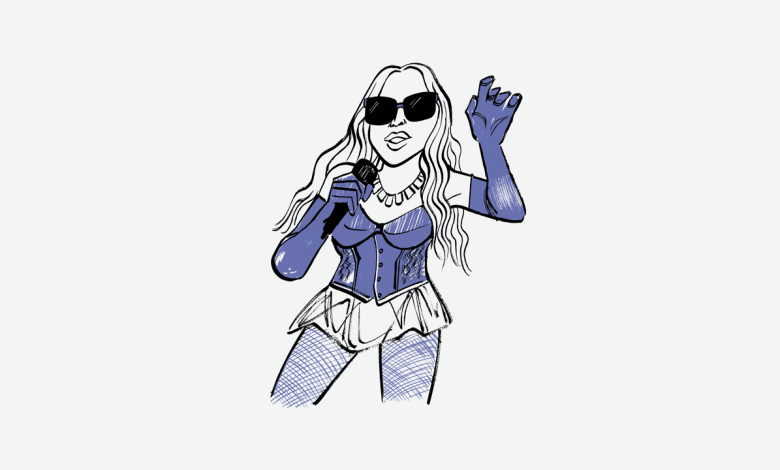
Yes, but it was a hell of a wait. Having been urged to arrive between nine-thirty and ten, guests were placed in the care of d.j.s until midnight, at which point Stuart Price, the producer of both “Confessions” albums, took to the decks. The mob, hitherto restless, surged to life, roaring the chorus of Madonna’s 2000 song “Music.” (The literary equivalent would be a publisher reading out bits of old novels at an author’s book launch.) At last, Madonna materialized. She wore shades and a loosely tied pink coat, which, when removed, revealed a shiny pink top and long pink gloves; it was as if the former queen of bubblegum pop were made of actual gum. Standing next to Price, she sang along to herself, a little, and issued moral commands. “Be whoever you want to be!” she cried, pointing a finger at the mob, like a much loved teacher advising her third-grade pupils on Halloween costumes.