
A Drug Already Proven Safe in Humans Just Reduced Multiple Signs of Alzheimer’s in Mice : ScienceAlert

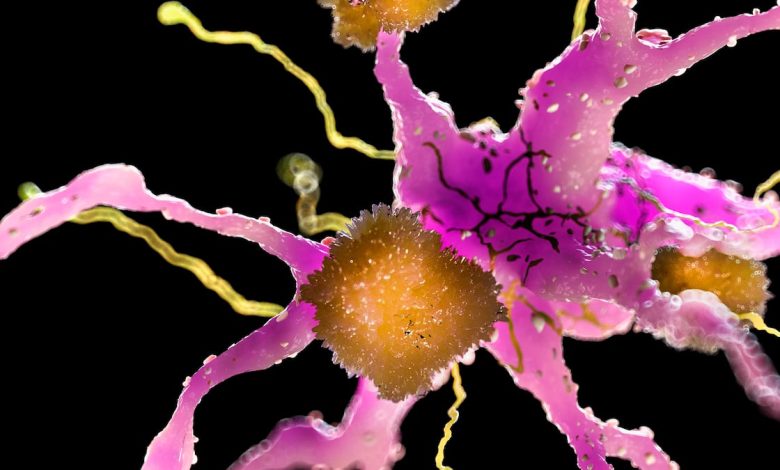
Early in the progression of Alzheimer’s and other neurodegenerative diseases, DNA inside neurons starts showing signs of weakness.
Double-strand breaks – in which both ‘legs’ of the DNA ladder are snapped at the same point – are a serious problem, that can either cause a cell to die, or go rogue.
In neurons, these breaks occur at far higher rates in people with Alzheimer’s disease than they do in the general population, suggesting they may be contributing to symptoms of the disease.
Scientists have only recently begun to investigate how DNA breaks and inflammation contribute to Alzheimer’s.

A study published in 2022, for instance, used a mouse model of Alzheimer’s to show that neurons with double-stranded breaks can set off an immune response in the brain that inflames microglia.
Chronic activation of microglia – the brain’s resident immune cells – is a core part of Alzheimer’s, which, in 2020, scientists suggested, “could potentially be modulated at various points in the AD trajectory to either prevent or modify disease progression.”
Now, the neuroscientists behind a new study published in FEBS Open Bio say they have found a way to do exactly that, using a drug that has already passed Phase 1 safety and tolerability trials in healthy human men.
The drug, KCL-286, can be taken orally and readily crosses the blood-brain-barrier. It stimulates nerve growth by activating a specific protein in the retinoic acid pathway.
It was originally developed to treat spinal cord and nerve injuries, and testing for these applications is still underway.
But the team that developed it saw it might have potential for Alzheimer’s, too.
And with safety testing already out of the way, that potential could be realized quite quickly.
“This will dramatically cut down the traditional multi-year timeline required for new drug development,” says Jonathan Corcoran, neuroscientist at King’s College London, who was involved in the new study, and the original drug development.
Corcoran and his colleagues have tested the drug on male mice that are genetically modified to develop an excess of amyloid-beta plaques in their brains, in a condition similar to Alzheimer’s disease.
Three of these Alzheimer’s-model mice (called Tg2576 mice) were given an injection of KCL-286 three times a week from the time they were 15 months old, until they reached 18 months.
Another set of Tg2576 mice was given inactive injections on the same schedule; meanwhile, three more mice, with no genetic modifications, were also kept under the same conditions for comparison.
At 18 months, the researchers euthanized all mice, and harvested their brains for closer examination under the microscope, using various staining solutions to highlight different kinds of proteins and molecules that had been active.

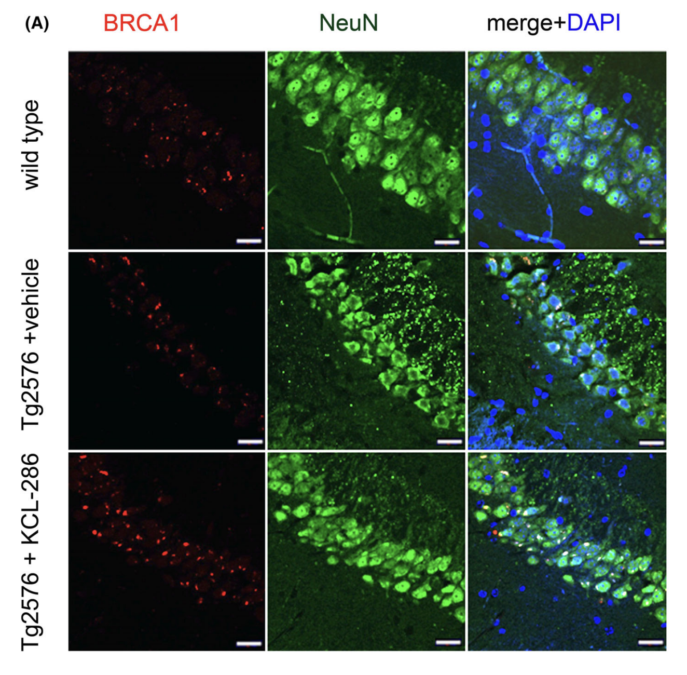
Double-strand break repair was greatly improved in mice that received the KCL-286 injections.
This was in part because the drug boosted production of a DNA repair factor called BRCA1, which is known to suppress tumors in cancer (another situation where double-stranded breaks cause trouble).
The researchers noted that BRCA1 expression is typically lower in untreated Alzheimer’s-model mice than in regular mice.
“These findings likely reflect a failure of DNA repair pathways in more advanced disease states,” the authors note.
But that wasn’t the case for the specific mouse model of Alzheimer’s used here.
“In contrast, in the Tg2576 mouse, we observe an apparent compensatory upregulation of BRCA1 in hippocampal neurons,” the team writes.
This suggests that the brains of untreated Tg2576 mice were still attempting (albeit not very successfully) to repair DNA damage.
They also saw evidence that KCL-286 had ‘calmed down’ the microglia in Alzheimer’s model mice, restoring their appearance to something more similar to that of disease-free mice. It appeared to have similarly beneficial effects on astrocytes.
Related: Brain Autopsies Reveal a Potential Culprit Behind Alzheimer’s
“Our findings demonstrate that KCL-286 not only targets DNA damage but also reduces inflammation, two processes that occur very early in Alzheimer’s disease progression,” says Maria Goncalves, a neuroscientist from King’s College London who was involved in both the new research and the original drug discovery.
“This highlights its potential as a disease-modifying therapy rather than simply addressing symptoms.”
The research was published in FEBS Open Bio.
This article was fact-checked by Michael Irving and edited by Rebecca. Dyer. While we pride ourselves on our process, we are only human. If you spot a mistake, please let us know.