
Andrew here. A fascinating development on Sunday underscores the brutal economics of the artificial intelligence race: Anthropic extended access to Fable, the consumer version of its high-powered Mythos model, for another week, delaying a plan to charge extra for it.
Because Fable requires so much computing power, Anthropic is most likely taking a loss on the move. The extension came after fierce internal debate, driven by fear that users would otherwise flock to OpenAI’s new GPT-5.6 model, which some find comparable or even superior.
This is more than a product story. It is a perfect prisoner’s dilemma, with tech giants burning cash to take market share before potentially trillion-dollar I.P.O.s. There’s a huge question with enormous consequences: Are these A.I. giants becoming low-margin commodities — or can they find a way to make huge profits?
What to watch for this earnings season
Even as the U.S.-Iran cease-fire unravels, stocks are approaching record territory again. And some on Wall Street see the rally grinding higher still.
That will depend on how companies manage geopolitical uncertainty — as well as high inflation, an uneven labor market and growth risks.
For some, there’s another question: Can corporate giants top last quarter, the best one in six years?
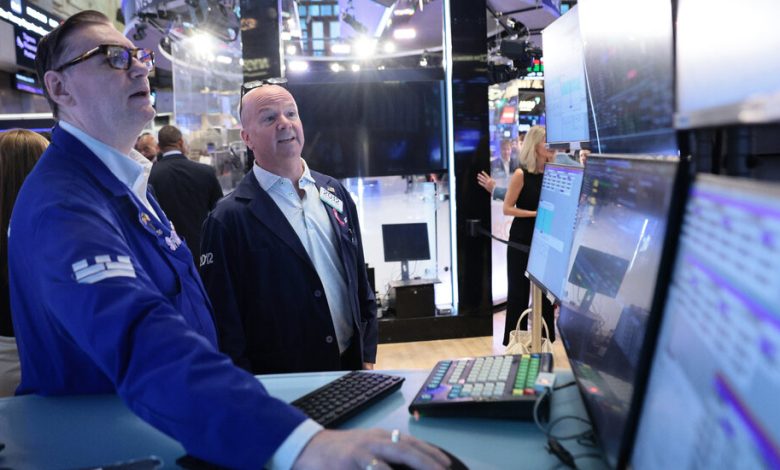
The schedule: In a rarity, JPMorgan Chase, Bank of America, Wells Fargo, Citigroup and Goldman Sachs are all set to report quarterly results on Tuesday. Netflix, BlackRock and others report later in the week.
What to watch for:
Can the profit machine continue? Analysts expect stellar bottom-line growth again, with S&P 500 companies’ average price-to-earnings ratio for the next 12 months — a closely watched measure — at a decade-high, according to FactSet.
Analysts will also want to see how a deal spree and a trading windfall have bolstered Wall Street giants’ profits.
What about cash flow? It’s particularly pertinent for the Magnificent Seven tech giants, which begin reporting this month. Four — Amazon, Google, Microsoft and Meta — plan to spend roughly $700 billion combined on capex this year, mostly on artificial intelligence infrastructure.
Investors remain antsy about that flood of spending. Shares in the Magnificent Seven have vastly underperformed the S&P 500 this year.
-
Worth reading: Torsten Slok, the chief economist at Apollo Global Management, asks tough questions about what happens if the anticipated “payoff” from A.I. spending takes longer than expected.
How is the consumer holding up? The war in Iran sent energy prices spiking worldwide, eroding the spending power of lower-income households.
The effects of penny-pinching and the so-called K-shaped economy became a major talking point on earnings calls last quarter. A gloomy consumer outlook could sap corporate profits and weigh on Republicans’ chances in the midterm elections.
-
On that note: The Bureau of Labor Statistics is set to publish the Consumer Price Index on Tuesday, with analysts expecting to see that inflation most likely cooled last month.
And there’s Kevin Warsh, the Fed chairman, who is set for two days of congressional testimony, beginning on Tuesday. Expect him to be grilled on inflation and interest rates.
HERE’S WHAT’S HAPPENING
Lindsey Graham’s death raises questions about the Republican agenda. The South Carolina senator died suddenly over the weekend; he was a onetime opponent of President Trump turned stalwart ally who was also an advocate for strong U.S. foreign policy, sweeping tax cuts and, sometimes, bipartisanship. While he was up for re-election this year, his death narrows Republicans’ current Senate majority to just 52-47 (and realistically less given, the absence of Senator Mitch McConnell).
The Justice Department investigates the president of the U.A.W. Federal prosecutors are examining accusations that Shawn Fain, the head of the powerful auto workers union, improperly pressured another official for benefits for his fiancée and her sister. Fain said he was the victim of “bogus allegations” that he claimed were meant to sway an upcoming leadership vote.
More states prepare to sue over the sale of Warner Bros. Discovery. Connecticut, New York and Washington will join California in a lawsuit to block Paramount’s takeover of the media company, which could be filed as soon as this week, The Times reports. The lawsuit, if it happens, would be the last significant obstacle for the $111 billion media deal.
Persian Gulf volatility
Oil prices have spiked again as the U.S. and Iran continue to trade strikes. And Tehran says it controls the Strait of Hormuz, a claim that Washington disputes.
Iran is aiming to attack not just commercial ships and U.S. military assets in the Persian Gulf. Its strikes have also put the energy infrastructure of some neighboring countries at risk. That’s spooking traders and casting doubt on the possibility of a lasting peace deal.
The latest:
-
Brent crude, the international benchmark for oil, hit $78.60 in extremely choppy trade. It has climbed more than 9 percent in the past week, stoking wider inflation fears.
-
S&P 500 futures are under pressure, as are cryptocurrencies and bonds.
Iran’s grip on the strait is solidifying. A U.S. barrage on Iranian targets over the weekend was intended to retaliate against Iran’s actions, an unnamed U.S. official said. Just 14 ships traversed the strait on Sunday, according to Kpler, a maritime data firm, down sharply from late June after Washington and Tehran signed a framework agreement.
That pact did not clearly specify how the strait would be secured, and may have given Iran an opening to exert more control over it, The Times reports.
Esmail Baghaei, a spokesman for Iran’s Foreign Ministry, said on Monday that the memorandum of understanding had “undoubtedly entered a crisis phase.”
What’s next? President Trump suggested on “Meet the Press” on Sunday that the two sides were close to a deal over the weekend, but offered no specifics.
Apple (and Musk) take on OpenAI
Silicon Valley is still abuzz about Apple’s trade secrets lawsuit against OpenAI.
The legal fight creates yet another headache for OpenAI, which is grappling with volatility in its business and unpredictable oversight from Washington. (And, for good measure, new gibes by Elon Musk.)
Apple accuses OpenAI of stealing information about products in development amid a campaign to poach hardware engineers and designers to build its own hardware offering. It marks the nadir of relations between the onetime partners.
-
The lawsuit focuses on Tang Tan, a former top Apple hardware executive who now leads hardware at OpenAI. Tan, according to the lawsuit, is accused of helping coach hires from Apple on how to evade the iPhone maker’s security processes for departing workers.
-
Another focus is Chang Liu, an iPhone engineer whom Apple accused of stealing confidential information. Upon discovering a networking vulnerability that let him access Apple information after leaving the company, according to the lawsuit, Liu told a former colleague, “LOL, I found out I can access the [network storage], so funny.”
Of note: Tan previously reported to John Ternus, Apple’s incoming C.E.O. Some designers favored Tan over Ternus for the hardware chief role, according to Bloomberg.
From the lawsuit:
OpenAI’s nascent hardware business now rests on the shakiest of foundations, rotten to its core by its illegal reliance on misappropriated trade secrets.
Musk piled on over the weekend, after losing a lawsuit against OpenAI this year. Amid a back and forth with Sam Altman, OpenAI’s C.E.O. and a longtime foil, Musk wrote on X: “After stealing an open source AI charity, you then stole all of Apple’s phone technology! Wow.”
The lawsuit adds to OpenAI’s challenges:
-
The company is racing to catch up with Anthropic, especially among corporate users.
-
OpenAI’s No. 2 executive, Fidji Simo, plans to step down because of health reasons, leaving a major hole in its leadership ranks.
-
A wide release of its latest artificial intelligence model was delayed by a request from the Trump administration.
Quote of the day
“I find it ironic that the status quo is to then turn around and impose restrictive terms on distillation, and to reserve the right to learn from customer usage and interaction data.”
Satya Nadella, Microsoft’s C.E.O., subtly jabbing artificial intelligence companies like Anthropic over their efforts to restrict rivals’ ability to copy their models via a technique known as distillation.
Nadella notes that leading A.I. models rely on fair-rights use of publicly available data (which some content providers argue is taken without their consent).
A record price for the Super Bowl champs
The venture capitalist Vinod Khosla has long been a member of Silicon Valley’s elite. Now, he and his family are joining another exclusive club by becoming primary owners of an N.F.L. team.
A group led by Khosla is buying the Seattle Seahawks, reportedly for a record $9.6 billion, just five months after the team won the Super Bowl.
The deal could end uncertainty over the fate of the team, which has been owned by the estate of Paul Allen, a Microsoft founder, since his death in 2018.
Khosla reportedly beat out rivals, including a group led by Aditya Mittal, an Indian tycoon, according to Sportico.
Khosla struck a record price for an N.F.L. franchise. The last time a team changed hands was when a group led by Josh Harris, a financier, bought the Washington Commanders for $6.05 billion in 2023. (Jeffrey Lurie sold a minority stake in the Philadelphia Eagles in 2024, valuing the team at $8.3 billion, according to The Wall Street Journal.)
It’s the latest big deal in Khosla’s long career. Over four decades, he has become one of Silicon Valley’s most prominent and prescient investors, investing early in ventures like OpenAI, DoorDash and Instacart.
Forbes recently ranked him No. 1 on its latest Midas List of top venture investors, citing OpenAI. The magazine estimates his net worth is $13.7 billion.
Khosla will have to divest an existing N.F.L. ownership stake: a 3.1 percent stake in the San Francisco 49ers that he and his family bought last year at a valuation of more than $8.5 billion.
His wife, Neeru Khosla, will become the Seahawks’ controlling owner if the sale is approved.
Who else can afford an N.F.L. team? The N.F.L. may yet grow, with speculation heating up last month after the owner of the United Football League mentioned that the N.F.L. was discussing adding two more teams.
But increasingly, it takes super-deep pockets to become an owner. The N.F.L. is already home to some of the world’s priciest franchises: The Dallas Cowboys are worth $13 billion, according to a Forbes estimate. The Los Angeles Rams and the New York Giants are each in the $10 billion club.
THE SPEED READ
Deals
-
Brookfield reportedly is nearing a stake in the Hudson Square Properties, valuing the Lower Manhattan hub, home to tech giants like Anthropic, at $3.5 billion. (WSJ)
-
Helsing announced a $1.8 billion funding round, which DealBook hears gives the German defense start-up an $18 billion valuation. Investors include Goldman Sachs Alternatives, JPMorgan Chase and Lightspeed Venture Partners. Helsing is also expected to announce its first attack drone factory in the U.S., in West Virginia. (Helsing, DealBook)
Politics, policy and regulation
Best of the rest
-
How far did Disney’s live-action “Moana” go at the box office? Not far, raising questions about the House of Mouse’s movie strategy. But Lionsgate’s Michael Jackson biopic just surpassed $1 billion at the box office. (NYT)
We’d like your feedback! Please email thoughts and suggestions to [email protected].