
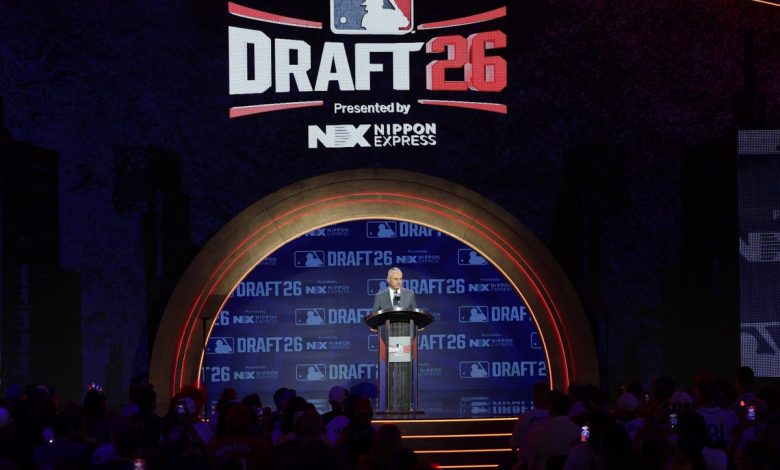
Day 1 of the 2026 MLB Draft was supersized, going four full rounds and 135 picks. The first round got off to a somewhat predictable start, but then surprises started piling up around pick 20. For more on how Day 1 unfolded, click here.
Below are all of those picks, plus analysis from our live blog and scouting reports. (Note: Scouting grades are on the 20-80 scouting scale.)
Round 1
Pick 1: Chicago White Sox — Roch Cholowsky, SS, UCLA
Live blog analysis: After all that, all the rumors of interest in other players and nitpicking about the swing and the competition he faced, the White Sox take the obvious guy in Roch Cholowsky. He’s a polished shortstop with power and excellent instincts on both sides of the ball, hitting 44 homers over the last two years at UCLA with very high contact rates, and should move quickly through the low minors. — Keith Law
Keith Law scouting report: Cholowsky has been a prospect for some time, as his dad is the Reds’ area scout for the Four Corners, and Cholowsky was No. 23 on my draft board in 2023 when he was a senior in high school. So it’s hardly surprising that he’s become the consensus top prospect in this year’s class, even if the field has gotten closer to him as this spring has progressed. He’s a plus defender at shortstop with a plus arm, showing good instincts and a solid first step to make up for below-average foot speed. He had an outstanding sophomore year for the Bruins, hitting .353/.480/.710 with a hard-hit rate of 60 percent and strikeout rate below 10 percent, though his junior year has been just slightly below that across the board. He has plus power with an average to slightly above-average hit tool. He wrecked Big Ten pitching, but hasn’t seen a lot of premium velocity, and in a limited sample, hasn’t done much with it. Barring injury, I don’t see a world where he’s not at least an everyday MLB shortstop who hits 15-20 homers — his ceiling is 25-30 homers with a high OBP — and he’ll play plus defense in any scenario. One bit of Roch trivia: He struck out looking only three times as a sophomore, but was already at six through May 5.

GO DEEPER
White Sox take UCLA shortstop Roch Cholowsky with No. 1 pick in the 2026 MLB Draft
Pick 2: Tampa Bay Rays — Grady Emerson, SS, Fort Worth Christian (North Richland Hills, Texas)
Live blog analysis: Tampa takes the top high school player in the draft, high school shortstop Grady Emerson, a strong hitter for contact who is likely to stay at shortstop and should develop enough power to make him an above-average or better regular. He was one of the best hitters on the showcase circuit in 2025, which should give the Rays some confidence that he’ll be able to handle the jump to low A next spring, especially since he faced weak competition this spring while playing for a small high school.
I am a little surprised they’d pass on a potential answer to their franchise history-long issues behind the plate in Lackey, so they must really believe in Emerson’s bat. — Keith Law
Keith Law scouting report: Emerson is the leading high school position player in the draft, by consensus, and maybe also by default, given the paucity of other candidates at the very top of the draft. His case is much more about his skills rather than plus tools or athleticism, and the descriptions I hear from scouts and execs make it sound like they’re hoping he’s the next Kevin McGonigle. And maybe he is: Emerson does hit, making contact at a reasonably high clip last summer at showcases (13.3 percent strikeout rate, 23.3 percent whiff rate), while showing fringe-average power now that projects to above-average at his peak. He shows good instincts and hands at short and should stick there despite being a below-average runner. He transferred from a large public school to a tiny religious school in part to play for Rusty Greer, the former Rangers outfielder who is now the head coach at Fort Worth Christian.

GO DEEPER
How pro connections around top MLB draft prospect Grady Emerson have helped block out the noise
Pick 3: Minnesota Twins — Vahn Lackey, C, Georgia Tech
Live blog analysis: Vahn Lackey might be a generational talent, and the long-term answer for the Twins behind the plate. He’s an outstanding athlete who’s played multiple positions and only became a full-time catcher this year, when he also broke out at the plate thanks to some swing adjustments, going from six homers as a sophomore to 20 as a junior. He’s got an excellent approach, should end up with 55-60 grade power, and is even an above-average runner. I think the Twins will end up with the best player in the class, and they have to be ecstatic that it fell this way.
Keith Law scouting report: Lackey’s surge at the plate in his draft year has lifted him from late first-round territory to the uppermost echelon, thanks to offseason work on his swing to help him get the ball off the ground and further in the air. He was hitting .371/.491/.682 through May 5, ranking in the top 5 percent of all Division I hitters in OBP and slugging, third among catchers playing in major conferences, and he finished the year at .397/.519/.772. He’s extremely athletic with 55 speed and outstanding agility, getting up out of the crouch quickly on blocks or weak groundballs, with an 80 arm that just needs to be more consistent. He’s an excellent hitter for contact, with a 15 percent whiff rate this year, but he doesn’t have the raw power that Roch Cholowsky offers. I think the two are very close as prospects, with Lackey’s appeal in his ability to stay behind the plate and add value at such a scarce position, while Cholowsky has more power upside.
Pick 4: San Francisco Giants — Jackson Flora, RHP, University of California, Santa Barbara
Live blog analysis: Giants fans have been telling me for weeks they wanted Jackson Flora at 4, and they got their wish, as San Francisco takes the best pitcher in the draft class. Flora held that mantle wire to wire, moving into the Friday night role at UC Santa Barbara vacated by last year’s No. 2 pick, Tyler Bremner, dominating hitters with plus control and an out-pitch changeup. He led Division 1 with a 1.06 ERA and finished fifth with 133 strikeouts.
There are some concerns about the lack of vert on the fastball, and he didn’t face a lot of great lineups in the Big West. That changeup is going to allow him to get to Double-A fairly quickly and buys him some time to work on trying to get better life on the fastball.
Keith Law scouting report: Flora is easily the best pitching prospect in this class, high school or college, because he’s that good and the pitching crop this year is … not that good. Through the end of the Gauchos’ regular season, he’d struck out 115 in 87 1/3 innings (33.2 percent) against just 24 walks, with a 1.03 ERA. He’s been up to 100 and sits 94-98 with his four-seamer, but that’s his least effective pitch thanks to a 70 changeup and plus slider. The changeup is around 86-90 and looks very similar to the fastball out of his hand, with some fading action away from lefties; hitters whiffed on it close to half the time they swung this year, and it’s equally effective against hitters on both sides. His slider is sharp with late downward break, getting a lot of swings that go right over the top of it, and he should probably just use that and ditch his upper-70s curveball. There’s a little effort to the delivery and I don’t think his release point is as consistent as it could be, but he throws strikes, is on time and gets some extra help on the fastball from a low three-quarters slot. He looks like a very likely major-league starter, no worse than mid-rotation, and could end up a No. 1 for someone if he tightens up the fastball command or maybe mixes in a two-seamer.

GO DEEPER
Giants fill a need with first-round pick Jackson Flora, plus other Day 1 MLB Draft musings

Derek Curiel hit .349 in two seasons at LSU. (Steven Branscombe / Imagn Images)
Pick 5: Pittsburgh Pirates — Derek Curiel, OF, LSU
Live blog analysis: Derek Curiel was one of the safest bats in the draft class; he was an outstanding hitter for contact in high school, showing well at the NHSI tournament in 2024, but didn’t show enough impact for teams to try to buy him out of LSU. He did get stronger, and while it’s not much over-the-fence power, he had a hard-hit rate over 50% this year, while showing exceptional contact rates: He whiffed on pitches in the zone less than 8 percent of the time that he swung. He should be one of the first position players from this class to reach the majors.
Keith Law scouting report: Curiel has always been able to hit, even in high school at Orange Lutheran, but between his lack of power at the time and his commitment to LSU, he went undrafted in 2024. Now a draft-eligible sophomore, Curiel has raked for two years in Baton Rouge, not hitting for much power but making enough hard contact to project a plus hit tool, maybe even better. He hit .353/.431/.526 this spring as a draft-eligible sophomore for the Tigers, dipping to .314/.386/.463 in the SEC, but he does show elite exit velocities that might imply some more power down the road. He’s played center and left and should at least start his pro career up the middle, with left field just the more likely option because he may get bumped by a faster player. He’s an extremely safe college position player, with maybe a little power upside, too.
Pick 6: Kansas City Royals — Zion Rose, OF, Louisville
Live blog analysis: We have our first shocker, as the Royals take Louisville outfielder Zion Rose at 6, which I assume will involve a discounted bonus. Rose is one of the best pure bats in the draft, hitting .417/.491/.646 in 36 games this spring after an ankle injury, doing nearly all of that damage in ACC play; the question will be figuring out where he plays. A high school catcher at IMG, Rose moved to the outfield almost immediately on getting to campus, playing mostly left field as the Cardinals had more established defenders in center. Rose is a plus runner, with 24 steals in that limited playing time this year, and should at least get the chance to handle center, although his defense in left has only been fair. Regardless of where he ends up, his bat should make him an above-average regular.
Keith Law scouting report: Rose can flat-out hit, and if he hadn’t missed almost half of the spring with an ankle injury, I think he’d be a top 15 pick. The Louisville junior hit .417/.491/.646 in 36 games — nearly all of it in ACC play — after returning from the injury, moving between center field and left field. He looked better in center than expected, though the corner is still the more likely outcome. He has excellent hand-eye coordination and bat speed, whiffing just 10 percent on fastballs this year, and 23 percent on everything else combined, and rarely chases outside the zone until he gets to two strikes. He does land slightly open and doesn’t pull the ball to the outfield as much as he should, which also means there’s some power upside here (with a 90th percentile EV of 104.6 mph, putting him well above the median) with what appear to be minor adjustments. He was a top 100 prospect out of high school, as a catcher at IMG Academy, but went undrafted due to his strong commitment to Louisville.
Pick 7: Baltimore Orioles — Eric Booth Jr., OF, Oak Grove HS (Hattiesburg, Miss.)
Live blog analysis: The Orioles have been linked to Eric Booth Jr., for weeks, so this wasn’t much of a surprise. Booth is one of the fastest players in the draft class, an 80 runner who should be a long-term center fielder and has surprising patience at the plate for a player from the Deep South. He’s kind of stiff in the box and will need some help rebuilding, or just building, a more rhythmic swing that takes better advantage of his physical abilities, which might also unlock some more power. He’s more of a high-upside player than the Orioles have typically targeted with their first-round picks in recent years.
Keith Law scouting report: Booth is an 80 runner and true center fielder with a leadoff hitter profile, making contact with a short, slashy swing without a lot of power. He’s a disciplined hitter for a high schooler, with modest whiff and chase rates last summer and fall, continuing to show patience this spring. He’s very upright at the plate and doesn’t bend his knees or rotate his hips that well, spinning off his front heel through contact so that his lead foot is pointing towards the pitcher (or further), so while he looks like he should have above-average power, it’s not showing up in games. He’s a supreme athlete who has bat-to-ball skills, which is both rare in the draft and also extremely coveted by teams who want long-term upside, but he needs an organization that can help him find a setup and swing that makes the most of his physical gifts.
Pick 8: Athletics — Drew Burress, OF, Georgia Tech
Live blog analysis: The Athletics land Drew Burress, the fun-sized, power-hitting center fielder from Georgia Tech who hit 19 homers as a sophomore, got a little pull-happy to start his junior year, then settled back in and ended up with 16 homers this spring. He’s a high-contact hitter, as you might expect from his size, but he swings hard and has made a ton of very hard contact, with a hard-hit rate over 55 percent and top-end exit velocities that argue that his power will hold up even with the wood bat. I’m not sure he sticks in center field; he’s fine there but might get pushed to a corner by a plus defender.
Keith Law scouting report: Though Burress be but little, he is fierce, although to be completely honest, he was a lot more fierce as a sophomore. The 5-foot-9 outfielder whacked 19 homers in 60 games in 2025, but got off to a slow start in 2026 as he seemed to be trying too hard to lift and pull the ball. He returned to his 2025 approach as the season has progressed, hitting better in conference play than outside of it, with 16 homers through 61 games overall, nine of them in the ACC. Despite his small size, he has easy plus power, with a 90th percentile EV of 109.1 during the regular season that put him in the top 3 percent of all qualifying batters. He swings hard, with excellent bat speed, and is short to the ball but long through it with enough loft in his finish to drive the ball in the air without having to force it. He’s had more walks than strikeouts in all three of his years with the Wreck, with a chase rate just under 20 percent, and his contact rate on strikes is well above the Division I median. He’s a center fielder now, but has a less than even chance to stay there in pro ball. He projects to 20+ homers a year, which would make him a star in center and still a regular even in a corner.
Pick 9: Atlanta — AJ Gracia, OF, Virginia
Live blog analysis: Atlanta pivots to a different college outfielder than the one they supposedly wanted in Drew Burress, taking Virginia outfielder AJ Gracia, who has plus power and walked more than he struck out in each of the last two seasons. In a clip of an interview with Gracia that MLB played before the draft began, he said he modeled himself after Cody Bellinger, which totally fits – both guys are left-handed hitters with very uphill swings designed to pull everything in the air. He’s played some center but likely moves to a corner, and there could be more power to come given that he played this spring with some kind of shoulder injury.
Keith Law scouting report: Gracia transferred from Duke to UVA this year and emerged as the Hoos’ best power threat, although he hasn’t improved from his breakout 2025 season with the Blue Devils. He has plus power and a good idea of the strike zone, chasing pitches well out of the zone just 13 percent of the time, while making contact at high rates for someone with his power — through May 9 his in-zone whiff rate was just 9 percent. His swing gets kind of uphill, and he might end up hitting more balls to the track than he should given the pure strength here. He’s played center field for the Cavaliers but will end up in right in pro ball. The whole right now is less than the sum of the parts, which points to an opportunity for a team that’s good with finishing off hitters’ development, especially if they can get Gracia’s bat more consistently on plane.
Pick 10: Colorado Rockies — Tyler Bell, SS, Kentucky
Live blog analysis: Tyler Bell is a steal at pick 10 for the Rockies: He was third on my board, as he absolutely raked this spring despite dislocating his non-throwing shoulder in the weekend’s first season. A second-round pick of the Rays out of high school, Bell might have ended up in the 1-1 conversation with a full, healthy season, and even with one functioning shoulder still hit .343/.510/.608 in 41 games, most of that coming against SEC pitching. He’s also a true switch-hitter with simple swings from both sides of the plate. I don’t think he’s a good enough defender to dislodge Ezequiel Tovar, but there’s a chance he could stick at shortstop if need be, with second base the most obvious place to move him.
Keith Law scouting report: Bell was the No. 66 pick in the 2024 draft by the Rays in the second round, and Tampa thought he was going to sign until he announced he was headed to Lexington instead. He’s now a draft-eligible sophomore, as he turned 21 at the end of June, and despite a severe shoulder injury suffered during the first weekend that nearly ended his season, he’s headed for a very high selection at the draft in July. Bell was one of the best hitters in the SEC this year with a .352/.517/.602 line heading into the conference tournament; he’d be leading the conference in OBP if he had enough PA to qualify. He’s a very disciplined hitter, with a chase rate of 13.5 percent during the regular season, and still shows above-average power with plenty of hard contact, including a 90th percentile EV of 105.5 mph that puts him in the top 20 percent of batters. He is a true switch-hitter with simple swings from both sides of the plate, taking a small stride and getting a lot of juice from his hip rotation, with slightly better bat speed from the left side. He projects to high OBPs with 15-20 homer upside at his peak. Given that he’s likely to stay at shortstop, he’s a potential All-Star. His early season injury, a dislocated non-throwing shoulder, may require surgery after the draft, which would push his pro debut to the spring of 2027, though he has played through it all spring rather than miss the entire college season.
Pick 11: Washington Nationals — Chris Hacopian, IF, Texas A&M
Live blog analysis: The Nats have been linked to Chris Hacopian all spring, and I suppose nothing happened to dislodge them. Hacopian DH’d most of the year for Texas A&M after suffering a lower back injury early in the season that knocked him out for most of a month. I saw the two at-bats he took the first time he tried to play through it, one of which ended in a long home run to left-center.
It’s a really good right-handed swing with power and loft, and he’s shown exceptional contact skills, whiffing on pitches in the zone less than 10 percent of the time he’s swung. He was Maryland’s starting shortstop in 2025, but was likely to move to second or third even before the injury.
Keith Law scouting report: Hacopian played one game over the span of a month near the start of the season due to a lower back injury, but didn’t miss a weekend after his return, hitting .319/.405/.578 in about two-thirds of a season’s worth of playing time as the Aggies’ DH. He still showed a very good line-drive swing and an excellent contact rate, with an in-zone whiff rate of just 8 percent, even though he wasn’t moving as well as he did prior to the back issue. He’s a transfer from Maryland, where he hit .375/.502/.656 as a sophomore while striking out less than 10 percent of the time. If his medicals don’t hold him back, he’s an easy first-round bat with the potential for power and high contact rates in pro ball.
Pick 12: Los Angeles Angels — Jared Grindlinger, OF/LHP, Huntington Beach (Calif.) HS
Live blog analysis: The Angels have played it safe in the first round for years, but with the scouting staff now making the picks, they went for one of the highest-beta players in the draft in two-way player Jared Grindlinger, who reclassified into this draft class before the season began and only turned 17 in mid-April.
Grindlinger is a lefty who’s up to 96 off the mound, while he’s also a left-handed hitting outfielder with excellent bat-to-ball skills and some projection for power. Scouts differ on how much his narrowish frame might fill out, and on whether he’s a better prospect in the box or as a pitcher. He’s going to take a long time to get there either way — maybe needing two years in the complex, but it’s refreshing to see the Angels aim higher for a change. The Angels announced him as an outfielder.
Keith Law scouting report: Grindlinger is the draft’s best two-way prospect. He’s a left-handed pitcher whose fastball is up to 96 and outfielder with outstanding bat-to-ball skills, and he only turned 17 in April. He reclassified into this draft just before the season started so he wasn’t seen as much last summer and fall as most of the high schoolers in the class. He’s still almost all projection at this point, and the bat speed isn’t great yet, but the ball carries well already and he’s likely to come into real power as he fills out. He has arm strength with a potentially plus slider but the delivery needs work, as he’s off the rubber very quickly and tends to spin off his front heel after he lands. He has all of the risk of a teenaged arm — more, really, as he’s younger than any other pitching prospect in the class. I think he’s a much better prospect in all respects as a hitter, while he also offers the backup option of putting him on the mound if hitting doesn’t work. (Or vice versa.)
Pick 13: St. Louis Cardinals — Trevor Condon, OF, Etowah High School (Woodstock, Ga.)
Live blog analysis: The Cardinals hadn’t taken a high school player with their first pick since Jordan Walker in 2020, but they returned to those ranks with Trevor Condon, a Georgia high school outfielder with plus bat speed, above-average foot speed and a chance to stay in center. His ultimate ceiling is going to depend on how much power he ends up with, as he’s shown some juice with metal but less with wood, with a leadoff profile of high on-base percentages and modest power the most likely outcome.
Keith Law scouting report: Condon has excellent bat speed and a high probability to stick center field, putting him in top two-rounds territory for this draft. He has a high setup and likes the ball in the upper part of the zone, generating average power thanks to his quick wrists. In the summer and fall of 2025, he made a ton of contact, especially on fastballs, but didn’t drive the ball that well with wood bats, and has just fair projection for power growth. He’s a 55 runner out of the box who shows good instincts and much better closing speed in the outfield. He’s committed to Tennessee.
Pick 14: Miami Marlins — Jacob Lombard, SS, Gulliver Prep (Pinecrest, Fla.)
Live blog analysis: The Marlins take Jacob Lombard, a local product and the younger brother of Yankees top prospect George Lombard Jr. By tools alone, Lombard was a top-five talent in the draft, and 20-30 years ago he would have been considered with the first pick; it’s plus power, run, and throw, at the very least.
He’s also shown an alarming propensity to swing and miss at showcases and even against high school competition this year, and cutting down on that is a bigger ask than merely adjusting a swing or getting someone to add 10 pounds of muscle. That said, the Marlins aren’t going to sign a player with this kind of upside in free agency at any point, and it makes sense for them to take someone with superstar ceiling even with this high level of risk.
Keith Law scouting report: The younger brother of top Yankees prospect George Lombard Jr., Jacob Lombard has been on the showcase circuit since he was in junior high school. He has some of the best pure tools in the draft class, college or high school. He’s a 70 runner with plus power, working with a quick, direct swing that is geared to pull the ball in the air. His path to the ball is direct and he’s very rotational, getting his lower half involved to help drive the ball, although he can get a little uphill on pitches down. He also whiffed 39 percent of the time at tracked events in 2025, getting destroyed by sliders, but even struggling with better velocity when he saw it. He’s a long-term shortstop, really just lacking the pure arm strength of the typical player there in the majors. He has the swing, strength, speed and athleticism to be a superstar, but can he hit enough to even be a regular?

GO DEEPER
After lifetime around baseball, Jacob Lombard begins his own journey with Miami Marlins
Pick 15: Arizona Diamondbacks — Ryder Helfrick, C, Arkansas
Live blog analysis: Arkansas catcher Ryder Helfrick is one of the best defensive players in the draft at any position, grading out for some teams as the best amateur catcher in years, and to his credit, he overhauled his approach this year to go from a very high-whiff hitter to an average one, cutting his in-zone whiff rate by more than a third year over year. He also had to handle some premium stuff while catching the Razorbacks’ staff, including lefty Hunter Dietz, who should go somewhere in the first round today. There’s a high floor here with the defense.
Keith Law scouting report: Helfrick is the best defensive catcher in the class, with a 70 arm, excellent blocking skills and apparently good framing (for whatever that’s worth). He came into the year as a very questionable pro prospect after he whiffed on over 30 percent of his swings as a sophomore, putting him in the bottom 5 percent of all qualifying hitters in that category. He cut that way down to 25 percent this year, swinging less often on all pitches while also making much more contact on sliders. The improvement was mostly just a matter of better swing decisions, while he’s also moved a little further away from the plate. He hit a career-high 18 homers this year, thanks, in part, to more playing time, and has enough juice to project to 15-20 in the majors. You don’t have to hit a ton to be an everyday catcher in the big leagues, and even if Helfrick gives back some of his gains at the plate, he could still end up a low-OBP regular. If they stick, the improvements this year give him a chance to be an All-Star.
Pick 16: Texas Rangers — Gio Rojas, LHP, Marjory Stoneman Douglas HS (Parkland, Fla.)
Live blog analysis: The Rangers go for upside, taking the first (pure) high school pitcher of the day in Miami-area lefty Gio Rojas, who was easily the consensus No. 1 prep pitcher in this class. He’s been up to 97-98 and lives in the low 90s from a lower slot that adds deception and helps make his sweeper a true out pitch, while he has a changeup that looks good but that he hasn’t used much. He’s already 19, which isn’t necessarily a bad thing for a young pitcher, and should be ready to handle Low A to start next year.
Keith Law scouting report: Rojas is the top high school pitching prospect in this class, and will also most likely be the first one taken. His fastball is low 90s, up to 97-98, with life from a lower three-quarters slot, while his best pitch is a high-spin sweeper/slider that batters whiffed on two-thirds of the time they swung at it at tracked events in 2025-26. He does lower his arm slot for the slider, which can cause it to flatten out a little and could give better hitters a clue what’s coming (although they might just miss it by less). He has a promising changeup he hasn’t used much, as he hasn’t needed it. He turned 19 in late June, and is committed to Miami.

GO DEEPER
Gio Rojas’ foundation as a Texas Rangers first-round pick came from Stoneman Douglas program
Pick 17: Houston Astros — Logan Hughes, OF, Texas Tech
Live blog analysis: Outfielder Logan Hughes was one of the best-performing hitters in Division 1 this year, with a .375/.510/.735 line for Texas Tech that put him among the leaders in OBP and SLG for the major conferences. He has power thanks to excellent bat speed, meeting the ball out front when his bat has fully sped up. He’s not much of a runner or defender, with left field the best-case scenario, so the Astros must really believe in his bat.
Keith Law scouting report: Hughes has raked for the Red Raiders for two years now, walking more than he’s struck out in both seasons and hitting 37 homers in that span, with a .375/.510/.735 line this spring that ranked him fourth among major-conference hitters in OBP and 12th in slugging. He makes a ton of contact and has shown he can hit all pitch types, including catching up to good velocity, with batted-ball data to back up the plus power output. It’s a quiet swing that benefits from his tendency to meet the ball out front, so he’s getting to better bat speed by the time he makes contact. He’s not a runner and is limited to left field or maybe first base, so there’s pressure on the bat. It looks like he’ll hit enough to be a regular regardless of his position.
Pick 18: Cincinnati Reds — Justin Lebron, SS, Alabama
Live blog analysis: For pure tools, Justin Lebron might be the top prospect in the class — he at least rivals Jacob Lombard, and has the benefit of three years of playing in the SEC. He’s a plus defender and above-average runner who hits the ball pretty hard already, with room to add strength as he gets older. He’s also struggled to hit good pitching, especially against decent breaking stuff, and his performance this year was way better in non-conference games. There’s All-Star upside here for sure, but he isn’t going to be a quick mover until and unless he learns to pick up spin.
Keith Law scouting report: Lebron has the tools to be the top pick, and if this were 1993, he’d probably be the obvious 1-1 pick. I’m increasingly concerned that he’s not going to hit, as he didn’t hit well this spring, especially once the opposing pitching got better in SEC play. Lebron is a gifted athlete who’s a 55 runner out of the box, maybe 60 underway, and a plus defender at shortstop. He has plenty of bat speed and projects to 70 raw power once he’s filled out. He did have a hard-hit rate over 50 percent this spring, and his batted-ball quality was excellent, with a 90th percentile EV of 105.8 mph that puts him in the top 15 percent of all Division I hitters. He fattened up early against some weak competition, but in conference, he hit .229/.328/.413 with a 21.6 percent strikeout rate, striking out three times as often as he walked, and he only managed an OBP over .300 because he was hit by eight pitches. Over the whole season, he whiffed on pitches in the zone 21 percent of the time (50 percent above the D1 median) and particularly struggled with breaking stuff of any sort. He is the sort of athlete on whom you bet, as he at least has the physical ability to make adjustments, but teaching a hitter who doesn’t recognize or hit spin to do those things is a difficult task for player development. He has real superstar upside, a 25-homer, 40-steal shortstop with plus defense, but too much risk for where I’ve heard him discussed this spring.
Pick 19: Cleveland Guardians — Liam Peterson, RHP, Florida
Live blog analysis: The Guardians love to take pitchers with command and good offspeed stuff but who need to add velocity; Liam Peterson is kind of the opposite, as he already has plus velocity but needs help with command. He’s 93-98 with two above-average breaking pitches, including a plus slider, and has an average changeup that I think could be a fourth above-average pitch with a little tweak to his grip.
He gives up way too much hard contact for this kind of stuff, surrendering a hit an inning with 11 homers this year, because he leaves way too much stuff in the middle of the zone. There’s pretty high upside here, at least No. 2, and I’ll be fascinated to see how the Guardians develop him given how he plays against type.
Keith Law scouting report: Peterson is stuff over performance, not that the performance has been bad, but he has frontline stuff that you’d think would produce better results. He has one of the best arsenals of any starter in the class, sitting 93-98 with a plus slider, above-average curveball and a straight changeup that’s average now, but I think points to the potential for a better changeup option down the road. His issue remains command and control, although the latter improved as the season went on, with three walks in his last four starts (24 2/3 innings) and 11 in his last 39 1/3 innings, bringing his walk rate for the season under 10 percent. There’s just too much hard contact for this kind of arsenal, including four homers allowed in his final outing against Troy in the NCAA Regionals, all on pitches just above the hitters’ belts. If he can locate better, he already has the pitches to be a No. 2 starter.
Pick 20: Boston Red Sox — Jake Schaffner, SS, North Carolina
Live blog analysis: The Red Sox take Jake Schaffner, the UNC shortstop who transferred to Chapel Hill from North Dakota State and actually improved his performance. He’s a plus runner and has excellent bat-to-ball skills, with one of the lowest in-zone whiff rates in D1 this year (under 6 percent), with an all-fields approach and below-average power. I don’t think he’s a shortstop, but would love to see him in centerfield, where his speed will play up. He’s a bottom-of-the-order bat as is; I’ll be curious to see if the Red Sox try to get him to pull the ball in the air more, which they’ve tried with several hitters, to see if they can get some more game power from him. Otherwise, this seems like a low-upside pick for Boston.
Keith Law scouting report: Schaffner transferred from North Dakota State to North Carolina this spring and hit .356/.467/.552 for the Tar Heels, showing plus speed and extreme contact skills. He finished the year with a 9.4 percent strikeout rate, 14.3 percent in the ACC. He makes hard enough contact to project to keep hitting for average with some doubles power in pro ball, although his slugging percentage for UNC was elevated by his speed on doubles and triples. He’s not a shortstop but his speed could make him an above-average or better defender in center. There’s a little Jacob Wilson in the bat, but from the left side, maybe with a touch more extra-base power.
Pick 21: San Diego Padres — Coleman Borthwick, RHP, South Walton HS (Santa Rosa Beach, Fla.)
Live blog analysis: The Padres do what they do, taking a high school pitcher with their first pick for the third year in a row, although this one’s a righty: Coleman Borthwick, a big-bodied pitcher from the Florida Panhandle who saw his velocity increase as the year progressed. He was up to 98 mph in the state playoffs, getting good riding life on the four-seamer, and even though he’s 6 feet 6, he comes from a low three-quarter-slot that gets some more sweeping action to his slider. He has to keep tightening that pitch up and will have to add/develop a changeup, while he also will need to maintain his conditioning as he matures. He could be a mid-rotation starter but will need time.
Keith Law scouting report: Borthwick struggled out of the gate, showing up with a thicker body and less velocity early in the spring, but he continued to improve as the season progressed, sitting more 94-95 later in the year and hitting 98 in the playoffs while filling up the zone with the fastball. He works primarily with that pitch, getting good ride on it thanks to a high spin rate, with a promising slider as his main secondary weapon, throwing everything from a low three-quarters slot and hiding the ball well. It’s a big frame, reminiscent of Jeff Juden physically. He’ll need to keep working on the slider, which is average when he finishes it out front, and develop a changeup to project as a starter. He’s committed to Auburn.
Pick 22: Detroit Tigers — Cameron Flukey, RHP, Coastal Carolina
Live blog analysis: The Tigers make an opportunistic pick with Cameron Flukey, who missed three months this spring with a fractured rib, but came into the spring with some top-10 buzz and still had the same stuff upon his return. He has a very high slot, getting up to 97 with a lot of depth on a 12/6 curveball, without a changeup or split for lefties and only a short slider to help him work more east/west. He has above-average control but fringy command. I think he can be a mid-rotation starter, probably not more than that with his present stuff.
Keith Law scouting report: Flukey missed three months with a fractured rib, but returned in time to make six starts for the Chanticleers, getting up to 69 pitches in his penultimate start, with the same stuff he’d shown prior to the injury but not quite the command. He comes from a high slot and gets up to 97 with a flat four-seamer, getting a ton of whiffs on a plus 12/6 curveball, with a short slider as his third pitch. He doesn’t use a changeup or splitter; he had a sizable platoon split in 2025, giving up five of his six homers to lefties, but basically none in a small sample this year. He projects as a mid-rotation starter, but perhaps needs a more effective fastball and/or a real change-of-pace pitch to be more than that.
Pick 23: Chicago Cubs — Cade Townsend, RHP, Mississippi
Live blog analysis: Cade Townsend was in my top 10 at one point this spring, when his stuff was at its peak: up to 98 with huge carry atop a five-pitch mix that arguably had two more plusses in the splitter and cutter. He’s a little undersized and faded as the season progressed, getting hit harder in SEC play (and still getting worked hard, throwing 115 pitches in five innings in the regional, because college baseball is all about winning today), which led to him dropping to the back of the first round. If healthy, it’s premium stuff in a lower innings total, which adds up to more of a mid-rotation guy who might look like a top-of-the-rotation guy in his best outings.
Keith Law scouting report: Townsend’s been up to 98 with big carry, along with a splitter and cutter that flash plus and a slider and curve with good spin rates. He throws strikes, with a 7.2 percent walk rate on the season heading into the Super Regionals, although it’s more control than command. Townsend is undersized, listed at 6-1, and not that physical. He wasn’t as sharp or as effective in his last couple of starts as he was earlier in the season. He did struggle more with hard contact as the season progressed, giving up nine homers in 40 1/3 innings in SEC play while his strikeout rate dipped to 27.7 percent. I also don’t love him going 115 pitches, 24 over his season high, in just five innings in the NCAA Regional. It’s mid-rotation upside given the potential for three above-average pitches, but there’s reliever risk here even with the elite stuff.

GO DEEPER
In need of pitching, Cubs draft Mississippi’s Cade Townsend with first-round pick
Pick 24: Seattle Mariners — Ace Reese, 3B, Mississippi State
Live blog analysis: Ace Reese has some of the best exit-velocity data in the class and backed it up with 45 homers in his two years at Mississippi State, while his swing decisions are poor, and he’s primarily a fastball hitter who is vulnerable to all kinds of offspeed stuff. He’s a mediocre defender at third, at best, and probably ends up at first base, although he could try right field first. I had him in the second round on my board because of all of those limitations.
Keith Law scouting report: Reese hit 45 homers in two years after transferring to Mississippi State for the start of the 2025 season, posting elite top-end exit velocities, although he doesn’t project to show top-end power in pro ball because of his swing decisions. He’s very strong and is swinging to do damage, but he expands the zone too easily, with a 29 percent chase rate overall and 19 percent on pitches well out of the strike zone. He’s also pretty susceptible to breaking stuff from lefties and changeups from righties. He’s 50/50 to stick at third base and might just end up at first, although he did play some corner outfield on the Cape.
Pick 25: Milwaukee Brewers — Trey Ebel, SS, Corona (Calif.) High School
Live blog analysis: The Brewers take the first player not on my Big Board, Trey Ebel, the brother of their second pick from last year, Brady Ebel, taken 32nd overall. Trey is a shortstop, like his brother, but he’s a right-handed hitter with a better swing than Brady has, showing high contact rates and barely swinging the bat at showcases. It’s limited upside, as he doesn’t have a lot of power or plus speed, with his instincts and feel for the game his best attributes; his dad, Dino, is the Dodgers’ third-base coach. I like Trey’s hands and his transfer, but he may not have the quickness to stay at shortstop.
Keith Law scouting report: Ebel is the younger brother of Brewers farmhand Brady Ebel, the No. 32 pick in last year’s draft, and the son of Dodgers’ third base coach Dino Ebel. Like Brady, he’s a high school shortstop with good feel for the game on both sides of the ball. His swing is different from his brother’s — he’s right-handed, doesn’t wrap the bat and gets into a better position when he loads, doing so early enough to adjust to the pitch. He barely swung and missed at all at showcases last year, and he barely swung the bat to begin with. He’s probably not a shortstop in the end; he has good hands and a quick transfer but he’s not fast and his range might fall short.
Player Promotion Incentive picks
Pick 26: Atlanta — Carter Beck, OF, Indiana State
Live blog analysis: Carter Beck is a Saskatchewan-born outfielder who played one year at the University of Mary in North Dakota — full disclosure, I had never heard of it before this spring — before transferring to Indiana State for the last two years. He’s a data guy who does make hard contact but didn’t face any good pitching this year, and sources I’ve talked to had him no higher than the third round. This seems like a reach.
Pick 27: New York Mets — Carson Wiggins, RHP, Arkansas
*Mets’ first-round pick after 10 pick penalty
Live blog analysis: Carson Wiggins is a fascinating pick because he might be able to pitch in the majors this spring. He had internal brace surgery last spring; I was at the game where he got hurt, by coincidence, and he was 99-101 before he came out of the game, with a plus slider, but rather than pitch for Arkansas this year, he just threw side sessions. I would not be surprised at all to see him go right to Double-A, if the plan is to keep him a reliever, with the possibility of a debut in August or September. I don’t think he can start, but we’ve only seen him throw 14 innings in 14 appearances in his one season for the Hogs.
Keith Law scouting report: Wiggins was 99-101 out of the Hogs’ bullpen last year, then his elbow screamed and he had internal brace surgery. By all accounts, he was ready to go and throwing sides in May, but Arkansas coach Dave Van Horn said “they’re not going to let him pitch,” which, maybe “they” is Bernie Horowitz? So he never pitched in a game, although I suppose that means he could pitch in pro ball after the draft. Anyway, he has a hellacious slider to go with the fastball, and I would love to see someone stretch him out gradually to see if he can start. At worst, it’s a high-leverage relief arm with two out-pitches already.

GO DEEPER
Mets take Arkansas pitcher Carson Wiggins in first round, bucking recent trend
Pick 28: Houston Astros — Jack Radel, RHP, Notre Dame
Live blog analysis: Jack Radel was a popular name in discussions of college pitchers who could move quickly and provide a high floor, as the Notre Dame right-hander is a big strike-thrower who had three solid years in South Bend. He picked up about 1.5 mph on his fastball and slider this year, while also adding a cutter, and mostly improved as the season went on, although in his last few outings he had some trouble with lefties and probably needs to add a changeup or split. He could be a fourth starter pretty quickly.
Keith Law scouting report: Radel is a big strike-thrower originally from Sioux Falls, S.D., who has posted excellent walk rates in three years with the Irish, including 6.2 percent this spring in a career-high 87 2/3 innings. His strikeout rate jumped this year, as he’s added a cutter to his mix and picked up over 1.5 mph on his fastball and slider. He was 94-98 in his last few outings this year and the slider has become a real swing-and-miss pitch for him. He’s built like a workhorse starter and could be a mid-rotation guy if he can develop his changeup or try a better pitch for lefties. He had very little platoon split most of the spring, but left-handed batters lit him up in his last few starts, with Stanford, Pitt and Clemson’s lefties slugging .710 off him in May.
Competitive Balance Round A
Pick 29: San Francisco Giants — Carson Bolemon, LHP, Southside Christian School (Simpsonville, SC)
Live blog analysis: Lefty Carson Bolemon was the No. 2 high school pitcher on my board, working up to 96 mph with four pitches, headlined by an above-average curveball that gets good two-plane break and an above-average slider. He’s been a strike-thrower. He’s already had internal brace surgery when he was 15, and his arm is late relative to his landing, so there’s some risk here beyond him just being a 19-year-old pitcher.
Keith Law scouting report: Bolemon was a little slow to ramp up this spring, so he’s no longer the top high school lefty on my board, but he’s still close and should get paid like a first-rounder. He’s up to 96 with a four-pitch mix, with the velocity a tick lower this spring, and he gets good depth on two breaking pitches from a three-quarters arm slot, with the curveball the better of the two. His arm is extremely late relative to his landing — he already had an internal brace procedure when he was about 15. He’s committed to Wake Forest.

Taylor Rabe was a potential top-20 pick and a good value here for the Royals. (Gary Cosby Jr. / Tuscaloosa News / USA Today Network)
Pick 30: Kansas City Royals — Taylor Rabe, RHP, Mississippi
Live blog analysis: Taylor Rabe was getting some top 15 hype going into today. He might be a steal for the Royals here, who may have to go over-slot to sign him but should have room after taking Zion Rose with their first pick.
Keith Law scouting report: Rabe redshirted as a freshman in Oxford as he recovered from Tommy John surgery, then threw just 16 innings in 2025, allowing 22 hits and striking out just eight. He emerged as a dominant starter down the stretch this season for Mississippi, however, with a 35 percent strikeout rate and 3.4 percent walk rate through the SEC tournament. He finished the regular season with 27 strikeouts in his final two outings across 12 innings. He sits 96-98 with some late hop to it, with a hard slider as his primary secondary pitch, a plus weapon with abrupt downward break, distinct from his sweeper slider that’s a few miles per hour slower and is more of a power slurve. He has a straight changeup but it’s not a factor for him right now and he’ll need to refine or alter it in pro ball. Rabe is tall and still has some projection left, while he’s obviously a plus control guy who’s very online to the plate and repeats his delivery well. He’s not a finished product but has at least mid-rotation upside.
Pick 31: Arizona Diamondbacks — Blake Bryant, RHP, Citizens Christian Academy (Douglas, Ga.)
Live blog analysis: Blake Bryant is more of an old-school projection pick, with a fastball in the low 90s and room to fill out, a plus slider, a real changeup, and a delivery that needs a lot of help from a pro player development group to get some consistency to the arm swing and slot. He’s also very athletic and was a star for his high school’s basketball team for three years. — Keith Law
Keith Law scouting report: Bryant really looks the part of a future No. 2 starter, with a low 90s fastball, a plus slider that has very late, sharp break, and a changeup where he shows good arm speed and gets hard fade to the pitch. He’s extremely projectable and generally around the plate by high school standards. There’s some opportunity for delivery help here: He has a high leg kick and takes a moderate stride towards the plate with just average extension out front that might be an area for some development, along with an arm slot that varies from very low three-quarters up almost all the way to a traditional three-quarters slot, an inconsistency that may tip off hitters to what he’s throwing. He’s very athletic and was an all-state selection in basketball three times. He’s committed to Clemson.
Pick 32: St. Louis Cardinals — Tegan Kuhns, RHP, Tennessee
Live blog analysis: Tegan Kuhns dominated in the SEC this year, working primarily with a plus fastball with huge vertical break and a plus curveball, along with outstanding control — he walked just 4.8 percent of batters in conference, facing the best hitters in the country. He’ll have to tighten up his changeup, and there are some concerns that he’s got a smaller frame and may not hold his stuff as well over a full workload. He improved a ton from 2025 to 2026, however, and I generally think that’s a positive sign for someone’s ability to make future adjustments. I’m a big fan of this pick for St. Louis. — Keith Law
Keith Law scouting report: Kuhns rolled through the SEC this year, with a 3.52 ERA in-conference along with a 4.8 percent walk rate, and a 31.1 percent strikeout rate, doing it primarily with his mid-90s, high-vertical break fastball and his plus curveball. He stayed away from the heart of the plate more after getting hit harder there early in the season, and he relegated his slider to fourth in his arsenal, using it even less than his seldom-seen straight changeup. I think he’ll need to develop a better changeup or even try a split to become a mid-rotation starter. He should be a first-rounder, given the stuff and the success he had in the SEC this year, although it seems at least equally likely that he’ll be some team’s second pick.
Pick 33: Tampa Bay Rays — Taj Marchand, SS, James Island HS (Charleston, SC)
Keith Law scouting report: Marchand makes a lot of contact with a funky — you might say ugly — swing that gets very inside-out, yet thanks to some added muscle this offseason he’s driving the ball more and giving some more reason to believe in a future plus hit tool. I don’t love how his swing works, as he leaks over his front side and it can be very inside-out, but he makes a ton of contact, with just a 13 percent whiff rate at tracked events in 2025-26. He’s mostly a shortstop now but he’s much more likely to move to third base, where his plus hands and arm should play up nicely. He’s an average runner and will have to cut down on his tendency to chase out of the zone, pitches he can often hit now but won’t be able to as he faces better competition. He’s committed to Mississippi and will still be 17 on draft day.
Pick 34: Chicago White Sox — Landon Thome, SS, Nazareth Academy (La Grange Park, Ill.)
Live blog analysis: In quite possibly the worst-kept secret of the 2026 draft, the White Sox selected Landon Thome, a local kid who played high school baseball with 2025 White Sox draftee Jaden Fauske, and whose dad has some sort of connection to the team, too. Landon’s not as hulking as his father, but he is a future power-hitting third baseman, with a swing that’s geared to get the ball in the air and that leaves him a little vulnerable to stuff up and/or in. He made significant improvements over the winter to go from a third-round talent to someone in that late first-round/comp round range. — Keith Law
Landon Thome on advice his father gave him
Johnny Flores Jr.
Keith Law scouting report: Yep, that’s Jim Thome’s kid, and yep, he’s a shortstop. He looks like his dad in the face, but he’s leaner and quicker, so if you’re envisioning Jim’s hulking frame trying to race back into the hole to stop a grounder from getting through, it’s OK, I promise, it’s not like that. Landon isn’t going to stick at short, probably moving to third base. As a hitter, he’s pretty upright and is clearly looking to lift the ball, potentially growing into 25-homer power. He hits best when he gets his arms extended, so he likes the ball middle-down and had some difficulty when pitchers attacked him in the upper third at showcases. It helped that he was on Jaden Fauske’s team last year, as Fauske was heavily scouted and ended up drafted in the comp round by the White Sox. Thome is committed to Florida State.

GO DEEPER
MLB Draft prospect Landon Thome’s hitting coach is his Hall of Fame dad, Jim
Pick 35: New York Yankees — Hunter Dietz, LHP, Arkansas
*Yankees’ first-round pick after 10 pick penalty
Live blog analysis: The Yankees get a legit first-round arm in Hunter Dietz, the Arkansas lefty who barely pitched for two years while recovering from a stress fracture in his elbow that he suffered in 2023. He was absolutely electric this spring, going wire to wire, sitting 94-96 with a plus cutter and two more breaking balls, with clear ability to spin just about any pitch. He also threw a ton of strikes and showed excellent command for a guy who’d barely pitched in two-plus years. I thought he was the best left-handed starter in the class, and this is crazy for the Yankees to get him at pick 35. — Keith Law
Keith Law scouting report: Dietz threw just 1 2/3 innings in two years at Arkansas after an arm surgery, but he was lights out this year for the Hogs, making 16 starts and posting a 36.2 percent strikeout rate. He’s 92-96, topping out at 98 this year, with three real breaking pitches, all of which get hitters to whiff about half the time. The cutter is his primary weapon and his best pitch, up to 90 on the season, 85-88 when I saw him, coming out like the fastball and spinning down and away from left-handed hitters. The slider and curveball can run into each other, but they are distinct pitches, with the curveball getting two-plane break and a more defined shape down towards 80-82 mph. He almost entirely shelved the curveball in his NCAA Regional outing, going just fastball/cutter/slider. After the surgeries, he’s come back with a new delivery, striding a shorter distance towards the plate, with his arm late relative to his front foot landing, although that latter point has not given him any problems whatsoever in throwing quality breaking stuff. He was still 94-95 in the seventh inning of his last outing of the season, which is good, and ended up throwing 116 pitches in that game, which is not. If he can handle the workload, he’s an above-average starter, and not that far off from the majors.
Pick 36: Philadelphia Phillies — Tyler Spangler, SS, De La Salle (Concord, Calif.)
*Phillies’ first-round pick after 10 pick penalty
Live blog analysis: The Phillies take a player who missed the entire spring in shortstop Tyler Spangler, who suffered a back injury and never took the field for De La Salle, which also had several games cancelled due to a hazing incident. Spangler has a longer swing but didn’t whiff much when he did play in 2025, with a lot of room on his frame to fill out and come into some power. He’s a shortstop now and solid enough to stay there in the short term, but if he gets bigger he might end up at third base. He’s a Stanford commit, so this won’t be cheap. — Keith Law
Keith Law scouting report: Spangler is a polished hitter who doesn’t whiff much despite some length to his swing, with a ton of projection to his 6-foot-3 frame that could point to future power. He takes a modest stride in the box and keeps his front side closed long enough to stay in the middle of the field, although there might be a benefit to him striding further and trying to pull the ball more once he’s filled out physically. He’s a solid defender at shortstop with fringy speed, and he might outgrow the position and move to third. Spangler has been out all spring with a back injury but did go to the MLB Draft Combine and apparently still has some real first-round interest. If it doesn’t work out, he’s committed to Stanford.

GO DEEPER
Phillies take a risk in drafting Tyler Spangler, who didn’t play his senior year
Pick 37: Colorado Rockies — Daniel Jackson, C, Georgia
Live blog analysis: The Rockies land Golden Spikes winner Daniel Jackson, a catcher at Georgia who hit 32 homers to lead all draft-eligible Division I hitters this year, with elite batted-ball data to back it up. It’s power over hit for sure, with a lot of whiff in and out of zone, and I don’t think he’s going to stay behind the plate, as he’s a below-average receiver and blocker. We’ll see what the Rockies do, but I might move him to first and concentrate on the bat, because it is clearly 40-homer upside for a player in that ballpark. — Keith Law
Keith Law scouting report: Jackson led all draft-eligible Division I hitters with 32 homers this year, finishing only behind Louisville sophomore Tague Davis among all Division I hitters. He has real power, with a 90th percentile EV in the top 5 percent of all hitters and a hard-hit rate of 53 percent that put him in the top decile. The hit tool is dicier here, as he swings very hard with the consequence of a fair bit of miss — he struck out 64 times this year, whiffing on 19.2 percent of pitches in the zone, 27.6 percent overall. His receiving and blocking are well below average; prior to this year he wasn’t a full-time catcher, so perhaps he could improve with more reps, but he has a long way to go. I wouldn’t be surprised to see a team draft Jackson and immediately move him out from behind the plate to try to get his bat to the majors much more quickly.
Round 2
Pick 38: Colorado Rockies — Logan Reddemann, RHP, UCLA
Live blog analysis: Logan Reddemann was going to end up in the top 10 when he hurt his arm. They called it “arm fatigue;” I’ve heard a flexor strain, although he never had surgery, and he ended up throwing at the MLB Draft Combine after UCLA was bounced earlier than anticipated from the tournament. He might have had the best command of any pitcher in the class and definitely had plus control, working 93-96 with life up, a hard slider, and a plus changeup. If he’s healthy, he could be a fast mover to the majors, and I love the Rockies taking a pitcher with this kind of command. Two of their three picks so far are bargains relative to where I had the players ranked. — Keith Law
Keith Law scouting report: In mid-April, Reddemann was a lock to go in the top half of the first round, likely to go in the top 10, and maybe even approaching Jackson Flora as the top pitcher in the class. Then he got hurt and all bets have been off. A transfer from the University of San Diego, Reddemann showed plus control of a three-pitch arsenal with a 93-96 mph fastball that has late life up in the zone, a power slider, and changeup that can at least flash plus, and his command was among the best anywhere in the draft class. He has plus control — maybe plus command, too — of a 93-96-mph fastball with late life up, a power slider and a changeup that shows plus. He barely threw his cutter during the first month of the season, but was using it more in his last five-to-six starts and it missed nearly 50 percent of bats when hitters swung. He could be a real four-pitch pitcher with command and control, which, as you might guess, would have made him one of the very best pitchers in the class. He struck out 18 against Rutgers on April 10, throwing only 104 pitches, then made one more start the following week before hitting the shelf with “arm fatigue” that ended his season. He did return to throw at the MLB Draft Combine, where he was 92-94, but it’s going to come down to his medicals and teams’ comfort level with whatever the injury was. He could still go in the mid-first round given how much he showed before the arm got fatigued.
Pick 39: Toronto Blue Jays — Cole Carlon, LHP, Arizona State
*Blue Jays’ first-round pick after 10 pick penalty
Live blog analysis: Another steal here in the comp round: Cole Carlon was a first-round talent and the No. 2 lefty on my board, just a few spots behind Hunter Dietz. He’s a four-pitch guy who works mostly slider/fastball, getting up to 98 mph without a ton of life on the heater. His changeup looks like it’ll be an average pitch, although he barely used it in college, with ASU calling the slider more than half the time. I think he’s a mid-rotation starter with some help with pitch selection and development on the changeup. — Keith Law
Keith Law scouting report: Carlon is a four-pitch lefty who’s 93-98 with a plus slider along with two average or better pitches he barely uses in the changeup and curveball. He works heavily off the slider, throwing it more than half the time, and still had a 56 percent whiff rate on the pitch this year, while deprecating the fastball despite its velocity because it doesn’t have a lot of movement. He’s been a little homer-prone this year, but it’s nearly always with no one on base; 11 of the 14 homers he allowed were solo shots, as he goes fastball-heavy with the bases empty. He’ll need to use his changeup more in pro ball, and maybe get a little more deception to it, although the pitch was effective in a small sample this spring. He looks like a potential mid-rotation starter with some modest tweaks.
Pick 40: Los Angeles Dodgers — Bo Lowrance, SS, Christ Church Episcopal (Greenville, SC)
*Dodgers’ first-round pick after 10 pick penalty
Live blog analysis: The Dodgers land a first-round talent at pick 40 in Bo Lowrance, who has earned comparisons from scouts to Kris Bryant and Freddie Freeman, although I also see some Nolan Jones here. He’s a strong left-handed hitter with a pretty swing that gets the ball in the air, gets good bat speed thanks to some very quick hands, and he hit very well at showcases last year against better pitching. He’s not going to stay a shortstop; he’ll probably move to third base for a while, but given his size and frame, he could end up in right field. — Keith Law
Keith Law scouting report: Lowrance has been the hottest high school name this spring, as teams are hunting for players in the high school ranks now that the college crop has turned out to be disappointing. He’s a big, strong left-handed hitter with a solid swing for hitting the ball in the air, a little long to the ball because of his height but making up for it with very quick hand acceleration, along with a strong follow-through that lifts the ball for power. He raked at showcase events last year, and offers a possible future plus hit tool/plus power combination. Scouts seem to agree he has no shot to stick at shortstop, probably going straight to third base in pro ball, with right field maybe his ultimate destination given his size.
Pick 41: Chicago White Sox — Cole Prosek, 2B, Magnolia Heights (Senatobia, Miss.)
Keith Law scouting report: Prosek is the best pure bat in the Mississippi prep class this year, hitting extremely well at showcases last summer and fall against good pitching. He takes a big stride and swings hard, producing plenty of hard contact with some swing and miss — 25 percent at tracked events, on the higher side but not alarming yet. He has a plus arm and will play on the left side of the infield, more likely third base than short. He’s spent some time behind the plate but it seems unlikely any team will try him there, with the potential of a plus hit tool at third base — and thus in the lineup more often — too tantalizing. He’s committed to Mississippi.
Pick 42: Washington Nationals — Chase Brunson, OF, TCU
Keith Law scouting report: Brunson is a toolsy center fielder with 20/20 upside, maybe even more than that in the power department. He recognizes offspeed stuff well, actually hitting better against non-fastballs this year. His bat speed is just fair, and he hasn’t done as well with better velocity this spring in a small sample — he saw 52 fastballs at 95+ and whiffed on 32 percent of his swings. He does show good hand-eye coordination, and might benefit from narrowing his initial setup so he can stay balanced better after striding. He could be an above-average regular because he stays up the middle and has that power potential, as long as he can adjust to the consistent heat he’ll see in pro ball.

Carson Tinney has huge power but it remains to be seen if he can stay behind the plate. (David Buono / Icon Sportswire via Getty Images)
Pick 43: Minnesota Twins — Carson Tinney, C, Texas
Keith Law scouting report: Tinney is huge for a catcher, but he’s been at least adequate there so far and has a plus arm, and if he can stick there he has the power to be a good backup or occasional regular there. It’s power over hit, but it might be 80 raw power; last year, while he was still at Notre Dame, his 90th percentile EV was 111.1 mph, and this year he bumped that up to 112.3 mph, both times ranking in the top 10 among all qualifying hitters. He’s definitely a prospect as long as he’s a catcher; in the May update, I questioned the hit tool based on his in-zone whiff rates, but he really cut that down in the last month or so of the season, even against good competition.
Pick 44: Pittsburgh Pirates — Aiden Ruiz, SS, The Stony Brook School (Long Island, NY)
Keith Law scouting report: Ruiz is undersized but has gotten stronger, to the point where he could get some first-round consideration as a potential leadoff type who sticks at shortstop. He’s one of the best hitters for contact anywhere in the draft class, with below-average power but more impact this year than he showed last summer. He is definitely a shortstop, potentially a plus or better defender there. He starts out a lot like White Sox infielder Jacob Gonzalez did when he was still in college, crouched back with a wide setup and his hands high, moving down to start his hands. He’s best able to drive the ball when he finishes balanced between front and back, but occasionally can glide over his front side, which will result in softer contact. He’ll be 19.3 years old at the draft, which works against him, and he is committed to Vanderbilt, where he’d be sophomore-eligible for the draft in 2028.
Pick 45: Los Angeles Angels — Jarren Advincula, 2B, Georgia Tech
Keith Law scouting report: Advincula hit .477/.546/.667 in ACC play, leading the conference in batting average, thanks to outstanding bat-to-ball skills — he whiffed on just 12 percent of his swings, down very slightly from 13 percent last year when he was still at Cal. It’s a flat swing and he’s hitting the ball on the ground too often, 53.6 percent on the season and 55.6 percent in conference, although he’d probably show average power if he got any loft in his finish. He’s a 70 runner and an above-average defender at second. He’s a regular, probably not much more than that unless someone gets him to put the ball in the air more often.
Pick 46: Baltimore Orioles — Ty Head, OF, North Carolina State
Pick 47: Athletics — Mason Edwards, LHP, USC
Live blog analysis: The A’s need pitching at the major-league level, like, tomorrow. They’ll need to wait a little longer for their second-round pick, Mason Edwards, to reach the big leagues, but he could eventually join a solid rotation with Gage Jump, J.T. Ginn and Jamie Arnold, their first-round pick last year. Edwards, a left-hander, had popped up on first-round mock drafts as a potential under-slot signing in that round heading into the draft. He had a 2.07 ERA and 169 Ks in 95 2/3 innings for USC this season. — Melissa Lockard
Keith Law scouting report: If Edwards threw about 3 mph harder, he’d be a top 10 pick. He didn’t just lead Division 1 in strikeouts; he lapped the field, with 169 in his 95 innings, 32 more than anyone else. He does it with his secondary stuff, with the curveball and changeup both easily 55s and showing plus, generating 60 percent or better whiff rates on both. He’s been up to 95 but sits more 90-92 and it’s not a great fastball, working now because hitters are so geared up for either of the other two pitches. He walked too many this year, 11.9 percent of batters faced, but the walk rate is low enough to hope he can bring it down slightly, and maybe attack more in the zone if someone can get a little more zing to his four-seamer. There’s risk that he gets too homer-prone in the high minors as is, but he strikes me as the perfect guy for a team with a decent pitching lab to play around with.
Pick 48: Atlanta — Kaiden McCarthy, RHP, Vermont Academy (Chester, Vt.)
Keith Law scouting report: McCarthy is a six-foot right-hander with a solid delivery, coming from a higher slot with a mid-90s fastball and a very vertical slurve as his main secondary pitch. He’s not that physical or projectable, and missed a few starts this spring, but he is more polished than many of his peers in this class. He turns 18 in August, having reclassified before the season. He’s committed to Tennessee.
Pick 49: Tampa Bay Rays — Ben Blair, RHP, Liberty
Keith Law scouting report: Blair has the best control of any prospect in the draft, with just 15 walks in 16 starts (4.3 percent of batters faced), even though he has a quick, funky delivery where he comes from a low three-quarters slot and often ends up on the side of the ball at release. His fastball is a consistent 94-96, and he has a 55 slider that has some tilt to it and a short upper-80s cutter as his third pitch, with a decent changeup he flips in occasionally to lefties. He tends to live up in the zone, which has worked because of the delivery and the low slot, although I always worry guys like this will end up too homer-prone to start. It’s definitely not a starter look, but the production overall certainly points to a rotation role.
Pick 50: St. Louis Cardinals — Rocco Maniscalco, SS, Oxford (Ala.) HS
Live blog analysis: The Cardinals have put together a very interesting draft so far. Their first pick, Trevor Condon, is a high-upside high school outfielder. Their second pick is a more polished college right-hander in Tegan Kuhns. Now they go with upside again with their third pick, taking the youngest player in this class, Rocco Maniscalco, who won’t turn 18 until next May. He re-classified into this class, like Jared Grindlinger. — Melissa Lockard
Keith Law scouting report: Maniscalco is the youngest player on this list, having reclassified into this draft class, only turning 17 in May. He’s a true shortstop, a plus defender with a cannon arm that might be an 80. He’s a switch-hitter who shows good bat speed but he really struggled at the plate this spring against local high school competition, with a level of swing-and-miss that you seldom see from an elite hitting prospect. His hands get pretty deep on both sides, worse left-handed, so he has a longer path to the ball, and given how high he loads you can probably guess what pitches have given him trouble — fastballs up, soft stuff down. His poor showing as a hitter this spring has likely pushed him from first-round consideration to later in Day 1, and possibly to where he’ll end up at Mississippi State, where he could be a draft-eligible 20-year-old in 2029.
Pick 51: Pittsburgh Pirates — Chris Rembert, 2B, Auburn
*Compensation pick for failing to sign second-round pick last season
Keith Law scouting report: Rembert turned 21 just a few days before the draft, so he’s among the younger college players in the class. He brings a high-contact, low-power approach that led to a .344/.467/.555 line in 2025, making him as a potential first-rounder coming into 2026. His surface production was down this year, with only four homers and a lower walk rate, but he still hits the ball hard, and consistently so, with a 90th percentile EV of 107.6 that puts him in the top 5 percent of Division I hitters. He wraps his bat behind his head pretty badly and nearly bars out completely, but his wrists are very quick and he generates a lot of bat speed once he gets his hands going. Not to be too simplistic, but I would love to see what he could do if he gets rid of the bat wrap and tries a simpler, even boring setup and first move. Even with those mechanical issues, he still only whiffed on 20 percent of his swings and has shown he can catch up to good velocity. He’s mostly played second base but has dabbled in the corner outfield. He might be a sleeper for someone late in the first or in the comp round.
Pick 52: Miami Marlins — Ethan Kleinschmit, LHP, Oregon State
Keith Law scouting report: Kleinschmidt is a finesse lefty without a clear out pitch, throwing strikes (8.3 percent) with a four-pitch mix. His fastball is light at 91-93 and the slider is average, while his command is below his control and there isn’t a ton of deception in his delivery. He’d be interesting for a team that has a strong track record of boosting velocity and/or improving breaking stuff, as he’s been durable and there isn’t much effort to the delivery.
Pick 53: Arizona Diamondbacks — Carson Kerce, SS, Georgia Tech
Keith Law scouting report: Kerce established himself as the Yellow Jackets’ starting shortstop after moving around the infield for his first two years. He’s a high-contact hitter with 45 power, making a ton of hard contact (61 percent hard-hit rate) without the kind of top-end juice that puts the ball over the fence. He was only fifth on his own team in homers, but finished second in all of Division I with 29 doubles, a testament to how hard he hit the ball on a consistent basis. It’s possible someone could get him to lift the ball more, as the swing right now is geared towards low line drives, although there’s risk in changing any player away from a swing where he’s already had success. He rarely whiffs at stuff in the zone or chases, coming in well above the median in both categories. Kerce is a 60 runner and could probably run around the outfield if he ends up in a utility role, but I think he could be a starter somewhere on the dirt.
Pick 54: Texas Rangers — Connor Comeau, SS, Anderson High School (Austin, Texas)
Keith Law scouting report: Comeau is a left-handed hitter with plenty of power projection. He has a very good swing that’s geared to drive the ball out to right-center and strong command of the zone already. He has a very slight bat wrap but so far it hasn’t affected his ability to get the bat to the ball on time. He whiffed on 21 percent of pitches he saw at showcases last year, hitting more for contact than power, but the latter is going to come in time — and I think his bat speed will improve as he gets stronger. He’s not going to stick at shortstop, but has the arm for third base and enough instincts to stay on the dirt. He’ll still be 17 at the draft and is committed to Texas A&M.
Pick 55: San Francisco Giants — Kaden Waechter, RHP, Jesuit HS (Tampa, Fla.)
Keith Law scouting report: The son of former Rays starter Doug Waechter, Kaden comes from a low three-quarters slot and produces huge induced vertical break on his 91-95 mph fastball, while showing good feel and above-average control of his four-pitch mix. He takes an enormous stride towards the plate, and his arm just barely keeps up, and gets low in his landing for that coveted lower release height, getting down to about 4-foot-8. His slider is his best secondary pitch, coming in the mid-80s with short but very sharp break, and he also throws a cutter up to 91 and a straight changeup he only uses for left-handed batters. It seems like he’s slid behind some other high school pitchers with higher ceilings, but he may have more probability of sticking as a starter since he has some command already and doesn’t rely on huge velocity.
Kaden Waechter on advice his father gave him
Johnny Flores Jr.
Pick 56: Kansas City Royals — Jack Slingtom, RHP, Lyons Township (Ill.) HS
Keith Law scouting report: Slightom has a lightning-quick arm, hiding the ball well and coming at hitters from a tough arm slot below three-quarters. He’s been up to 95-96 with big life on the two-seamer, working with an average slider and above-average changeup. He gets some of that power from his legs with a good stride toward the plate, though he spins off his front heel at release. He’s committed to Cincinnati.
Pick 57: Houston Astros — Wes Mendes, LHP, Florida State
Keith Law scouting report: Mendes is 92-94 with a four-pitch mix led by his changeup, which has good late fading action, throwing everything for strikes. He struck out 32.6 percent of batters he faced on the season, up from 26.3 percent in 2025, and reduced his walk rate from 11.4 percent to 6.5 percent. This year, he’s kept the ball in the park, unlike the prior two seasons, helping him cut his ERA by more than half from 2025. He does need a better breaking ball, as he throws two but doesn’t finish either one consistently. He looks like a high-probability back-end starter.
Pick 58: Cincinnati Reds — Eric Becker, SS, Virginia
Keith Law scouting report: Becker hit .317/.427/.533, losing about 15 points of average while he tried to play through a hand injury before finally sitting out from April 16 through May 14. He has a very simple operation at the plate, with great hand speed and a short, direct path to the ball, generating plenty of hard contact and using the whole field well. The swing generates low line drives, so he doesn’t have more than average power and probably more like 12-15 homers at his peak, but being able to make hard contact bodes well for his ability to continue to hit for average. He does have to tighten up his approach with two strikes, as he expands the zone wildly in those counts; he has a 42 percent chase rate this year with two strikes on him. He’s not a shortstop — not only does he lack the range to be a pro shortstop, but he’s not even a good defender for a college shortstop — and should move immediately to second base, where he has the instincts and hands but may still have to work to be a solid-average defender. I see a 60 hit tool here, and maybe a little more power if a pro team gets him to lift the ball more.
Pick 59: Cleveland Guardians — Logan Schmidt, LHP, Ganesha HS (Pomona, Calif.)
Keith Law scouting report: Schmidt is up to 96 on his four-seamer with a sharp sweeper/slider in the mid-80s, while also showing a high-70s curveball, sinker, cutter and changeup. He threw a gem in the California state semifinals for Ganesha, then closed out the championship game (after some controversy over whether Ganesha’s coach and several star players were even going to be at that contest), sitting 94-96 in both outings in late May. He’ll need some delivery cleanup — his stride is so long that he’s almost entirely off the ground at one point — though he’s in good position when he lands, with a slot a little below three-quarters that’s still high enough for him to get real depth on his breaking stuff. He might actually be throwing too many different pitches, since he has a potential out-pitch now in that sweeper. He’s committed to LSU.
Pick 60: San Diego Padres — Elliot Lascelles, SS, Upper Canada College HS (Toronto)
Pick 61: Detroit Tigers — Tyson LeBlanc, SS, Kansas
Keith Law scouting report: LeBlanc played two years at LSU-Eunice, a junior college, but went undrafted both years. That won’t be the case this year after he had a breakout season for the Jayhawks, hitting 25 homers to finish tied for eighth in Division I (fourth among draft-eligible players). He’s not built like a power hitter, but he gets the ball in the air consistently and hits it hard enough — his 90th percentile EV was 104.4 mph, above-average like pretty much all of his batted-ball data — to get to consistent power across all pitch types, just struggling with some breaking stuff down that he’ll chase. He’s maybe an average runner and probably moves off shortstop to second base, but the bat may profile there given the power and his strong contact skills, with a whiff rate of just 15 percent on the season. At worst, I think he’s a good utility player, but I’m leaning 60/40 that he’s a regular at the keystone.
Pick 62: Chicago Cubs — Caden Sorrell, OF, Texas A&M
Keith Law scouting report: This year’s version of Jace LaViolette — or maybe Vance Honeycutt, without the elite defense — Sorrell has huge power that he got to plenty this year, finishing the season tied for 14th in Division I with 23 homers, and huge propensity to swing and miss, with a 32 percent whiff rate this spring. He missed more than half of the 2025 season with a hamstring injury and hasn’t played anywhere the last two summers where he could be scouted and measured while hitting with wood. He’s a solid defender in center and would probably end up plus in right field if he moves back there in pro ball, but he has to hit and his history of touching the ball is not good.
Pick 63: New York Yankees — Sean Duncan, LHP, Terry Fox Secondary School (Port Coquitlam, BC)
Keith Law scouting report: An athletic three-pitch lefty who has a plus changeup now and can spin the ball well, Duncan has shown some real competitiveness even pitching against pro hitters during spring training trips with Team Canada this year. He throws strikes, has a good delivery and enough feel to foresee a plus breaking ball. His fastball was an easy 93-95 in pitch-limited outings, with projection for more as he grows. Unfortunately, he injured his elbow late in the spring and will need to undergo Tommy John surgery. He’s committed to Vanderbilt but may still go high enough to sign and rehab with a pro team. He would have been the No. 2 high school lefty on my board had he stayed healthy.
Pick 64: Philadelphia Phillies — Caden Bogenpohl, OF, Missouri State
Keith Law scouting report: Bogenpohl hits the ball about as hard as anyone in this draft class, ranking in the top 1 percent in max exit velocity and 90th percentile EV, but give the man anything but a fastball and he’s gone. He’s strong and reasonably athletic, playing a capable center field for Missouri State, and he can turn on even a good fastball. He got crushed by offspeed stuff, and only hit six homers in 55 games this spring, with a .274/.427/.413 line that doesn’t match up at all with the tools or even the body. One cause for some optimism: even with all of his swing and miss, with two strikes, he cut his whiff rate from 27 percent overall to 20 percent, so he has shown the capacity to make some kind of adjustment. It’s 20/20 upside if he can transfer that to a better approach in all counts.
Pick 65: Seattle Mariners — Jake Brown, OF, LSU
Keith Law scouting report: Brown might still end up in the first round, although a broken hamate bone that ended his season cost scouts some looks at him down the stretch and in the SEC tournament. He hit .309/.404/.642 before the injury and doubled his 2025 homer total with 16. He has a plus arm and was a pitching prospect out of high school; he’s mostly played right field for LSU, but has the speed and instincts to move back to center field. The batted-ball data backs up the power production, and he puts the ball in play more than you’d think from the batting average, with a moderate 22 percent whiff rate on the season. He’s probably a solid regular, but given the improvements this year and the chance he could stick in center, he has some above-average upside.
Pick 66: Milwaukee Brewers — Sawyer Strosnider, OF, TCU
Keith Law scouting report: Strosnider has a beautiful left-handed swing and makes plenty of hard contact, but he scuffled this year to a .273/.415/.590 line before an ankle injury ended his season before the Big 12 tournament. Almost all of his dropoff at the plate was due a 90-point decline in his BABIP; he still hit the ball hard, consistently, with a 51 percent hard-hit rate on the year. His 90th percentile EV of 109 mph puts him in the top 3 percent of all qualifying Division 1 hitters, so it’s not about contact quality. There’s some bad luck baked in here, but it’s also indicative of the fact that he needs to lift the ball more to turn more of those screaming line drives into extra-base hits. It’s the kind of adjustment many MLB teams, notably the Dodgers, have shown they can make with hitters who have these underlying traits. It’s a corner outfield profile so he has to hit; I think he’s still good value in the back half of the first.
Competitive Balance Round B
Pick 67: Boston Red Sox — Owen Hull, OF, North Carolina
Keith Law scouting report: Hull transferred to UNC from George Mason this year, and slightly boosted his performance despite facing much stronger pitching than he did in 2025; his only dropoff was in steals, where he went from 42 for 48 as a sophomore to 18 for 23 this spring. He gets his hands in a good position to drive the ball and makes plenty of hard contact to hope for 20+ home run power in the future, but the swing is very flat and he hit the ball on the ground 53 percent of the time this season. He’s probably an extra outfielder and a Day 2 pick, but there’s some juice in there and someone has to at least try to help him get the ball in the air.
Pick 68: St. Louis Cardinals — Andrew Williamson, OF, Central Florida
Keith Law scouting report: Williamson is a strong data guy, with a 61 percent hard-hit rate and very strong exit velocities that may point to more power in the future, although his surface stats in the Big 12 this year were more good than elite, with a .322/.442/.645 line and 16 homers. He has excellent bat speed and swings hard all the time, getting to good velocity but whiffing a third of the time against anything beyond fastballs. He’s a slightly above-average runner who’s played some center field but is most likely a corner outfielder in the long run. Williamson won’t turn 21 until 10 days after the draft, so he’s on the younger side for a college prospect.
Pick 69: Detroit Tigers — Evan Dempsey, RHP, Florida Gulf Coast
Keith Law scouting report: Dempsey was a two-way player for FGCU, hitting .335/.413/.538 as a right fielder and posting a 3.15 ERA in 15 starts while striking out 34.1 percent of batters he faced. He’s a prospect on the mound, where he’s 92-93 from a low three-quarters slot with a short slider and a little curveball that both generated whiff rates over 40 percent this year. He might see his stuff tick up once he’s no longer a two-way player, as both the velocity and power of his breaking stuff, which has high spin rates without huge movement, have potential for growth. He has no pitch for lefties and right now I don’t see a valid out pitch for hitters even in the high minors.

Mulivai Levu can really hit but can he find more power? (Dylan Widger / Imagn Images)
Pick 70: Cincinnati Reds — Mulivai Levu, 1B, UCLA
Keith Law scouting report: Levu was overlooked in the powerhouse Bruins lineup, but he finished with the second-lowest strikeout rate among all UCLA regulars, a shade behind Dean West and ahead of Roch Cholowsky and Roman Martin. He has excellent bat speed and recognizes spin well, so other than the fact that he didn’t see a lot of elite pitching playing in the Big Ten, he’s shown most of what you’d want to see to demonstrate an above-average to plus hit tool. It’s first base-only, and he doesn’t walk a lot, and it’s more 55/60 power than truly plus, so the profile is a tough one, but I also think there’s a reasonably high floor for him as someone who hits enough all the way up the ladder to reach the majors, even in a reserve role.
Pick 71: Miami Marlins — Ryan Peterson, RHP, Sam Houston State
Keith Law scouting report: Peterson is 93-95 with good ride up top, and he can spin the ball too, but he doesn’t have a changeup and gave up more power to lefties this spring as a result. He walked only 6.3 percent of batters he faced this spring, and there’s some deception here with his late release point, as he’s dropped his slot since his freshman year from three-quarters to low three-quarters and is definitely coming from a lower height as well. The delivery works pretty well. Give him a viable pitch for lefties and he’s a mid-rotation starter. Without that, I think it’s bullpen.
Pick 72: St. Louis Cardinals — Dawson Montesa, RHP, West Virginia
Keith Law scouting report: Montesa pitched for two years at Division II Adelphi on Long Island, then transferred to West Virginia this year, where he still showed premium stuff but struggled with command, failing to get out of the fifth inning in four straight starts before two longer outings at the end of the season (including a season-high 7 1/3 inning outing). He sits 93-96 and has been up to 98, working with four pitches, nothing plus, although he can definitely spin the ball and I bet there’s a better slider in there somewhere. His four-seamer has some ride and it’s missed bats when he locates it, but he’s just not in the zone enough yet, despite a very athletic, repeatable delivery. He walked 12.8 percent of batters, even though he goes to the fastball three-quarters of the time in three-ball counts, and his control deteriorated as the season went on, with 20 walks in 24 innings over his last five starts (around a couple of relief appearances in the postseason). He’s not a surefire starter, but there are some good elements here to help him develop into one. He won’t turn 21 until September.
Pick 73: Athletics — Gabe Gaeckle, RHP, Arkansas
Keith Law scouting report: Gaeckle came into the year as Arkansas’ No. 1 starter and a probable second rounder, but lost his rotation spot after a couple of bad outings and bounced back and forth between roles the rest of the year. He’s mostly fastball-slider-curveball, up to 98 from a three-quarters slot, although he crouches in his delivery so the release height is lower than you’d guess. Lefties whacked him this year for a .549 slugging percentage, and he was homer-prone overall as the four-seamer is flat. He has some starter upside but is more likely a reliever.
Pick 74: Minnesota Twins — Brett Renfrow, RHP, Virginia Tech
Keith Law scouting report: Renfrow had a rough start to his draft year, thanks to some questionable pitch-calling, but he finished his season on a roll in ACC play, as he went back to the curveball as his main offspeed pitch. He’s 94-96 and will show a cutter, changeup and curveball, with the cutter as the preferred weapon early in the year, but perhaps more effective if he’s using it less. His curveball is plus and hitters whiffed on it 63 percent of the time through May 10. He takes a huge stride towards the plate to generate power from his legs, so I like his odds to handle a starter’s workload. I put a 45 on his control earlier in the year, but he’s been solid-average down the stretch. He might be pushing himself into being a late first-round pick as a well-known college starter with now stuff and mid-rotation upside.
Round 2 Compensation pick
Pick 75: Chicago Cubs — Myles Bailey, 1B, Florida State
Keith Law scouting report: Bailey had an unbelievable start to 2026, hitting .363/.582/.913 in 26 games, but wrecked his ankle sliding into second base at the end of March, just barely after the start of conference play. He makes extremely hard contact, ranking in the top 1 percent of Division 1 hitters as a freshman last year in hard-hit rate and 90th percentile EV, with a long swing and a lot of swing and miss. He had brought his strikeout rate down to start this year but still whiffed on 24 percent of pitches in the zone, 36 percent overall, and that was mostly against non-ACC opponents. He’s a draft-eligible sophomore.
Round 3
Pick 76: Colorado Rockies — Jack Natili, C, Cincinnati
Keith Law scouting report: Natili got stronger this past offseason and reduced his leg kick at the plate, producing a breakout season where he tripled his previous high in homers while cutting down on his whiff rates. He’s still too vulnerable in the strike zone, with a whiff rate above the Division I median this year, and he may not be able to catch up to better velocity. He’s a below-average receiver and blocker with an easy plus arm.
Pick 77: Chicago White Sox — Joey Volchko, RHP, Georgia
Keith Law scouting report: Volchko gets very high marks for his “pitch shapes,” which will likely push him well up the board for model-heavy teams. He struck out 29 percent of batters on the season, missing more bats as the year progressed, with a 15-strikeout complete game against Texas in his final appearance. He walked 11.2 percent, up a little from 2025 when he was at Stanford but still well down from the 18 percent walk rate he posted as a freshman. He’s up to 98 from a low three-quarters slot, with two potentially plus breaking pitches. He showed no real platoon split even without a real changeup. His very sharp downward-breaking slider is his best pitch right now, missing right-handers’ bats 42 percent of the time they swung this year even though he threw it more than he did the fastball. It’s a funky delivery and he may never repeat it enough for average command, so his path to staying a starter involves missing more bats with that breaking stuff.
Pick 78: Washington Nationals — Luke Williams, SS, Franklin Regional HS (Murrysville, Penn.)
Keith Law scouting report: Williams is a very athletic eventual outfielder who’s a 70 runner and has some bat speed but whose hit tool lags behind the rest of the package. He takes a large stride in the box, sometimes getting too far out front and ending up off-balance, but other times getting to a good position to drive the ball from his lower half. He’s a shortstop now and has the speed and arm to be a strong defender there, needing more consistency to stick, with center field the obvious backup plan. He missed most of the showcase circuit last year with an ankle injury. He’s committed to Vanderbilt.
Pick 79: Minnesota Twins — Ethan Wachsmann, RHP, Grandview High School (Aurora, Co.)
Keith Law scouting report: High school pitching prospects from Colorado are rare, which I assume is because it’s about as conducive an environment to pitch in as the surface of the moon would be, but Wachsmann is one. He’s picked up a ton of velocity, touching 100 and sitting 94-97 now, while he can spin a true curveball, although I’d like to see him develop a better slider. There’s some recoil in the delivery, but that’s the only big question I can see in his mechanics. He’s online, repeats everything and finishes well out over his front side. He’s still projectable, having turned 18 a month before the draft, and doesn’t have as much pitching experience as many of the other high school arms in this class. He’s committed to Wake Forest and could become a top prospect for 2029 after a little time in their pitching lab.
Pick 80: Pittsburgh Pirates — Jason DeCaro, RHP, UNC
Keith Law scouting report: DeCaro is very young for a college prospect, only turning 20 in April, but he is also more of a work in progress than many of the other college starters in the class. He’ll sit 92-94, hitting 97, with four pitches, nothing plus but enough spin on the breaking stuff to see the potential for an above-average slider, especially if he can bump up its velocity. He had a large platoon split this year despite a solid-average changeup, as lefties hammered his four-seamer. His delivery is easy and repeatable, and there’s definitely some room left on his 6-5 frame to add some bulk. He ended up having a very strong season for the Tar Heels — I say that with some surprise, as I saw his worst start of the regular season, where he allowed 10 baserunners in three innings and threw a couple to the backstop — and was in the top 10 among Division I starters in ERA until Oklahoma hit him around in the College World Series finals. DeCaro seems like a great target for teams with a good pitching development program, as there is starter foundation here, needing work on command and control, along with a better plan for lefties.
Pick 81: Los Angeles Angels — Gavin Grahovac, 3B, Texas A&M
Keith Law scouting report: Grahovac has really turned his approach around from his last healthy season. Back in 2024, he struck out 95 times for a 29 percent strikeout rate, the result of him whiffing on 32 percent of his swings that year, all of which, not that you need me to tell you, was atrocious. The strikeout total led all Division 1 hitters, and the strikeout and miss rates put him in the bottom 5 percent. He then missed most of 2025 with a torn labrum in his non-throwing shoulder, playing in just six games. Since his return this year, he looks like a completely different hitter. He’s whiffed only 25 percent of the time, and he cut his strikeout rate in half, to 16 percent. He has big-boy power, with high hard-contact rates and exit velocities. He’s played some third base, but he’s going to play first, which is why he’s not higher on this list. The fact that he’s on this list at all given his near-record* strikeout total two years ago is incredible. (*The record, according to the NCAA, is 99, by Fresno State’s Tommy Mendonca in 2008. And the Rangers took him in the second round!)
Pick 82: Baltimore Orioles — Dominic Voegele, RHP, Kansas
Pick 83: Athletics — Jacob Dudan, RHP, NC State
Keith Law scouting report: Dudan blew out his elbow after the Wolfpack worked him very hard this spring, with 110 or more pitches in his last five starts, even though he threw just 30 innings last spring. When healthy, he comes from a low three-quarters slot and works almost exclusively fastball/slider, sitting 95-96, while the slider misses nearly half the bats that try to hit it. He barely throws a changeup, although it can show decent fade, and the fastball doesn’t miss as many bats as I’d expect given the slot and release height. Before his UCL went, he pitched extremely well for NC State, with just 12 walks in 50 innings and only three homers allowed, and I thought he was heading for a first-round selection.
Pick 84: Atlanta — Jensen Hirschkorn, RHP, Kingsburg (Calif.) HS
Keith Law scouting report: Hirschkorn is a big projection right-hander who’s largely a work in progress as a pitcher, with some arm strength right now but no single pitch to point to as a future plus offering. He was up to 95 last summer in shorter bursts and was a tick down from that as a starter this spring, with good fading action on his changeup. His slider is fringy and at the very least needs to be harder. Hirschkorn is also a basketball star who averaged nearly 19 points a game this winter, which may explain some of the overall rawness on the mound. He’s committed to LSU.
Pick 85: Tampa Bay Rays — Gavin Giese, RHP, Dana Hills (Calif.) HS
Pick 86: St. Louis Cardinals — Caden Ferrero, OF, Texas Tech
Pick 87: Miami Marlins — Cam Kozeal, SS, Arkansas
Pick 88: Arizona Diamondbacks — Brayden Dowd, OF, Florida State

Brody Bumila is a plus athlete who stands 6-foot-9 with a triple-digit fastball, but he may need elbow surgery. (Cameron Merritt/ Taunton Daily Gazette / USA Today via Imagn Images)
Pick 89: Texas Rangers — Brody Bumila, LHP, Bishop Feehan HS (Attleboro, Mass.)
Keith Law scouting report: Bumila has been up to 102 mph this spring from a low slot, with good extension from his 6-foot-9 frame, giving the pitch plus life up in the zone. He led his private school to the state championship in basketball and you can see some of the athleticism on the mound as well, although ultimately his profile is “big guy with arm strength.” His secondary stuff is way behind the heater; the slider flashes above-average but mostly it’s too soft without a lot of bite, and he doesn’t show much feel for his changeup. He’s already had one elbow surgery, getting an internal brace on his UCL in 2025, and his delivery still looks like it puts stress on the joint, with his elbow bent and up until pretty late in his arm action. You can dream on a high-end starter here, but I think it’s a long development path to get him there. He’s committed to Texas.

GO DEEPER
Towering lefty Brody Bumila looking to make Massachusetts history in the MLB Draft
Pick 90: San Francisco Giants — Peyton Bonds, OF, Rutgers
Keith Law scouting report: Bonds missed nearly half the spring for Rutgers after getting hurt diving for a ball, but he did return at the very end of the regular season and was able to go to the MLB Draft Combine. He shows huge top-end exit velocities, but it hasn’t translated into in-game power, with 11 total homers in 93 games for Rutgers over the last two years. He’s had better luck hitting for average, with high contact rates, even though he swings at everything, with a 40 percent chase rate on the spring that put him in the bottom 1 percent of all Division I hitters, and a 32 percent chase rate on stuff well out of the zone. He’s a 55 runner who plays plus defense in center, so there’s a hypothetical ceiling here of 25-30 homers and +5 runs or more saved on defense in center field, just an unlikely one. He turns 21 about a week after the draft. Oh, and Barry is his uncle.

GO DEEPER
Giants select Barry Bonds’ nephew in third round of MLB Draft
Pick 91: Kansas City Royals — Maxx Yehl, LHP, West Virginia
Keith Law scouting report: Yehl was a reliever for the Mountaineers in 2024 and not a very effective one, but after missing the 2025 season while recovering from Tommy John surgery, he came back as West Virginia’s best starter this spring. Yehl sits 91-93, topping out at 96 this year, with a 55 slider that’s up to 89 and has good tilt to it. Despite using those two pitches as his whole repertoire, and a delivery that should give righties a good look at the ball, he’s had a significant reverse platoon split this year. His arm is very late and he cuts himself off when he lands, neither of which is usually conducive to retiring hitters on the opposite side of the plate. He has at least average control, with just a 6.7 percent walk rate through the end of the regular season, although the command lags behind, and he doesn’t go down-and-in to lefties at all for some reason. He’s more likely to end up a two-pitch reliever, but I imagine some team will try to add a third pitch and boost his fastball velocity to see if he can start.
Pick 92: New York Mets — Aiden Robbins, OF, Texas
Keith Law scouting report: Robbins transferred from Seton Hall to Texas this year and went from six homers in 2025 to 24 this year after showing some similar power last summer on the Cape. He did exactly what hitters of this profile should do — he started lifting the ball more, boosting his launch angle by several degrees, and that combined with increased exit velocities led to a quadrupling of his home run total even with the jump to facing way better pitching. It’s power over hit, with a 32 percent whiff rate on the season that rose over 40 percent against all offspeed stuff, as it’s an involved approach with a high setup and late leg kick. He definitely has bat speed and can run a little; he’s played center field but is going to end up in right field. He has an outside shot to be a regular but the contact issues make him more likely a bench piece.
Pick 93: Houston Astros — Keon Johnson, SS, First Presbyterian Day School (Macon, Ga.)
Pick 94: Cincinnati Reds — Ty Horn, RHP, Nebraska
Pick 95: Cleveland Guardians — Tre Broussard, OF, Houston
Keith Law scouting report: Broussard can fly, and if this were 1985 he’d be a first-rounder. He has a flat, slappy swing, rarely missing but hitting for minimal power, hitting .344/.433/.472 this spring with 25 steals in 29 attempts. He’s a center fielder and could be a bottom-of-the-order hitter who provides value with his legs and glove. He also is young for the class, turning 21 in September, having spent one year at San Jacinto College before transferring to Houston.
Pick 96: Boston Red Sox — Jace Mataczynski, SS, Hudson High (Janesville, Wis.)
Keith Law scouting report: Mataczynski is an athletic but physically immature infielder from Wisconsin who shows excellent feel to hit right now, and could end up a plus hitter once he fills out more and develops more coordination. He’s a potentially plus defender at short with at least a 60 arm already and good actions at the position. He’s committed to Auburn and could be a first-rounder in three years if he goes there and gets stronger.
Pick 97: San Diego Padres — Ryan Lynch, RHP, UNC
Keith Law scouting report: Lynch is 93-97 with a slider and changeup, using the slider pretty heavily to both lefties and righties and the changeup only occasionally to lefties. He had some platoon splits this year, mostly on the power side, and will have to use the changeup more to stay as a starter; the pitch has some deception right out of his hand and good separation from the fastball. The slider is just fair, better when he can sweep it down and away to righties than when he tries to backdoor it to lefties for a called strike. He’s a little across his body but otherwise gets online to the plate, throwing strikes but also hitting 18 batters this year in 98 1/3 innings. He has fourth starter upside with some real development help on the pitch mix and the shape of the breaking ball.
Pick 98: Chicago Cubs — Carson Jasa, RHP, Nebraska
Keith Law scouting report: Jasa is a monster at 6-foot-7, but after a 2025 season where he walked 19 in 18 2/3 innings with an 8.68 ERA, he wasn’t exactly on the radar for a Day 1 selection. He’s a redshirt sophomore who missed 2024 due to Tommy John surgery, returning with big stuff this year but still questionable command. He comes from a three-quarters slot and his fastball sits 95-96, touching 98, but the Huskers had him throw over 60 percent breaking balls this spring. His slider is more of a slider-cutter hybrid, an upper-80s pitch with some downward break, while his traditional 12/6 curveball got a higher whiff rate (51 percent) but probably would be less effective if hitters saw it more. He has 40 command, and maybe 45 control, especially against left-handed batters; he gave up a .379 OBP to them this year, a problem exacerbated by his changeup that acts more like a BP-fastball. There’s definitely some upside here from his size, ability to spin the ball and the potential for more command/control as he gets more innings under his belt, with clear relief risk.
Pick 99: New York Yankees — Brendan Brock, C/OF, Oklahoma
Keith Law scouting report: Brock is a catcher and outfielder with plus-plus speed and very strong batted-ball data. He had a hard-hit rate of 55 percent on the season, but he only hit .302/.399/.522 for the national champs with an alarming 25.5 percent strikeout rate and too much in-zone miss. He can handle the duties behind the plate, but that doesn’t take advantage of his speed and might cost him some over time. The Brewers took him in the 15th round last year out of a junior college but he didn’t sign (obviously).
Pick 100: Philadelphia Phillies — Ruger Riojas, RHP, Texas
Keith Law scouting report: Riojas is a senior who became a full-time starter for Texas this year and saw his stuff tick up for his age-22 season. He sat 94-96 with a low- to mid-80s changeup as his primary offspeed pitch; it got a 47 percent whiff rate, which is incredible, but didn’t have the kind of life or movement you’d expect from that performance. He also has a cutter and a little curveball, neither of which has great spin. He comes from a slot a little above three-quarters without a ton of deception to the delivery. Riojas could be a back-end starter, as he throws a lot of strikes and missed plenty of bats (35.5 percent strikeout rate) while playing in the best conference in Division I, but I think he’s more likely a reliever with this arsenal.
Pick 101: Seattle Mariners — Nathan Taylor, RHP, Cincinnati
Pick 102: Milwaukee Brewers — Kyle Jones, OF, Florida
Keith Law scouting report: Jones is a plus defender in center field and a 70 runner who has strong bat-to-ball skills with about 45 in-game power. He only whiffed on 9.5 percent of pitches he swung at in the zone this spring, putting him in the top 20 percent of Division I hitters for in-zone contact. He handled sliders reasonably well this year — I happened to see him struggle off them in two games — but all other offspeed pitches gave him trouble. There’s some stuff under the hood that might point to better power down the road — he does get the ball in the air at a good launch angle pretty frequently, and his top-end exit velocities are more in the 55 power range — but probably not enough to bet on him getting to more than 12-15 homers at his peak. He could be a regular if he keeps his contact rate up against better pitching.
Pick 103: Toronto Blue Jays — Ryan Cooney, SS, Oregon
Round 4
Pick 104: Colorado Rockies — Ben Davis, RHP, Mississippi State
Pick 105: Chicago White Sox — Eric Segura, RHP, Oregon State

Cooper Harris had a huge performance in front of a crowd of scouts in the spring. (Aryanna Frank / MLB Photos via Getty Images)
Pick 106: Washington Nationals — Cooper Harris, RHP, Flower Mound (Tex.) HS
Keith Law scouting report: Harris picked the right night for the best start of his life, striking out 13 straight in front of a lot of scouts who were in town for the Amegy Bank Series that included UCLA, Tennessee and Texas A&M. Harris sits 90-94 from the windup with late ride to the pitch, missing bats with it in and atop the zone, while he shows some feel to spin the ball with a potentially above-average or better slider and two-plane curveball. He has an old-school delivery, just cutting himself off a little and spinning off his front heel, neither of which should be hard to clean up, while his arm path in back is clean. Fastballs that play like this are in high demand and he has the ingredients to project as a third or fourth starter, fitting best for a club with strong pitching development beyond just boosting velocity. He’s committed to Texas.
Pick 107: Minnesota Twins — Tommy LaPour, RHP, TCU
Pick 108: Pittsburgh Pirates — Andruw Giles, OF, Basic HS (Henderson, Nev.)
Pick 109: Los Angeles Angels — Rylan Lujo, OF, Georgia
Pick 110: Baltimore Orioles — Kevin Roberts Jr., OF, Jackson Prep (Flowood, Miss.)
Pick 111: Athletics — Roman Martin, SS, UCLA
Keith Law scouting report: Martin played third base for UCLA because of Roch Cholowsky, but he’s a legit shortstop in his own right, at least Cholowsky’s equal on defense according to scouts who’ve seen him there. He’s still one of the most passive hitters in the draft, with a swing rate around 30 percent this year and 32 percent last year, but the flip side of that coin is that he doesn’t chase (19 percent) or whiff (22 percent) much at all, and does do some damage when the bat leaves his shoulder, with a .333/.446/.549 line this spring. He can really sock it to the ball, with a hard-hit rate of 51 percent that actually edged Cholowsky’s (50 percent), although Martin has less top-end power and his swing is going to produce more low line drives as is. He looks very much like a quiet regular at short for someone, and very good value if he really does slip out of the first round.
Pick 112: Atlanta — Cole Dennis, RHP, Bishop Snyder HS (Jacksonville, Fla.)
Pick 113: Tampa Bay Rays — Collin Bland, OF, Houston HS (Germantown, Tenn.)
Pick 114: St. Louis Cardinals — Dee Kennedy, SS, Kansas State
Keith Law scouting report: Kennedy exploded at the plate this year to hit 20 homers after he hit just 15 total in his first two years, although it’s probably more 55 or even 50 power with the wood bat. He does make a lot of above-average contact, with a 53 percent hard-hit rate on the year, but lacks the top-end EVs you’d expect for a big power hitter and doesn’t have much physical projection to see more. He gets the most from what he has, and that should be good enough to get him to the big leagues. He’s not a true shortstop, so he’ll probably move to second base and could become a regular there — especially if he turns out to be a better defender there than expected — or could be a utility infielder.
Pick 115: Miami Marlins — Wessley Roberson, OF, Glynn Academy (Brunswick, Ga.)
Pick 116: Arizona Diamondbacks — Josh McDevitt, RHP, Missouri
Pick 117: Texas Rangers — Hudson Calhoun, RHP, Mississippi
Pick 118: San Francisco Giants — Carlos Martinez, RHP, Hofstra
Pick 119: Kansas City Royals — Dominic Battista, OF, Oswego (Ill.) East High School
Pick 120: New York Mets — Shane Sdao, LHP, Texas A&M
Keith Law scouting report: Sdao returned this year from Tommy John surgery with just slightly reduced velocity, but still has a solid assortment of breaking stuff and projects as a back-end starter — better than his results this year for the Aggies indicate, as he ended up with a 7.03 ERA thanks to 16 homers allowed and a wild BABIP of .372. (Texas A&M was not a good defensive team.) He’s still throwing a ton of strikes and someone who thinks the velocity will return will see a fourth starter. He’s a redshirt junior, as he was eligible last year but declined to sign with anyone, and turns 23 in September.
Pick 121: Houston Astros — Kam Durnin, SS, Missouri
Pick 122: Cincinnati Reds — Ethan Norby, LHP, East Carolina
Keith Law scouting report: The younger brother of Marlins infielder Connor Norby, Ethan is a finesse lefty with plus control, coming from a slightly lower slot at 91-93 and working heavily with his low-80s slider. He’s better against lefties, as he attacks righties too often with his slider and doesn’t have the command of the slider to make it work, barely using his changeup. He hit 15 right-handed batters this year, 11 of those on sliders he tried to throw at their back feet.
Pick 123: Cleveland Guardians — Kade Lewis, 3B, Wake Forest
Pick 124: San Diego Padres — Robbie Lavey, C, Georgia Washington
Keith Law scouting report: Lavey has a lot of average on the scouting report, but does enough of everything to profile as a backup catcher with an outside chance to develop into a regular. He hit well enough with wood on the Cape last summer to answer some questions about his hit tool, since he plays in a weaker conference and has shown a little too much propensity to whiff even in the zone. He hits the ball hard enough for fringy power, and to hit for average, but probably won’t peak at more than 10-12 homers a year. He’s adequate behind the plate as well, with an average arm that can play down a little because his transfer is slow, although he’s nailed about 40 percent of runners this year. He’s young for his class and won’t turn 21 until September. No word if he’s related to Anton.
Pick 125: Detroit Tigers — Dominic Pellegrin, SS, Holy Cross HS (New Orleans)
Pick 126: Chicago Cubs — Dylan Marionnea, RHP, Northwestern State
Pick 127: New York Yankees — Paul Gutierrez-Contreras II, OF, Cal State-Fullerton
Pick 128: Philadelphia Phillies — Deven Sheerin, RHP, LSU
Pick 129: Seattle Mariners — Trevor Lucas, 3B, UNC-Wilmington
Pick 130: Milwaukee Brewers — Julian Garcia, RHP, St. John Bosco High (Santa Ana, Calif.)
Pick 131: Toronto Blue Jays — Will Brick, C, Christian Brothers HS (Memphis)
Keith Law scouting report: Brick is a very strong defensive catcher with an excellent build for that demanding position. He makes good quality contact with solid but not exceptional bat speed, with some concerns about his ability to keep making contact against better quality stuff. He has a plus arm and is an agile receiver who blocks well. He reclassified into the 2026 class before the season began, so he’ll be 18 and a month on draft day (versus an old 19 plus one month had he stayed in the 2027 draft). He’s also part of one of the worst demographics in the draft — high school catchers — which will likely steer some teams away from him with early picks. He’s committed to Mississippi State.
Pick 132: Los Angeles Dodgers — Russell Sandefer, RHP, Florida
Round 4 compensation picks
Pick 133: Houston Astros — Beau Peterson, IF, Mill Valley HS (Shawnee, Kan.)
Keith Law scouting report: Peterson’s lost some steam since last spring, with several red flags popping up in the last 12 months to drop his stock. He’s very strong and shows plus power already, while the hit tool lags behind. He can hit a fastball but gets handcuffed by breaking stuff, whiffing nearly half the time he saw those pitches at showcase events. Peterson has a plus arm and probably could stick in right field, as third base is a stretch, and he’s a below-average runner who’s going to get caught stealing too often to be of value on the bases. He’s committed to Texas and could put up some showy power numbers there.