

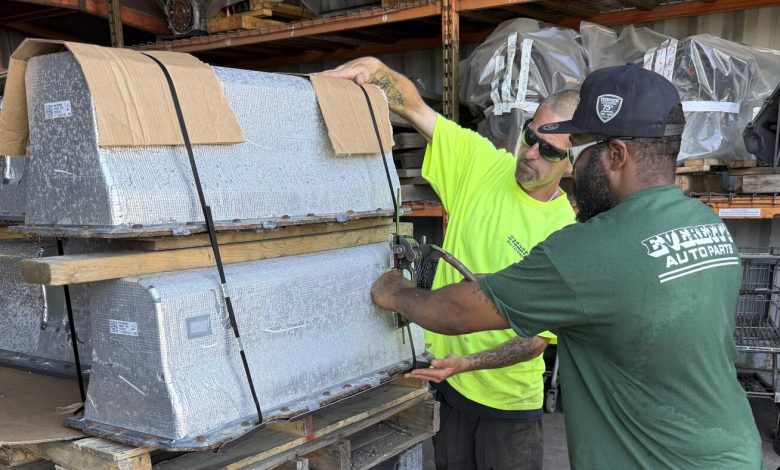

Chris McQuiggen and Archie Brewton of Everett Auto Parts strap two Chevy Volt batteries to a pallet in preparation for shipping. The batteries are separated by a layer of wood so they don’t make contact with each other. Everett Auto Parts found a battery recycler who will accept these hybrid vehicle batteries, but the salvage yard won’t make any money off of them.
Thomas Andrade
hide caption
toggle caption
Thomas Andrade
Stay up to date with our Up First newsletter, sent every weekday morning.
On a sweltering morning in early July, Thomas Andrade, the co-owner of Everett Auto Parts in Massachusetts, supervises as a team of workers carefully straps two Chevy Volt hybrid batteries to a pallet, ready to ship out for recycling.
Selling off valuable bits and pieces of a vehicle is, fundamentally, how a salvage yard makes money. And these batteries are, in fact, full of valuable minerals: nickel and cobalt and manganese and lithium. They’re headed to a battery recycler who will shred them into a fine, dark powder called black mass, from which those minerals can be recovered and reused in new batteries.
So how much will Andrade make off this particular deal?
Zilch.
And he’s pretty happy with that.
“The good thing with these is, they’ll at least take them at no expense,” he says of the battery recycler.
The fact that Andrade is quite pleased to make no money at all points to a problem for the vehicle recycling industry — and for society at large.
It’s extremely important that EV batteries get recycled. If they’re treated like trash, they become hazardous waste due to the risk of toxic leaching or dangerous fires. Treating them like waste is also, well, a waste: It squanders minerals that could be reused.
Recycling battery minerals, the better option, reduces the climate footprint of new vehicle production and eases U.S. reliance on China for those critical minerals. In the best case scenario, it also makes money for everyone involved.
But in many cases, the math for EV battery recycling is not penciling out. That’s leaving salvage yards stuck with old batteries nobody wants, not even recyclers.

Two Chevy Volt batteries sit on a pallet at Everett Auto Parts in Brockton, Mass.
Thomas Andrade
hide caption
toggle caption
Thomas Andrade
As Andrade is packing up those T-shaped Chevy Volt batteries, across the state at Westover Salvage Yard, CEO Brian Bachand is staring at another EV battery. This one is a mattress-sized Tesla battery, sitting on a shelf.
It, too, is hypothetically valuable. It still works just fine. If a Tesla driver wants to buy it as a replacement battery, it could be worth up to $2,000, Bachand estimates. But he’s priced it at $1,200.
“We try to price our parts to sell,” he says. “We don’t run a museum here.”
So far, this might as well be a museum display. No one’s biting. And if Bachand can’t sell it, his other option is to ship it off to a recycler — and he hasn’t been as lucky as Andrade. The only quote he’s gotten from a recycler who will accept this particular battery is negative $1,800.

As in, he would have to pay $1,800 to cover the cost of shipping a hazardous material and to make it worth the recycler’s effort to process the battery. If he can bundle together five batteries like this, he might be able to get a recycler to take them for free, but so far, he’s only got the one. Which is why it’s still here, on a shelf.
“This is a liability,” Bachand says. “No one’s paying me for it. I have to pay to get rid of it.”
Battery recycling can be profitable — for some
At a recent General Motors event in San Francisco, the automaker announced new battery chemistries and a commitment to using old EV batteries to help feed energy back into the grid. It was a celebration of “circularity,” the idea of a closed-loop system where old batteries never go to waste. In conversations on the sidelines, executives sounded optimistic about the economics of battery recycling.
J.B. Straubel, the founder and CEO of Redwood Materials, a major U.S. battery recycler, was bullish. “Every year that goes by, every month that goes by, it’s getting more economical, it’s getting more competitive,” he said. “We’ve got a fundamental economic tailwind because these materials are valuable to recycle.”
General Motors itself has a lot of batteries to recycle, including scrap that comes off its own cell manufacturing lines. Andy Oury, a battery engineer at GM, said that while recycling used to be an expense, it’s now “a source of revenue” for the company, with battery recyclers paying for that scrap.
“Capitalism is doing its thing, where there’s a positive incentive structure to go get those materials,” he said.
He acknowledged that the cost of shipping batteries can cut into revenue. But for a huge company like GM, which has large volumes of scrap to recycle, they can optimize the logistics of shipping them.
The view looks different from salvage yards, which don’t have those economies of scale. Think of Bachand, who could strike a better deal if he had five batteries instead of just one.

But there’s more at play, too.
It’s already challenging for scrapyards to make a profit off of disassembling EVs, simply because they have fewer parts than gas-powered cars do, says Emil Nusbaum, the vice president of strategy and government affairs for the Automotive Recyclers Association.
In a traditional gas-powered car, he says, “the two most valuable components are engines and transmissions for reuse and vehicle repairs. We don’t have those components in electric vehicles.” Instead of a complex engine, there’s an electric motor with a single moving part that rarely, if ever, needs to be replaced.
And of course, there’s the battery. For a salvage yard, that battery is a wild card. It could be worth a chunk of change, if it’s in good shape and can find a second life, either in another car or as energy storage for a building or the electric grid. Or it could be worthless, if it’s only useful for recycling and the cost of shipping will cancel out its recycling value. Or it could be a costly liability, if the minerals inside aren’t valuable enough to cover the price of shipping and processing it.
When an old EV is up on the auction block, auto salvagers often have no way of knowing whether its battery will be a boon or a burden.
“Is it going to be something that we can actually have as a valuable asset, for recycling or repurposing or repair?” Nusbaum asks. “Or alternatively, is this something that is going to be a substantial cost — in some cases thousands of dollars — in order to find a responsible home?”
More batteries may get stranded
This is the economic conundrum that can lead to unwanted EV batteries piling up at salvage yards. And the problem is expected to get worse.
Partly, that’s just because there will be a lot more old batteries. Right now there aren’t many genuinely old EVs on the road.
And EV batteries have been lasting longer than anticipated, meaning that there just haven’t been many that need recycling. In fact, most of the EV batteries that get recycled in the U.S. right now are scrap from factories, like defective batteries rejected by quality control, rather than dead batteries from old cars, according to data from Benchmark Mineral Intelligence.

But that will change. EV adoption is expected to rise over time, and the cars on the road today will eventually reach the end of their lifespans.
Meanwhile, EV batteries themselves are also changing. Increasingly, manufacturers are shifting away from packing them with expensive minerals, like nickel and cobalt, toward cheaper ones, like iron phosphate.
Lithium-ion batteries made with iron phosphate, known as LFP batteries, last longer and are more affordable — those are perks if you’re buying one. But the cheaper ingredients are a real challenge if you’re trying to recycle one.
“There’s really no value in recycling iron phosphate, unfortunately,” says David Klanecky, the CEO of Cirba Solutions, a major battery recycler in the U.S.
The lithium in them is still worth something — but for Cirba to make a profit extracting it, they have to charge both the person providing the battery and the buyer of the minerals on the other end.
“If I have to pay anybody to get an LFP battery, we don’t make any money,” Klanecky says.
Frederick Bloomfield, an analyst at Benchmark Mineral Intelligence who tracks prices along the battery recycling supply chain, uses the term “gate fee” to refer to any time a recycler charges to accept scrap. It’s akin to the payment you might have to make at your local dump to drop off trash.
“Crunching the numbers, it is pretty clear to say that there’s around $1.50 to $2 per-kilogram gate fee at the moment in North America for LFP,” he says. EV batteries can easily weigh a ton or more. Do the math, and that’s hundreds of dollars salvage yards have to pay to get an LFP battery accepted for recycling, even before they front the often-substantial cost of transporting a hazardous material.

That’s compared to the scrap value of some more expensive EV batteries, packed with pricier minerals, where instead of charging a gate fee, recyclers are willing to pay $2 a kilogram or more for scrap.
A few years ago, when companies were investing in building battery-recycling capacity in the U.S., they didn’t anticipate that the cheaper LFP batteries would perform as well as they do, or take off as quickly as they did. So they built facilities that “are now kind of looking a little bit ill-prepared,” Bloomfield says, for the kinds of batteries that will actually need recycling in the future.
A problem that stretches beyond scrapyards
Joe Hearn co-founded the SHiFT vehicle retirement initiative, which promotes responsible recycling for all kinds of aging vehicles. He says the risk of holding a battery that will be expensive to dispose of is making some players in the supply chain very cautious.
“The scrappers and shredders are very conservative about what they’re willing to receive at this point,” he says. “Our auto recycling partners have had loads refused and returned to them because there is an EV or hybrid in that load.”
What happens if responsible recyclers are reluctant to take these old batteries? Bloomfield says they might get shipped overseas to places where recycling is done in unsafe and dirty conditions.
Or someone stuck with old batteries might just let them pile up. “There’s really a risk of those batteries catching fire, becoming damaged,” says Jessica Dunn, a scientist with the Union of Concerned Scientists who focuses on battery recycling. “That’s a huge cost and also just a huge safety risk.”

She says EV and hybrid batteries are already showing up in landfills. “It is illegal to put a battery in a landfill, but they end up there anyway. And then that cost falls on a public entity to try to deal with it,” she says.
Colorado tackles the problem with a new law
One state is trying to get ahead of the problem. This summer, Colorado passed a new law that puts the onus of recycling unwanted EV batteries on the companies that sold them in the first place — an extension of the state’s embrace of a philosophy known as “producer responsibility.”
“Producer responsibility just means that the people making the trash — or whatever we’re considering the trash, the thing we’re disposing of — have to take responsibility for recycling it and for taking care of end-of-life,” says state Sen. Lisa Cutter, who co-sponsored the bill and previously pushed similar laws for smaller batteries and plastics.
“There’s not a magic trash fairy,” she says. “We have to plan for these things.”
The law serves as a sort of backstop. If an EV battery is dumped at a landfill or stranded at a salvage yard, then the manufacturer who originally sold the EV — Tesla or GM, for instance — will be on the hook to pick it up and make sure it’s recycled, at the carmaker’s expense.
Dunn, with the Union of Concerned Scientists, notes that the law also requires that a certain percentage of the battery’s minerals be recovered, which is a way of requiring that it be recycled well.
The bill was shaped not just by environmental groups — namely Dunn’s group and Western Resource Advocates — but by a remarkably broad swath of industry players. Emil Nusbaum’s association representing salvage yard operators enthusiastically supported it. So did battery recyclers; both Redwood and Cirba praised the law in interviews with NPR.
Even automakers who will be footing the bill were on board with the new law, which is less onerous for them than a similar law in the European Union. The Alliance for Automotive Innovation, the trade group representing most of the major automakers in the U.S., praised the law as “balanced,” and noted in a letter to Colorado Gov. Jared Polis that keeping battery minerals within domestic supply chains is “foundational to America’s automotive industrial base.”
That is to say: Everyone in this supply chain has a vested interest in making sure these old batteries become resources, rather than hazards.
Dunn, who worked on the legislation, is optimistic that this broad coalition of support will increase the chances that other states will follow Colorado’s lead.
“We see Colorado as the starting place,” she says.
NPR’s John Ruwitch contributed to this report.