Iran launches retaliatory attacks after fresh US strikes – as it happened | Iran

Closing summary
We are closing our live coverage of developments in the Middle East – you can read our latest report here. Here is a quick recap of the latest.
-
The United States and Iran each asserted Monday they controlled the strait of Hormuz after a weekend of attacks stretching across the wider Middle East, further threatening any diplomacy to end the war.
-
The attacks were sparked by Iran striking a container ship in the strait off the coast of Oman.
-
The US military’s Centcom described its forces as hitting dozens of sites in the strikes Monday, including air defense systems, radar sites, missile and drone equipment and small boats. “The Strait of Hormuz is a vital maritime corridor for global trade,” Central Command said. “Iran does not control it.”
-
The US military early Sunday said it hit some 140 targets, including missile and drone launch sites, ammunition dumps, communication equipment and other sites — a far-heavier set of attacks than in two previous rounds of strikes in the last week. “We bombed the hell out of them last night,” U.S. President Donald Trump told NBC’s “Meet the Press.”
-
Iran retaliated by attacking nations in the region hosting US military forces, while insisting it alone must control the strait and potentially charge vessels for traveling through it. Iranian attacks on Sunday stretched Bahrain, Kuwait, Qatar, Jordan and even Oman — whose territorial waters with Iran make up the strait. Oman, which long has been an interlocutor between Tehran and the West, summoned an Iranian diplomat to criticise the attack.
-
“The era of one-sided deals is OVER,” Mohammad Bagher Qalibaf, the speaker of Iran’s parliament and a main negotiator, wrote. “We told you: keep your word or pay the price. Reality is knocking.”
-
Iran and the US are nearly at the midway point of the 60-day period of an interim deal that was supposed to set-up talks for a permanent end to the war. Instead, it has devolved into a series of attacks over the strait and its future. President Donald Trump suggested last week that the interim deal in the war was “over.” But mediators, including Pakistan, Qatar and Egypt, have continued efforts to reach a final agreement to end the war.
-
“A return to full-scale hostilities would have catastrophic consequences,” United Nations Secretary-General António Guterres said in a statement.
Key events
Kuwait’s army says it is engaging “hostile aerial targets” in Kuwaiti airspace after Iran’s IRGC claimed it had attacked US military bases.
Iran’s IRGC is now also claiming that it has attacked US military bases in Kuwait.
Meanwhile, sirens are sounding for a second time today in Bahrain.
Iran’s IRGC also claims it has hit a US base at Sheikh Isa in Bahrain in the second phase of retaliatory operation. The Guardian could not immediately confirm this claim.
Centcom said it struck Iranian military air-defense systems, coastal radar sites, missile and drone capabilities, and small boats using US fighter aircraft, naval vessels, one-way attack aerial drones, and one-way attack sea drones in its latest wave of attacks.
The Strait of Hormuz is a vital maritime corridor for global trade,” Centcom said. “Iran does not control it.”
Centcom completes latest round of strikes
Centcom says it has completed a new wave of offensive strikes against Iran, hitting dozens of targets at multiple locations with precision munitions.
IRGC claims it has set fuel tanks, ammunition tanks on fire in Jordan
Iran’s Islamic Revolutionary Guard Corps (IRGC) said it had set fuel tanks and ammunition depots on fire at Prince Hassan airbase in Jordan by firing missiles and drones. The Guardian could immediately verify the IRGC’s claim.
The IRGC said the strike was the first phase of response to US attacks on Iranian coastal bases and its retaliatory operation was continuing.
The Jordanian military later said that it intercepted and shot down four missiles that entered airspace from Iran, according to its state news agency.
Bahrain’s interior ministry instructed residents to take shelter after attacks on the island nation as Iran targets US interests in the Gulf.
The siren has been sounded… citizens and residents are urged to remain calm and head to the nearest safe place,” the ministry posted on X.
Sirens in Bahrain
Sirens have sounded in Bahrain, according to the country’s interior ministry.
We’ll bring you more as it comes in.
A comment on the reported fatality in South-western Iran:
Following the attack of the American enemy on Monday morning… one person was martyred and four others were injured,” official news agency IRNA reported, citing Khuzestan province’s deputy governor for security and law enforcement, Valiollah Hayati.
One person has been killed and four wounded in a US strike on a water pumping station in Iran’s mahshahr, Iranian state media Irna news is reporting.
Oil prices opened sharply higher on Monday after the United States launched a wave of attacks on Iran and as Tehran announced it would close the strait of Hormuz.
A barrel of international benchmark Brent crude for September delivery rose 3.75% to $78.86 at around 2210 GMT on Sunday.
US benchmark West Texas Intermediate rose 3.65% to $74.02 per barrel for August delivery.
Strikes over the weekend have had wider regional implications.
Qatar, which has previously said it would not act as a mediator so long as it was under attack, said three people, including a child, had been injured by falling shrapnel. It said Iran was “fully legally responsible” for the attack.
The UAE said it detected missile threats outside its borders, while Bahrain said it intercepted several Iranian aerial attacks, Jordan reported missile strikes and Oman reported being targeted with drones. Kuwait’s army later reported damage from strikes, and said an attack on an oil drilling platform injured a worker.
Oman said it had summoned Iran’s ambassador to protest over drone attacks in two regions and the US embassy in Oman told its nationals in Duqm and Musandam to shelter in place.
Iran’s foreign ministry has condemned “aggressive” US attacks against Iran.
In a statement, the ministry also said talks between Iran and Oman on Saturday in Muscat — focused on arrangements for managing the strait and transit routes — were unable to reach a result because of “overt and covert” US pressure on Oman.
In the past week, Trump has said he considers the ceasefire over, while leaving the door open to more talks.
Iran’s top negotiator, Mohammad Baqer Qalibaf, posted on X on Sunday.
The era of one-sided deals is OVER. We told you: keep your word or pay the price. Reality is knocking.”
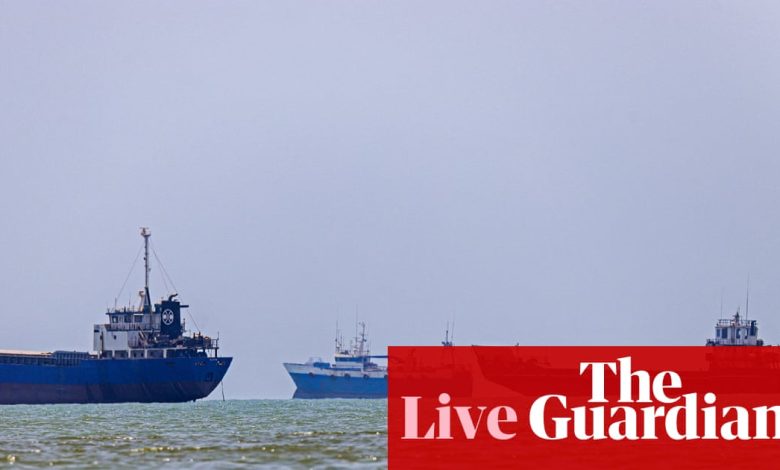
The renewed fighting followed an Iranian attack early Sunday on a commercial ship in the strait of Hormuz, whose crew was forced to abandon it after it went up in flames.
Iran’s Revolutionary Guards said after the incident that “the Strait of Hormuz will be closed until further notice and until the end of American interventions in this region,” according to state news agency IRNA.
CENTCOM countered on X that the strait was “open to all vessels seeking to lawfully transit.”
It said US forces were “positioned and prepared to ensure” freedom of navigation, adding: “Iran does not control the strait. Traffic is flowing.”
Control of the waterway has become key leverage for Iran, with an adviser to the country’s supreme leader on Sunday saying it was more important than “dozens of atomic bombs”.
The latest salvo by US forces began at 2100 GMT on Sunday, Central Command (CENCTOM) said on X, after earlier announcing approximately 140 strikes the previous night.
On Sunday evening, Iranian state media reported at least 10 “enemy projectiles” hitting Qeshm Island, which sits on the strait of Hormuz.
It also reported strikes on the island of Farur, to the east of Qeshm in the Gulf, that it said killed a telecommunications worker and wounded two others.
Shortly after, Kuwait said three of its land border posts in the north were damaged in an attack, and that an offshore drilling platform “was targeted by a hostile drone,” with one person injured.
Tehran said it had targeted two ships in Hormuz early Sunday, including the one that caught fire. Iran’s Guards said they also hit Oman, which has rarely been targeted.
Opening summary
The US and Iran have again exchanged heavy missile and drone assaults, with Tehran targeting US facilities in states across the Gulf and saying it had again closed the vital strait of Hormuz.
The US military began launching more strikes against Iran at 5 pm ET on Sunday, US Central Command said in a statement, “to continue degrading their ability to attack civilian mariners and commercial ships freely transiting the strait of Hormuz.”
In a brief phone interview with Reuters on Sunday afternoon, Trump referred to this weekend’s US strikes on Iran. “We’re beating them up,” he said.
Iran’s latest barrage marked an escalation in pace and range, extending as far as Qatar, a mediator in ceasefire talks that had not come under attack since April. The United Arab Emirates, which had not been targeted since early May, said its air defenses had engaged missiles and drones from Iran.
The renewed violence casts further doubt on the future of an interim US-Iranian agreement signed last month that aimed to reopen the strait and end the war after a further 60 days of negotiations.
Iran said early on Monday that the latest attacks had “rendered futile” all the diplomatic efforts of the last few months.
“The US regime has also caused the return of insecurity in the strait of Hormuz and disruption of international commercial shipping by openly interfering in the process of Iran implementing the necessary arrangements in the strait of Hormuz,” a foreign ministry statement said.
We’ll bring you all the latest here.