
For a few weeks, this World Cup belonged to the outsiders and newcomers. Cape Verde became the story of the tournament. Morocco made another run to the final eight. Nine of the 10 African teams advanced to the knockout stage. The expanded 48-team field produced more compelling underdogs, more competitive group-stage matches, and plenty of memorable moments. Even if none of the favorites were ever in serious danger, the opening weeks were like a party they were content to arrive late to.
Once the knockout rounds began, though, the sport’s established powers reminded everyone why only eight nations have ever won a World Cup. All four semifinalists are former champions, and three have lifted the trophy since 2010. The quarterfinals featured six teams from Europe, plus Argentina. The expanded tournament may have broadened the middle class of international soccer, but it didn’t change who occupies the penthouse.
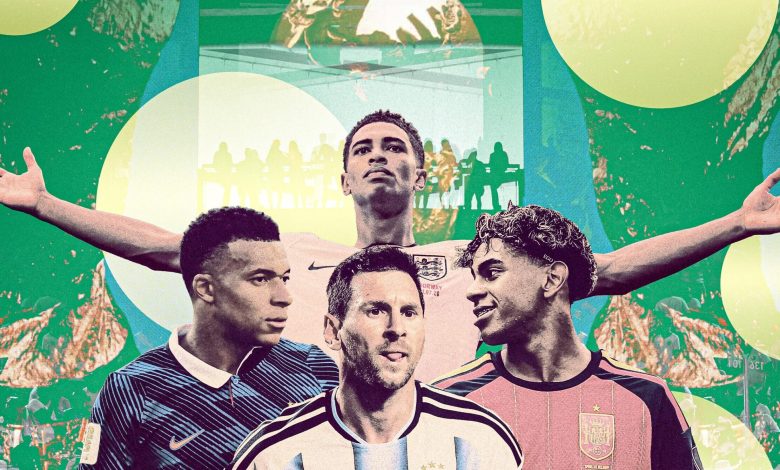
This is exactly the semifinal stage FIFA envisioned when it seeded the tournament bracket. France, Spain, England, and Argentina entered as four of the betting favorites and the four highest-ranked teams in the world. Now they each stand two wins from immortality. Tuesday pits the tournament’s two most complete teams against each other, and Wednesday sets us a clash of two historic narratives: England’s 60-year drought and Argentina’s last dance with Lionel Messi. Here is The Ringer’s World Cup semifinal cheat sheet, with everything to know about these two classic matchups.
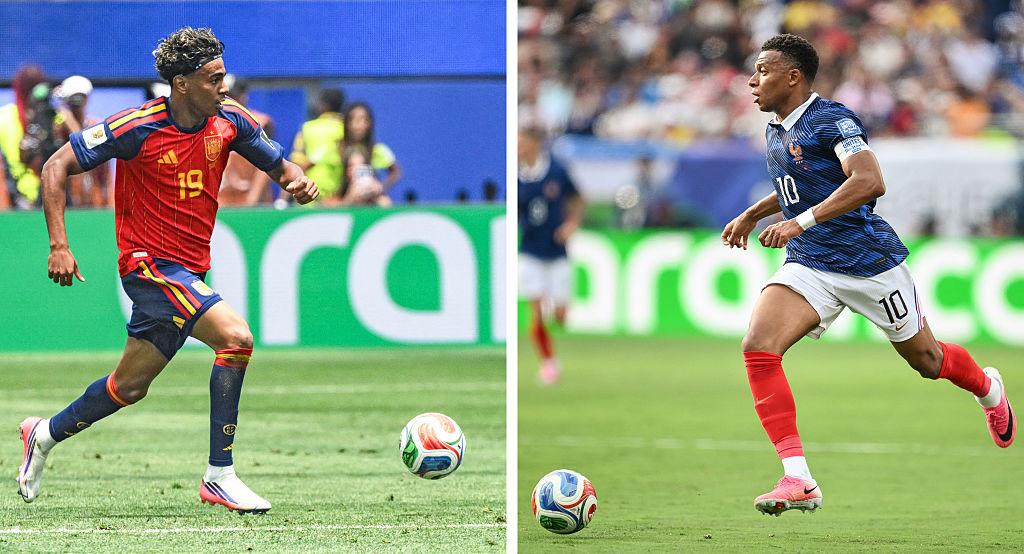
Lamine Yamal and Kylian Mbappé
France vs. Spain
Tuesday, 3 p.m. ET in Dallas
1. France and Spain are meeting in the semifinals of a tournament for the third consecutive summer. At Euro 2024, then-16-year-old Lamine Yamal scored a curling goal from outside the penalty area to help propel Spain to a 2-1 victory. And while the Nations League isn’t nearly as prestigious or important as the World Cup or Euros, both nations played strong starting lineups in Spain’s 5-4 win last June. Spain led that match 4-0 and then 5-1 in the 75th minute before a furious late comeback from France came up just short.
2. France has evolved quite a bit over the past 24 months. After a disappointing Euro 2024 in which Les Bleus scored four total goals in six matches (two of them own goals and one a penalty), manager Didier Deschamps was criticized for playing a 4-3-3 midfield formation with too many defense-minded players in the center. Their identity revolved around a totally lackluster press and an overreliance on transition opportunities to create scoring chances. It made them stale and predictable, and Spain was vastly superior in possession. La Roja had 61 percent of possession in the second half of that match, and France trailed the entire time. France barely threatened the Spanish goal, and Spain went on to win the match and the Euros.
But the emergence of Désiré Doué, Michael Olise, and Manu Koné at the Olympics the same summer paved the way for the new and improved France side, which has ripped through this World Cup. At the Nations League last summer, Deschamps debuted a formation with more emphasis on attacking: a 4-2-3-1, with an extra attack-minded player in midfield. Kylian Mbappé played as a central striker instead of a wide forward. Doué replaced Mbappé wide off the left. N’Golo Kanté aged out of a key role in France’s midfield and was replaced by Olise. It still wasn’t enough, as Spain won the semifinal, but the match was considerably more competitive than the score line would suggest.
That brings us to this World Cup. With the exception of the opening half against Senegal, France has dominated its opponents. Olise’s playmaking plus two elite wide outlets plus Mbappé makes for one of the most gifted attacking groups in World Cup history. Whereas past versions of France at times relied on winning ugly, they don’t really have to do that anymore because basically no one can keep up with their attacking quality.
3. If any team is built to blow up the idea that France is inevitable, it’s Spain. Ahead of the quarterfinals, I wrote about why France doesn’t quite have the World Cup sewn up yet. Essentially, France had yet to face the kind of elite team that can keep possession, allowing Les Bleus to dictate the state of play in each matchup. Senegal tried to press them and got blown out in the second half. Norway didn’t even bother to play its best players. Sweden couldn’t match their athleticism. Paraguay refused to play soccer at all. And last week, Morocco was able to put together spells of possession to challenge France but lacked the healthy attackers to capitalize.
Spain is different. Spain won’t concede territory. Spain won’t abandon its principles just because the opponent is France. Luis de la Fuente’s side will aim to control the ball, compress the field with its counterpress, and force France to defend long possessions for the first time in this tournament.
That counterpress is the defining characteristic of the Spanish side. The moment possession is lost, Spain doesn’t retreat; it swarms. Midfielders immediately close passing lanes, fullbacks squeeze high up the pitch, and Rodri serves as the stopper to put out fires all over the pitch. Spain eliminates outlets until the only remaining option is a rushed clearance or an ambitious long ball that Spain recovers.
France has been devastating whenever its opponents have allowed matches to become open and transitional. Spain’s entire philosophy—both with the ball and immediately after losing it—is built around preventing those opportunities from ever materializing.
4. An aggressive counterpress against France is like walking a tightrope. France has an elite ability to create transition opportunities, and most teams just aren’t willing to risk getting exposed defensively. But Spain has made that bet all tournament, and it has paid off. They have the most attacking penalty area touches (226) and the fewest expected goals conceded (1.8) of the four semifinalists. Before Spain finally conceded a goal to Belgium in the quarterfinals—its first of the tournament—it had previously broken a record by logging six consecutive World Cup clean sheets. When Spain faced elite wide outlet Jeremy Doku, it was Doku who had to move all over the pitch to try to show for the ball and help Belgium escape relentless pressure. He had his moments but wasn’t consistently able to relieve the pressure.
5. As fascinating as the tactical battle is, matches of this magnitude are still often decided by star players and individual moments of brilliance. Spain may have a tactical edge, but France has more game-breaking and in-form super-talents. Mbappé is the favorite to win a second consecutive World Cup golden boot. (He and Lionel Messi are currently tied in this World Cup with eight goals apiece.) He’s on track to shatter all of the Cup scoring records by the time his career ends. If he leads France to a second title in three tournaments, Mbappé will have a case as the best World Cup player of all time. He is France’s megastar, and his face is plastered on the posters and advertisements in the buildup to any World Cup match. Yet you could still make a solid case that he hasn’t even been France’s best player at this tournament. That title should belong to Olise.
Olise is the point guard making everyone around him better. He has five assists. He has created more big chances for France than anyone else. He is averaging nearly three dribbles per 90 minutes, second on his team only to frequent substitute Bradley Barcola. And remember that half against Senegal during group play way back in June? The one when France could barely generate a scoring chance and that Landon Donovan called “arrogant”? It was the only half of this tournament in which France played with Olise out wide to the right instead of in the center. Since he’s flipped with Ousmané Dembélé, Les Bleus have become a supernova in attack.
While Mbappe’s finishes dazzle us, Olise’s meteoric rise elevates France from a talented group of attackers into one of the best international teams ever.
6. In a tournament where almost every global megastar has shined, Spain’s biggest star has had a relatively quiet tournament. Yamal played only 19 minutes in Spain’s opening-match draw with Cape Verde and 45 minutes against Saudi Arabia as he returned from a leg injury. But even as he ramped up to a full 90 minutes in their last two matches, the 18-year-old wunderkind has not lived up to the supremely high expectations placed on him. He’s had only one goal contribution all tournament: Spain’s opening score in a 4-0 win against Saudi Arabia. Yamal doesn’t look quite as explosive as he did the past two summers, and he isn’t moving as efficiently as he did for Barcelona before his grade two hamstring injury in April.
The data backs it up. Yamal has averaged 0.34 expected goals per match on an average of five shots. That’s a very low average shot quality and a sign of how little he’s getting on the ball in truly dangerous areas. Against Portugal and Belgium in the knockout rounds, he settled for a lot of low-quality looks against set defenses.
Yamal also hasn’t been creating much for others. He ranks behind Spanish midfielders Alex Baena, Pedri, and Rodri and right back Pedro Porro in total chances created at this tournament. It was one thing for Yamal to struggle to beat elite Portuguese left back Nuno Mendes in the round of 16, but his difficulties against Belgium’s average left backs raise some concerns about his fitness levels. In last summer’s Nations League semifinal, Yamal created three chances, scored two goals, won a penalty, and was the best player on the pitch. Spain needs him to find that form to win the next two matches.
7. Luis de la Fuente has an interesting lineup choice ahead of him. Against Belgium, the Spanish manager decided to bring Fabian Ruiz into the starting midfield for Pedri, a choice that was validated when Ruiz scored the opening goal of the match. Ruiz offers more ball-winning ability and forward box running, while Pedri is the superior possession passer and chance creator. Both players are certain to feature at some point in the semifinal, and de la Fuente’s decision will tell us whether he believes Ruiz’s athleticism or Pedri’s technical ability matches up better against France.
8. Spain’s midfield depth is superior to France’s. Their depth was a major reason Spain and France were the two pretournament favorites and remain so entering the semifinal. Spain’s Nico Williams Jr. made a cameo off the bench against Belgium in the 79th minute as he continues to recover from injury. If he can play only 30 to 45 minutes, he’ll likely come on for Baena to give Spain some more direct attacking threat on the left. Williams was a key cog in Spain’s Euro 2024 title campaign, but injuries have derailed his World Cup campaign. Spain is considerably more dangerous in possession when it can feature two great wide players in Williams and Yamal, especially since Baena isn’t a natural winger in that left-sided role. And while Spain lacks quality striking depth, it can turn to midfielder and pseudo-striker Mikel Merino in desperate times. Merino—who is Marouane Fellaini–esque in his play—is an unconventional midfielder who loves to get forward and score goals. He scored the winner in both the round of 16 and quarterfinal.
9. But France has more match winners in reserve. Rayan Cherki was one of the most creative players in the Premier League this year, and he’s coming off the bench for France. Bradley Barcola will likely be Doué’s replacement on the left at some point, and there’s basically no drop-off from one to the other. As we saw in Norway and England’s dramatic quarterfinal, depth and quality bench play are even more important when you can make five or even six substitutions. As the match progresses, we’ll see both teams double down on their strengths.
10. The margins are incredibly thin. When the tournament began, oddsmakers saw these two teams as relative equals. According to FanDuel, France is now a small but notable –152 favorite to advance to the final. Statistically, there’s basically nothing to separate these two teams. Spain has played marginally tougher opponents, but France has been a marginally better side—especially at creating the highest-quality chances.
Spain vs. France
Whichever team comes through this first semifinal will unquestionably be the favorite to lift the trophy on Sunday, but neither England nor Argentina is a pushover. It would be a mistake to call Tuesday a de facto final, even if Spain and France have been the two best teams all tournament long. And as for that second semifinal on Wednesday …
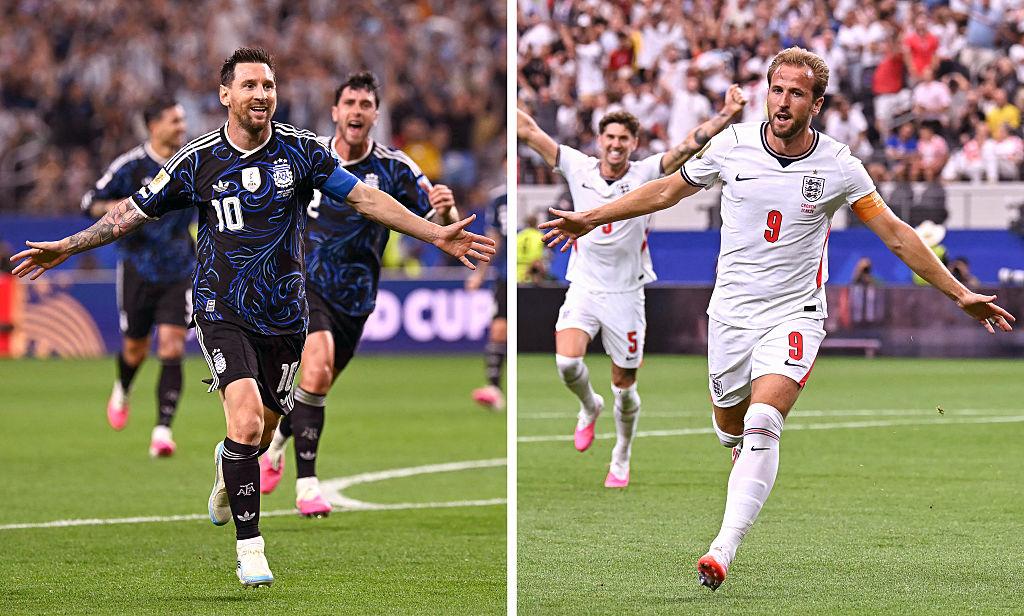
Lionel Messi and Harry Kane
England vs. Argentina
Wednesday, 3 p.m. ET in Atlanta
1. When England beat Mexico in the round of 16 at the Estadio Azteca, it exorcised one of the defining ghosts in its soccer history. England’s previous World Cup match at the Azteca ended with Diego Maradona’s infamous “Hand of God” goal in the 1986 quarterfinal. Now comes the chance for an even more direct reckoning. England and Argentina are set to meet in the World Cup knockout stage once again, renewing one of international soccer’s most emotionally charged rivalries. Argentina eliminated England in both 1986 and 1998, while England’s only World Cup revenge came in the 2002 group stage. Wednesday will be their first competitive meeting in 24 years—and their first meeting of any kind in 21 years—with a place in the World Cup final at stake. Unlike Spain and France, whose rivalry has been defined by recent high-profile clashes, England and Argentina have spent more than two decades apart.
2. Neither England nor Argentina played well in the quarterfinals on Saturday. While Spain and France largely controlled all of their matches en route to the semifinal, that has not been the case for either of these two semifinalists throughout the knockouts. England had comeback wins in the round of 32 against Congo and in the quarterfinal against Norway. Down to 10 men against Mexico in the Azteca, it held off a furious late push for an equalizer with some heroic defending. England’s best game in this tournament actually came in the opener—a 4-2 demolition of Croatia that was even less competitive than the final score line would indicate.
Argentina has been an incredibly dramatic but flawed team throughout the knockouts. Despite enjoying a massive crowd advantage, Argentina barely scraped by Cape Verde after blowing 1-0 and 2-1 leads. It needed some controversial VAR help to stage a dramatic comeback after being down 2-0 against Egypt, and then it was outplayed by Switzerland for the first 65 minutes of its quarterfinal before a Swiss red card and brilliant Julián Álvarez extra-time goal sent it through to the semifinal. Blown leads aren’t a new thing for Argentina, either. Argentina surrendered a 1-0 lead against Ecuador at the last Copa América and famously blew two-goal advantages against both the Netherlands and France during its victorious 2022 World Cup run. Lionel Scaloni’s team has repeatedly made knockout matches more dramatic than they need to be, and another 120-minute battle leaves an aging squad with little margin for error.
3. The setting of this match matters. After playing in altitude in Mexico City and then in the brutal heat and humidity of Miami, England should be quite happy to play this semifinal in a controlled climate in Atlanta’s Mercedes-Benz Stadium. England has played six games at this World Cup, and its attack has generated considerably more chances in its two indoor games; it’s a small sample, but it seems like a decent signal to me. Here are England’s non-penalty expected goals by match, with its indoor matches in bold:
- Croatia: 2.4
- Ghana: 1.4
- Panama: 1.6
- Congo: 2.1
- Mexico: 0.82
- Norway: 1.04
Jude Bellingham brushed aside manager Thomas Tuchel’s criticism of their performance against Norway in Miami by saying that Tuchel “doesn’t know what it’s like to play in those conditions.” Erling Haaland couldn’t even finish the match. Declan Rice came off at halftime. England’s substitutes and depth advantage proved the difference in the win against Norway, but this core group continues to get stretched as far as possible.
4. If England wants more of the ball in this matchup, it will have it. Tuchel’s England seems to have an innate desire to press and possess the ball, even if a lot of that possession doesn’t really lead to much. And while Argentina won’t be as passive as Norway (especially early on), it has not shown a consistent ability to counterpress and win the ball back. This graph of the field tilt between Switzerland and Argentina in the quarterfinal illustrates some of Argentina’s issues. Field tilt measures where most of the time is spent in a soccer match, and until Breel Embolo’s red card in the 71st minute, Switzerland controlled the flow of the match (represented in red in the graph below).
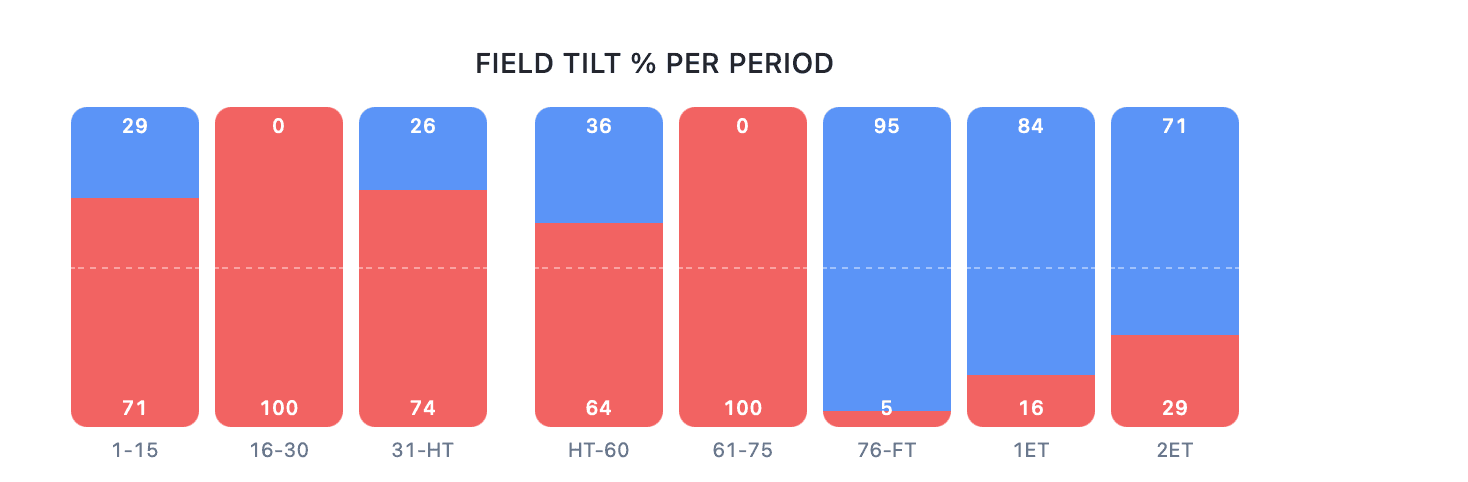
Argentina wouldn’t mind this if it were consistently dangerous in transition. It was not—at all. Switzerland is the first team Argentina’s faced in the entire tournament with the talent and willingness to keep possession against them. And the Swiss had much more success than anyone really would have expected. England is even better with possession than Switzerland, so I expect them to have quite a bit more of the ball, too.
5. Argentina’s biggest defensive flaw is out wide, especially on the right side. Some of the tournament’s biggest goals against Argentina have come from this area—not only did Argentina concede that incredible finish to Sidny Lopes Cabral of Cape Verde from its weaker right side, but Switzerland’s Dan Ndoye’s equalizer also came from there. That makes this semifinal a huge opportunity for England’s Anthony Gordon. Gordon is a pressing menace who has won over a lot of fans with his relentless energy. He came off the bench and had two assists against Congo and added another assist to Jude Bellingham for the equalizer against Norway.
6. Argentina faces a Harry Kane dilemma. Kane has never played like traditional no. 9s, who typically wait on the shoulder of the last defenders and aim to run in behind or serve as a target man. Instead, Kane constantly drops into midfield to receive the ball, dictate possession, and pull defenders out of position. That movement is one of the biggest reasons England is able to dominate the ball for long stretches. It also presents Argentina with a dilemma. If Cristian Romero or Lisandro Martínez—a highly aggressive center back duo—follows Kane into midfield, it could leave space for Bellingham’s late runs and Gordon’s pace in behind. If Romero stays home, Kane has the freedom to turn and pick passes against a midfield that has struggled to consistently pressure the ball throughout the knockout stage. Switzerland repeatedly found space between Argentina’s midfield and back line, but its most explosive ball progresser and chance creator, Johan Manzambi, was out with an injury. England’s striker is uniquely equipped to exploit some of the gaps in Argentina’s defense. But he won’t be the best player on the pitch on Wednesday, and he isn’t the player most likely to decide this semifinal.
7. That title belongs to Lionel Messi, who has once again been the best player at the World Cup. It was absurd when Messi did it at age 35 in Qatar; now it’s borderline impossible to believe. Messi has had 10 combined goals and assists at this tournament, second only to Mbappé. Messi has created seven big scoring chances for others—two more than Olise, who’s had the second most. Messi leads all World Cup players in expected assists plus expected goals per minute. Outside of two horrendous penalty misses against Austria and Egypt, Messi has bailed out Argentina’s otherwise middling attacking performance at this Cup. It’s a formula that should look familiar to most NFL fans, most recently Kansas City’s: a sports megastar dragging an aging and flawed team through a handful of close matchups with some heroic late-game play.
And to make the Messi lore even more absurd, he’s been forced into roles he hasn’t played in years because of Argentina’s imbalanced squad. Because La Albiceleste have no consistent wide production or wingers, Messi broke glass in case of emergency and played out wider in the matches against Cape Verde and Egypt. It helped Argentina create better chances to score against teams that had otherwise exposed its lack of width.
8. Bellingham is one of the most unique players in all of Europe. While he technically plays in the same spot on the field as a no. 10, he’s not a primary creator for others like traditional 10s such as Norway’s Martin Odegaard, France’s Olise, or even Messi. Bellingham’s chance creation from open play with Real Madrid was below average compared with other attacking midfielders—ranking in the 33rd percentile in expected assists, according to Scout Lab.
Bellingham does a ton of work without the ball that makes him look more like a traditional box-to-box defensive midfielder, too. It’s probably why Tuchel felt comfortable dropping Bellingham deeper into the England pivot against Norway in the second half when more traditional attacking midfielder Eberechi Eze came into the match.
The problem with dropping Bellingham deeper on the pitch is that it’s way harder for him to use his most valuable skill—the one that led to four goals in the past two matches, on top of two more in the group stage. Bellingham is an incredible ballcarrier and box crasher who gets shots and scores goals in moments of individual brilliance.
It’s easy to see why Bellingham doesn’t always show up as a consistent performer: When he isn’t scoring, his lack of creation ability limits his value. But as a goal scorer, he also possesses an invaluable and irreplaceable skill for a midfielder. And for that reason, he has been absolutely essential for England in this tournament.
9. Look out for set pieces. England entered the tournament as one of the best attacking set piece teams on paper, and it’s been quite efficient at scoring goals from set pieces. But as good as the Three Lions have been at creating chances, they’ve conceded plenty, too. Mexico scored its opener from a corner, and Norway thought it had a go-ahead goal from a corner until VAR controversially overturned it. This is a weakness that Argentina can absolutely exploit.
Argentina and the U.S. are the only teams that have had more set piece goals than England at this tournament. As we’ve seen from Messi’s free kick against Jordan, Romero winning headers from corners against Cape Verde, or Alexis Mac Allister’s beautiful opener against Switzerland, Argentina will always have a chance as long as the magisterial Messi graces the pitch (and takes the dead ball situations).
10. For most of the tournament, Argentina would have been favored over England. That is no longer the case. Even though Argentina is the defending World Cup champion and football hasn’t come home since 1966, England is now the favorite on Wednesday. FanDuel currently says that England is –130 to reach the final. England has spent six decades trying to win another major tournament by finding the right formula. Argentina has spent the past four years proving that as long as Messi is on the field, formulas are overrated. Wednesday will tell us which is more powerful: England’s star-studded generation or the greatest player the sport has ever seen.

Anthony Dabbundo
Anthony Dabbundo writes about all things sports and is a podcast host featured on The Ringer Gambling Show and The Ringer’s Philly Special. He is a graduate of Syracuse University, and a proud Philadelphian who spends his summers at Citizens Bank Park.