

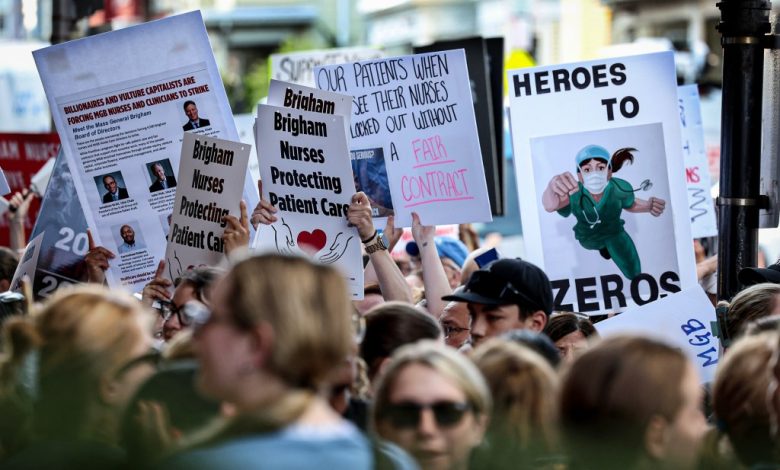
It’s a battle over big salaries at Mass General Brigham, with both sides in the state’s largest-ever nurses’ strike accusing each other of being out of touch with economic reality.
Brigham and Women’s Hospital nurses announced they will gather before 6:59 a.m. Monday for a brief rally then drop their picket signs and walk back into work, with others not scheduled for shifts standing by in solidarity. But the rift between management and union members remains.
Gov. Maura Healey, Boston Mayor Michelle Wu, U.S. Sen. Ed Markey and others joined the picket line last week as the nurses held a work stoppage.
Among the signs on the strike line were a few accusing hospital CEO Dr. Anne Klibanski of being paid millions. According to the last 990 tax forms posted on the non-profit tracking site Guidestar, Klibanski earned a total of $8.4 million in 2023.
Klibanski is the president and CEO of Mass General Brigham, which is the parent healthcare system that owns both Massachusetts General Hospital (MGH) and Brigham and Women’s Hospital (BWH).
The top 100 nurses at Brigham and Women’s Hospital are also highly paid, according to a list of salaries shared with the Herald by BWH.
The highest-paid nurse, who is not identified by name, earned $412,299 in 2025.
The next 10 nurses on the list all took home $300,000, with one topping out at $358,175.
All the rest in the Top 100 list all made more than $237,000 last year, according to the hospital.
“We value our nurses, as evidenced by the below” list, BWH added in an email to the Herald, adding that “like other healthcare organizations, MGB is faced with difficult decisions.”
Clearly, it is a snapshot of management’s stance on the union demands for raises and hospital costs continue to skyrocket — especially for patients.
Joe Markman, Massachusetts Nurses Association spokesman, told the Herald Sunday the nurses are just looking for a cost-of-living bump.
“Brigham nurses are highly skilled, expert nurses who provide care to some of the most medically complex hospital patients in the world. They absolutely deserve and need to be paid well so that BWH can have a strong nursing workforce,” he said in an email to the Herald
“In addition,” he added, “the cost of living has skyrocketed in the past five years — going up 50% from 2020 to 2024 in Massachusetts and still rising. MGB needs to include a cost-of-living raise to ensure the nurses’ existing wage scale does not fall behind, and BWH loses nurses.”
He said the current 0% cost-of-living offer just isn’t working.
“Dana-Farber and MGB are fighting for hundreds of oncology nurses, for example, over the next few years,” he added. “Other hospitals are also raising their wages to keep up with a high-demand market for nurses.”
The work stoppage at Brigham and Women’s Hospital and MGB Home Care sites began Wednesday, when Massachusetts Nurses Association members voted to strike after months of contract negotiations failed.
The 4,000 BWH nurses finished their one-day strike Thursday morning, but the work stoppage continued due to a four-day lockout ordered by MGB leadership to accommodate what they called “extensive operational and emergency preparedness measures.”
The 450 MGB Home Care clinicians called a seven-day strike to last through July 15 at 8 a.m.
MGB replaced the union members with nearly 1,300 agency nurses at BMC and over 175 home care clinicians.
MGB said their current proposal would add “meaningful value” to the wage and benefit packages for nurses. The proposal continues the 5% increases throughout the 20-step wage scale and a 2.5% increase for nurses at the top step, without adding to base wages.
Their proposed compensation package adds about 30% “through health insurance, retirement contributions, paid time off, and tuition support,” MGB stated.
Under the MNA proposal, the hospital system stated, Brigham nursing salary and benefit expenses would increase from about $746 million to $920 million annually. Nurses wages would represent nearly 50% of all BWH labor costs, MGB said, “illustrating the significant financial impact of the proposal on the hospital’s overall operating budget.”