
Artificial intelligence could transform the economy faster than any previous technology, and policymakers must move equally quickly to figure out how to respond, a group of economists and researchers are warning.
“A.I. may become radically more powerful over the next 10 years,” the researchers wrote in a statement released on Monday, adding that the technology “could bring risks, including large-scale job displacement, as well as opportunities such as major gains in living standards.”
The statement, titled “We Must Act Now,” was signed by nearly 200 people, including 15 Nobel laureates and the chief economists of two of the leading A.I. labs, Open AI and Anthropic. Other notable signatories include Jack Clark, a co-founder of Anthropic; Eric Schmidt, the former chief executive of Google; and Vinod Khosla, a prominent venture capitalist.
Tech industry leaders have been warning for several years that as A.I. grows more powerful, it could quickly take over a large share of human work, leading to widespread joblessness. Economists have tended to greet those predictions with skepticism, noting that technological changes tend to play out more gradually than predicted by industry boosters.
Some economists, however, have grown concerned that A.I. is spreading through the economy more quickly and more broadly than past technologies, and that their profession is downplaying the risks.
The statement on Monday is the latest sign that such concerns are becoming more widespread. It warns that the effects of A.I. could be “larger than the Industrial Revolution, but unfolding over a vastly shorter time frame.”
Notably, the list of signatories includes some people who have in the past been prominent A.I. skeptics, including Daron Acemoglu and Simon Johnson, professors at the Massachusetts Institute of Technology who won the Nobel in economics in 2024.
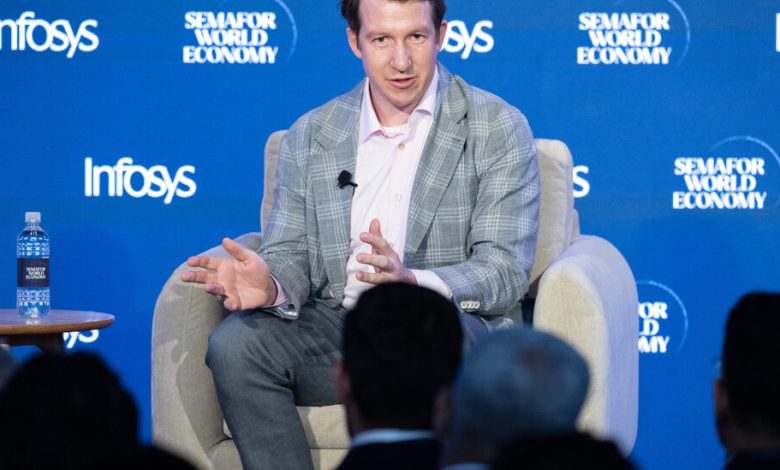
“There’s been a notable change in the profession,” said Erik Brynjolfsson, a Stanford economist who helped organize the statement. He said his goal was to get economists and policymakers to take the disruptive potential of A.I. more seriously.
“I still see a big gap there, a big mismatch, and I’m kind of worried that we’re not going to be ready for the tsunami that’s coming,” he said.
Many economists, including Mr. Brynjolfsson, say they believe that A.I. will ultimately be beneficial, making workers more productive and raising living standards. They point to historical examples of technologies — including steam power and the personal computer — that wiped out some categories of jobs but ultimately created far more new ones.
Even if A.I. follows the same pattern in the long run, however, it could be hugely disruptive in the shorter term, potentially displacing millions of white-collar workers. Economists have warned that the unemployment insurance system and other safety-net programs aren’t ready to handle such an influx.
“If you look at what robots did in the manufacturing sector, if A.I. does something equivalent in a more compressed time period, that would be really disruptive, really costly for people’s livelihoods,” Mr. Acemoglu, at M.I.T., said.
Mr. Acemoglu said he remained skeptical that A.I. would prove as revolutionary as quickly as many in Silicon Valley predict. But he said recent advances had made him more concerned about the possibility of significant job losses. He has called for A.I. labs to develop tools that augment human labor rather than trying to replace it.
The statement calls on economists, policymakers and industry leaders to “act now to understand the economics of transformative A.I.” and to put in place policies that will “steer A.I. in a direction that complements humans and benefits society.” But it does not include any specific policy recommendations.
Mr. Brynjolfsson said one of the highest priorities for economists should be developing better ways to measure A.I.’s spread and impact. The lack of reliable data has been a major obstacle for researchers in recent years, with different measures telling conflicting stories about whether A.I. is leading to job losses and which workers will be most affected.