

July 12, 2026, 9:00 a.m. ET
A total solar eclipse is set to happen next month, but not everyone in the world will be able to see it.
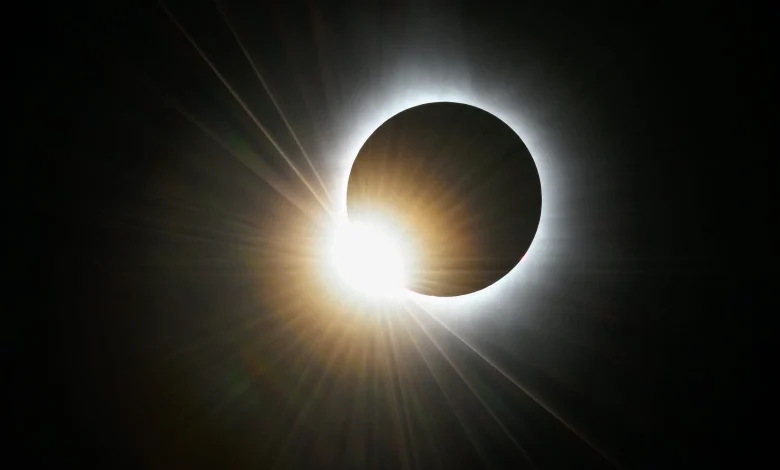
A total solar eclipse will soon take place across Greenland, Iceland, northern Russia, Spain, a part of Portugal and the Atlantic Ocean, according to NASA. While Americans would have to travel to the locations listed above to experience the total solar eclipse, areas of the U.S., from Alaska to North Carolina, will be able to experience a partial solar eclipse, along with Canada, Europe and northwestern Africa.
The night after the eclipse will also offer an extra-special treat, as the Perseid meteor shower will peak during the new moon, the optimal time for viewing. The Perseid is “considered the best meteor shower of the year,” according to NASA.
A total solar eclipse usually only happens about once every 18 months, per Time and Date. The last total solar eclipse was on April 8, 2024.
Here’s what to know about the upcoming event.

When is the total solar eclipse?
The total solar eclipse will take place on Aug. 12, at around 11:34 a.m. ET, according to Date and Time.
US will see a ‘bite’ taken out of the sun and see a partial solar eclipse
During the solar eclipse, areas of the U.S. and southern Canada in line to view the event will look as if a “bite” was taken out of the sun, and the moon will appear to cover only a tiny portion of the sun from North America’s perspective, according to NASA.

Total solar eclipse vs. partial solar eclipse
A solar eclipse occurs when the moon moves between the sun and Earth and casts a shadow on Earth that either fully or partially blocks the sun’s face, according to NASA. When the sun is completely blocked by the moon, it is known as the period of totality. During this time, the sky darkens, and viewers can remove their eclipse glasses to view our planet’s moon blocking our star.
However, only a small part of the Earth, called the path of totality, will get to experience a total solar eclipse. Because it is not on the path, the U.S. will only experience a partial solar eclipse, where only a portion of the sun will be covered, but we will not see it completely blacked out.
It will appear as if the sun had a bite taken out of it. However, to see the partial solar eclipse, viewers will need a special pair of eclipse glasses to avoid permanently damaging their eyes by looking at the sun.
Which US states will be able to see the partial solar eclipse?
The following states will be able to see the partial solar eclipse on Aug. 12, according to USA TODAY’s previous reporting and National Eclipse, an organization that provides information on upcoming eclipses:
- Alaska
- Connecticut
- Delaware
- Illinois
- Iowa
- Indiana
- Maine
- Maryland
- Massachusetts
- Michigan
- Minnesota
- Montana
- New Hampshire
- New Jersey
- New York
- North Carolina
- North Dakota
- Ohio
- Pennsylvania
- Rhode Island
- South Dakota
- Vermont
- Virginia
- West Virginia
- Wisconsin
Do you need any special equipment to view the partial solar eclipse?

Yes! People wanting to see the partial solar eclipse should never look at the sun with the naked eye and should use eclipse glasses, which are different from typical sunglasses, to view the sun during the celestial event, according to NASA.
The only time it is safe to look at the sun during a solar eclipse is during totality, which will not occur in the U.S., according to NASA.
Solar eclipse glasses or handheld solar viewers can be purchased, but should comply with the ISO 12312-2 international standard, according to NASA.
While products might say that they comply with standards, there is no way to know for sure unless they have been tested in a laboratory that is approved by a recognized accrediting body to conduct these tests, according to the American Astronomical Society.
Test if your viewers or eclipse glasses are safe to use indoors before taking them outside. You might only be able to see “very bright lights,” according to the society, but that’s it. If they pass the test, take them outside on a sunny day, but do NOT look at the sun yet. If you still aren’t able to see anything except for the sun’s reflection bouncing off of objects, then you can move on to the next test.
Finally, take the glasses outside and look at the sun for less than a second. It should be “comfortably bright, with a dark background all around it,” according to the society. If they pass all three tests, they should be safe to use.
If the glasses or solar viewers do not pass any of the tests, or they’re damaged, do not use them.
Contributing: Saleen Martin, USA TODAY
Julia Gomez is a Trending reporter for USA TODAY and covers space phenomena, scientific studies and natural disasters. Connect with her on LinkedIn, X, Instagram, and TikTok: @juliamariegz, or email her at [email protected]