Europa, one of Jupiter’s moons, is sealed beneath a shell of ice, but the ocean hidden below may contain twice as much liquid water as every ocean on Earth combined — and Jupiter’s gravity may have kept it liquid for billions of years

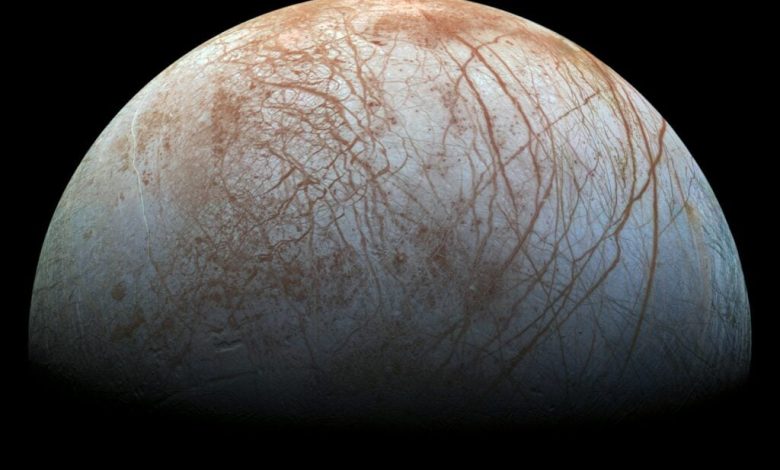
Europa looks, at first, like a frozen world that should be finished. It orbits far from the Sun, locked in the cold outer Solar System, its surface crossed by long reddish fractures and pale plains of ice. There are no blue seas visible from space, no clouds, no rain and no open water under sunlight.
Yet beneath that ice, Europa may be one of the wettest worlds humans have ever found. NASA’s Europa page says scientists believe a saltwater ocean lies beneath the moon’s icy shell, holding twice as much water as Earth’s global ocean. If that estimate is right, a moon smaller than Earth’s Moon may hide more liquid water than all the oceans on Earth combined.
The word “may” matters. No spacecraft has drilled through Europa’s ice. The ocean is inferred from physics, surface geology and magnetic-field measurements. But the evidence has grown strong enough that NASA built Europa Clipper, launched in 2024, to investigate whether places below the surface could support life.
A moon with an ocean under armor
Europa is one of Jupiter’s four large Galilean moons. It is slightly smaller than Earth’s Moon, but its outer layers appear to be rich in water. On the surface, that water is frozen hard. Beneath it, scientists expect a global ocean, trapped under an ice shell that may be many kilometers thick.
NASA’s Europa Clipper overview describes the mission’s goal as understanding the nature of the ice shell and the ocean beneath it, along with the moon’s composition and geology. The spacecraft will not land or drill. Instead, it will make nearly 50 flybys, using instruments to study Europa’s surface, interior, thin atmosphere and possible plumes.
This is not a simple hunt for a lake. The suspected ocean is planetary in scale. If the ice shell is the lid, the ocean below may wrap around the entire moon, sitting above rock. That combination, liquid water in contact with a rocky seafloor, is one reason Europa has become such an important target in astrobiology.
How scientists know to look below the ice
One of the strongest clues came from the Galileo spacecraft, which orbited Jupiter from 1995 to 2003. Galileo measured how Europa disturbed Jupiter’s magnetic field. NASA’s Europa Clipper “Up Close” page explains that the measurement strongly implied a deep layer of electrically conductive fluid, like saltwater, beneath the surface.
The underlying science was laid out in a 2000 Science paper by Margaret Kivelson and colleagues, which argued that Galileo magnetometer measurements made a stronger case for a subsurface ocean at Europa. Saltwater conducts electricity. A buried conductive ocean moving through Jupiter’s changing magnetic environment can generate an induced magnetic field, which is exactly the kind of signal Galileo detected.
Europa’s surface also looks geologically restless. The ice is cut by ridges, bands, cracks and disrupted terrain, as if the shell has been flexed, broken and reworked. NASA notes that Europa’s water-ice surface is the smoothest of any solid body in the Solar System, with relatively few craters and an apparently young surface. That does not prove an ocean by itself, but it fits a world whose outer shell has been active.
The heat does not come from the Sun
At Europa’s distance, sunlight is weak. A simple frozen moon should lose heat and lock its water away as ice. The reason Europa may still have liquid water is not solar warmth. It is gravity doing mechanical work.
As Europa orbits Jupiter, it is pulled by the giant planet and by resonances with neighboring moons. The gravitational tug is not perfectly steady. Europa is squeezed and stretched, a process called tidal flexing. NASA describes how strong tidal forces cause Europa’s icy shell to flex, creating cracks, ridges, bands, pits and domes across much of the surface.
Flexing can generate heat inside a world. The same general process powers the extreme volcanism of Io, another moon of Jupiter, though Europa expresses it more quietly. In Europa’s case, tidal heating may help keep the ocean from freezing completely, even though the surface remains frigid.
Billions of years is the hard part
The headline version says Jupiter’s gravity may have kept Europa’s ocean liquid for billions of years. The careful version is that tidal heating from Jupiter’s gravitational system is one of the leading ways to explain how a subsurface ocean could persist over geological time. The details depend on ice-shell thickness, viscosity, salinity, radiogenic heat from rock, and how heat moves through the ocean and ice.
Recent modeling keeps testing that balance. A 2024 thermal-evolution study by Jun Kimura examined the conditions under which Europa’s subsurface ocean could persist, including different ice viscosities and tidal-heating values. The results show why the question is not as simple as “ice world equals frozen solid.” Under plausible conditions, Europa can remain an ocean world for immense spans of time.
Other work asks how heat moves once it is generated. A 2023 study by Daphné Lemasquerier and colleagues modeled how Europa’s ocean may translate interior tidal-heating patterns to the ice-ocean boundary. In other words, the hidden ocean is not just a passive tank of water. It may circulate, redistribute heat and help shape the thickness of the ice above it.
Why an ocean is not the same as life
Liquid water is essential to life as we know it, but it is not enough by itself. Europa would also need the right chemistry and usable energy. NASA’s Europa Clipper pages frame the mission around habitability, not life detection. The spacecraft is designed to ask whether Europa has environments that could support life, not whether organisms are definitely there.
That distinction matters because Europa is difficult. Its surface is blasted by radiation trapped in Jupiter’s magnetic field. Its ocean is buried under ice. If material from the ocean reaches the surface through cracks, plumes or geologic exchange, it may carry clues. But the connection between ocean and surface is still uncertain.
Europa Clipper will help narrow those uncertainties. It will use radar to probe the ice, instruments to map surface composition, thermal measurements to look for warmer regions, and magnetic and gravity measurements to learn about the ocean and deep interior. The mission is, in effect, an attempt to read the ocean through its frozen lid.
A sea where no sea should be
Europa’s appeal is that it reverses what habitability once seemed to require. Earth has surface oceans warmed by sunlight. Europa may have a buried ocean maintained partly by tides. Earth wears its water openly. Europa hides it under armor.
If the current picture is right, Jupiter’s gravity has helped turn a frozen moon into a possible ocean world. The energy comes not from a star overhead, but from the constant gravitational kneading of a moon locked in orbit around a giant planet.
That is why Europa has become one of the most compelling places in the Solar System. It is not Earth-like in the easy sense. It is dark, cold, irradiated and sealed. But beneath the ice may be a global ocean, twice Earth’s supply of seawater, kept liquid by a force that never stops pulling.