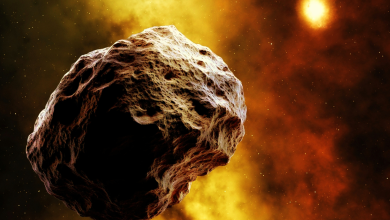
A rare meteorite examined in 2026 revealed evidence of a Moon-sized world that orbited the young Sun more than 4.5 billion years ago, then vanished — possibly shattered in a catastrophic collision while Earth was still being assembled

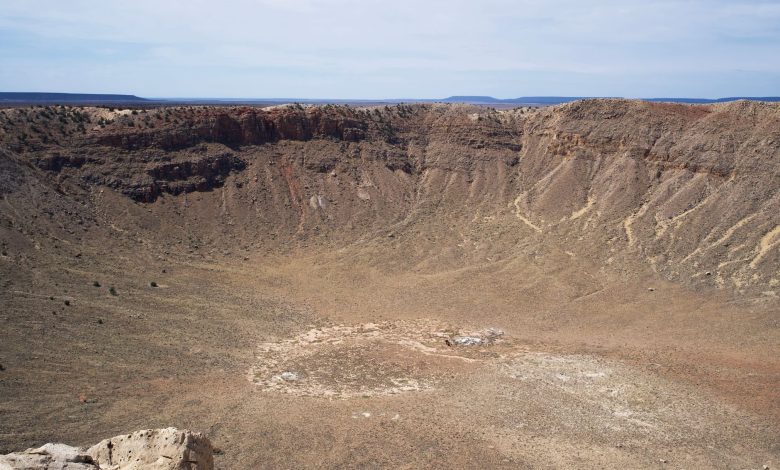
A small stone from Northwest Africa has become evidence for a much larger absence. In a 2026 paper, researchers argue that the meteorite known as Northwest Africa 12774 may preserve material from a vanished planetary embryo, a body perhaps comparable in size to the Moon and possibly larger, that once orbited the young Sun.
The claim is not that anyone has found a missing planet intact, or mapped its orbit. It rests on minerals inside a single meteorite, and on the pressures those minerals appear to record. The study, published in Earth and Planetary Science Letters, identifies high-pressure clinopyroxene in NWA 12774 and uses that mineral record to argue for an angrite parent body much larger than the small asteroid long assumed for this rare class of meteorites.
This is one study, not settled consensus. But it is an unusually direct way of approaching one of planetary science’s harder problems: how much of the early solar system has simply disappeared, leaving only broken fragments in meteorite collections.
A meteorite with an old address
NWA 12774 was recovered through the Northwest Africa meteorite trade and formally recognised as an angrite after being found in 2019. The Meteoritical Bulletin entry for Northwest Africa 12774 lists it as a 454 gram stone, classified as an angrite, with green crystals set in a dark matrix. That sounds modest, but angrites are among the more important rock types for reading the earliest inner solar system.
Angrites are volcanic meteorites. They are also very old. A NASA Astrobiology report on angrite meteorites describes them as material that formed early enough to preserve clues about the building blocks of terrestrial planets. They are chemically odd compared with Earth, Mars and many other rocky materials, with low silica and a distinctive mineral record.
That odd chemistry is one reason angrites had usually been treated as fragments from a relatively small asteroid. A small parent body would be easy to destroy, easy to scatter, and broadly consistent with the idea that meteorites are often rubble from asteroids rather than from full planetary embryos.
NWA 12774 complicates that picture.
The pressure clue
The key mineral in the 2026 study is clinopyroxene, a crystal common in planetary rocks. In this meteorite, the clinopyroxene is unusually rich in aluminium. Lead author Aaron Bell of the University of Colorado Boulder and colleagues argue that this chemistry points to formation under very high pressure.
According to the University of Colorado Boulder account of the study, the team reconstructed the conditions required for those crystals to form and found pressures of at least 17.5 kilobars. For comparison, the same release notes that the pressure at the bottom of the Mariana Trench is roughly 1 kilobar.
That comparison is useful because it shows why a small asteroid is hard to make fit. A body with a radius of a few hundred kilometres cannot easily generate that kind of pressure near the surface. To reach such pressures, the parent body would have needed either much greater size, much deeper formation depths, or a history that preserved high-pressure minerals without erasing their textures.
The paper’s argument turns on that last point. If the crystals had sat deep inside a hot planetary interior for a long time, their sharp edges and chemical zoning would probably have been softened or reset. Instead, the meteorite appears to preserve delicate mineral features. The researchers therefore infer that the crystals formed at relatively shallow depth inside a large body, not deep inside a small one.
A world large enough to vanish
Under the more striking scenario, the parent body may have exceeded 1,800 kilometres in radius. That would make it comparable to the Moon in scale, and the upper end of the possible range approaches Mars-sized territory. Space.com, reporting on the same 2026 paper, framed NWA 12774 as possible evidence for a lost solar system world rather than a mere asteroid fragment.
The phrase “lost world” needs handling carefully. It does not mean there is a hidden planet waiting to be found between Mars and Jupiter. The idea is that the early solar system contained many planetary embryos, some of which grew large enough to melt, differentiate, erupt lavas and develop their own geological histories. Most did not survive as neat planets.
During the first tens of millions of years after the Sun formed, the inner solar system was crowded with growing bodies. Some merged to build Earth, Venus, Mars and Mercury. Some were scattered away. Others were shattered in collisions, with fragments later folded into planets, moons, asteroids, or meteorites.
NWA 12774 may be one such fragment. If the interpretation is right, it carries a mineral memory of an object that had enough gravity and internal structure to behave more like a planetary embryo than a simple asteroid.
What the study does not show
The result does not identify the lost body’s orbit. It does not show that the object struck Earth. It does not connect the meteorite to the Moon-forming impact. It also does not prove that every angrite came from a Moon-sized world. The evidence is mineralogical, model-based and drawn from a rare rock whose parent body is already difficult to reconstruct.
Those limits matter because early solar system stories can easily become too clean. A meteorite can tell researchers pressure, temperature, cooling history, chemistry and isotopic relationships. It cannot, on its own, replay the whole collision sequence that produced the present planets.
Still, the finding is a reminder that meteorites are not only small objects. Some are small surviving witnesses to large objects. A stone weighing less than half a kilogram can carry information from a body thousands of kilometres across, provided the right mineral textures survive the journey.
Why a missing planet matters
The larger implication is not that planetary science has added another planet to the old classroom list. It is that the list of surviving planets is a poor guide to the population that once existed. The young solar system was an assembly site, not a finished architecture.
Earth was still being built during the era recorded by angrites. Its chemistry was being set by impacts, melting, core formation and the mixing of material from different reservoirs. A vanished angrite parent body, if real, would represent one more pathway that planetary materials could take before being erased as a world and preserved only as rock fragments.
That is why the 2026 paper is interesting even if later work revises the size estimate. It suggests that some meteorite classes may be remnants of bodies larger and more geologically active than their surviving fragments imply.
There is also a practical point. Many meteorites in collections have not been studied at the level now possible with modern imaging, microanalysis and geobarometry. The next missing world, if there is one, may already be sitting in a drawer, waiting for someone to ask a more precise question of a very old stone.