Every Frame of a Black Hole Movie Is a Time Machine – And Physicists Think We’re Oversimplifying : ScienceAlert

We usually treat a photograph as a record of one moment in time.
Whether it’s a snapshot preserving your happiest memories or a long exposure tracing the slow sweep of stars across the night sky, a photograph normally has a straightforward relationship with time.
Around black holes, however, that relationship falls apart.
There, thanks to the extreme warping of spacetime, a single image may combine light that left its source at different moments before finally reaching the observer, a complication physicists usually describe using “fast” and “slow” light models.
Now physicists Daniel Rojas-Paternina of the National University of Colombia and Alejandro Cárdenas-Avendaño of Wake Forest University have shown in a paper accepted for upcoming publication in Physical Review Letters when those hidden differences in light-travel time matter – and when they can be safely ignored.
“A useful starting point is an ordinary photograph,” Cárdenas-Avendaño told ScienceAlert.
“A camera records photons that arrive at the detector during a short exposure. Those photons did not all leave the object at exactly the same time… But because the speed of light is so large, we normally treat the photograph as a record of one instant.”
 frameborder=”0″ allow=”accelerometer; autoplay; clipboard-write; encrypted-media; gyroscope; picture-in-picture; web-share” referrerpolicy=”strict-origin-when-cross-origin” allowfullscreen>
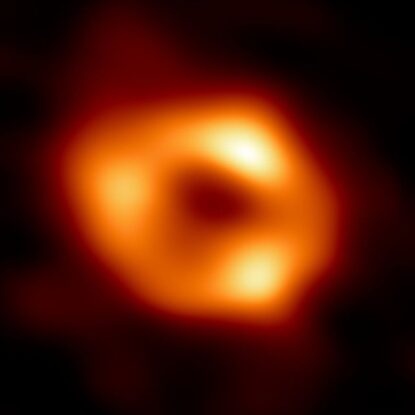
To date, scientists have managed to image two supermassive black holes, M87* in a distant galaxy and Sgr A* at the heart of the Milky Way – but of course, the images don’t show the black holes themselves.
These images show a dark shadow surrounded by a glowing orange halo. That glowing halo comes from a maelstrom of superheated gas swirling around the black hole in an accretion disk, shining brightly enough to be imaged from tens of millions of light-years away.
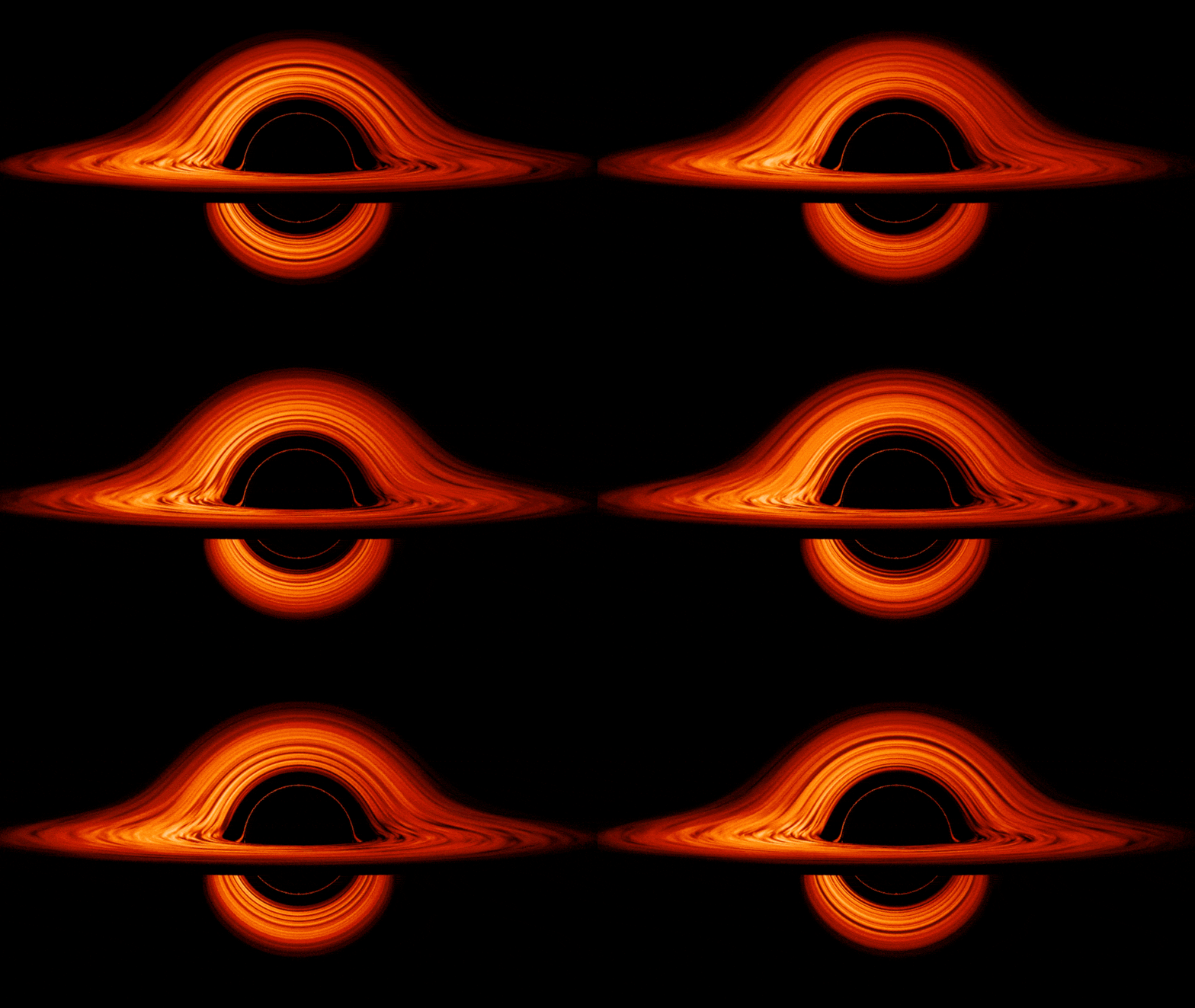
By combining observations with sophisticated simulations, scientists can build models of how that material changes over time, allowing them to compare observation with theory, and even create simulated movies of matter and light flowing around a black hole.
The speed of light in a vacuum is one of the fundamental constants of the Universe, and this new paper has not changed that. Rather, the designations of “fast” and “slow” light are used to model how light travels around a black hole.
“The gravity of a black hole can bend light very strongly,” Cárdenas-Avendaño said.
“Some photons can take nearly direct paths to us, while others can loop around the black hole before reaching the detector. This means that photons arriving in the same image frame may have left the emitting gas at different times.”
The fast-light model treats black-hole observations the same way you might treat a photo of your dog, ignoring the tiny differences in when those photons began their journeys. The light from her snoot may have been emitted slightly later than the light from her tail, but you accept it as a single instant.
The slow-light model, on the other hand, keeps those delays intact.
But that time-delay information retained in the slow-light model comes at a cost. It’s computationally a lot more expensive, so physicists may sometimes opt for the fast-light model for simplicity and speed.
“In fast light, one takes one snapshot of the accretion flow and images it. Then one moves to the next snapshot and repeats the process,” Cárdenas-Avendaño explained.
“In slow light, even one image frame may require many snapshots of the accretion flow, because different pixels correspond to different emission times.”
Previous studies had suggested that the fast-light approximation was accurate enough for many observations.
Imagine the glowing accretion disk doesn’t really change much from moment to moment. It wouldn’t really matter if one photon left a little later than another – essentially you’re still looking at the same scene.
Now imagine that the turbulent gas is flickering violently, with knots and eddies racing around the flow. In a single frame, you might be looking at photons from before and after a flare; suddenly, that time difference matters a great deal.
The problem boils down to a competition between two clocks – how quickly the glowing gas changes, and how widely separated the photons’ travel times are.
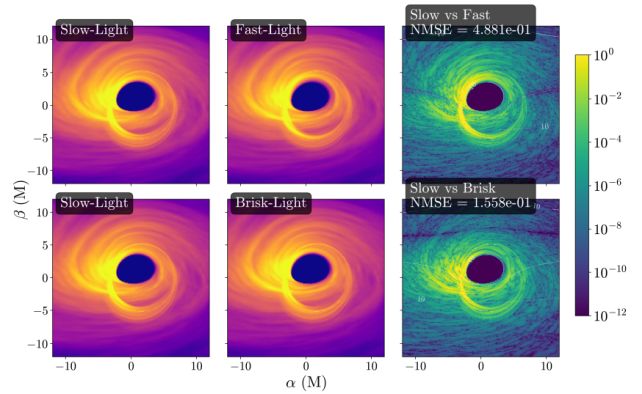
To bridge the gap between fast and slow light, the researchers introduced a middle ground – what they call brisk light, which is neither fully fast nor fully slow.
“Fast light collapses the whole image to one source time. Slow light keeps the full time-delay map across the image. Brisk light is an intermediate prescription,” Cárdenas-Avendaño said.
“It keeps the dominant time-delay structure while reducing the computational cost relative to full slow light. In some cases, it approaches the slow-light result without requiring the full expense.”
The good news is that we don’t need to go back to the drawing board on those iconic images of M87* and Sgr A*. Those black holes were viewed from angles where the fast-light approximation still works for the images produced by the Event Horizon Telescope.
The real payoff may come with the next generation of black hole observatories, which aim to operate in regimes where fast-light timing can give an image that may look right, but still have the wrong timing information.
The next generation of observatories, such as the Black Hole Explorer, hopes to probe more subtle features like photon rings, where the relative arrival times of photons become part of the signal.

The photon ring signal is dominated not by the flowing accretion material, but the geometry of spacetime around the black hole. Because the ring is shaped by photons taking different paths around the black hole, preserving those hidden time delays becomes far more important.
Related: Scientists May Have Detected The First Signature of a Black Hole’s Event Horizon
“We would not be seeing the accretion flow at a single instant. Each frame would combine light emitted at several different times,” Cárdenas-Avendaño said.
“In that limited but precise sense, a black-hole movie is stranger than an ordinary movie.”
Currently, the Event Horizon Telescope collaboration is working to make a movie of M87*. We’re far from crisp, detailed observations of the processes around a black hole, but we’re closer than we’ve ever been to seeing one in action.
When that day comes, each frame will be far more than it appears – a time machine revealing multiple moments from the recent history of one of the strangest spacetime regimes in the Universe.
The paper has been accepted for publication in an upcoming edition of Physical Review D. Until then, you can read the preprint version at arXiv.
This article was fact-checked by Rebecca Dyer and edited by Michael Irving. While we pride ourselves on our process, we are only human. If you spot a mistake, please let us know.