Leafcutter ants don’t eat the leaves they carry home in long green columns — they feed the clippings to an underground fungus, and it is the fungus they farm and eat, a practice that predates human agriculture by around 50 million years

Deep beneath the forest floor in Panama, a colony of Atta cephalotes is tending a pale, spongy mass the size of a soccer ball. Above ground, worker ants stream along cleared trails carrying half-moon leaf fragments larger than their own bodies, sometimes for hundreds of meters. The leaves are not lunch. They are compost. The ants are farmers, and the crop growing in their humid underground chambers is a fungus called Leucoagaricus gongylophorus, a cultivar that no longer exists in the wild and cannot survive without them.
This arrangement is around 66 million years old, according to a 2024 genomic study led by Ted Schultz at the Smithsonian National Museum of Natural History. Human agriculture, by comparison, is about 12,000 years old. Leafcutter ants were running fungal farms while Tyrannosaurus rex was still fresh in the fossil record.
The green column is a supply chain
A mature Atta colony can contain eight million ants and strip a mature tree of its leaves in a single night. The famous processions — those wavering green ribbons snaking through the leaf litter — are the visible tip of an operation that reaches ten meters down and spans hundreds of interconnected chambers.
The leaves themselves are indigestible to the ants. Plant cell walls are locked up in cellulose and lignin, defended further by tannins and toxic secondary compounds the tree evolved specifically to poison herbivores. An ant that tried to eat a fresh cut of rainforest leaf would get almost nothing out of it.
So the ants outsourced digestion. They hand the leaves to something that can break them down.

What actually happens underground
Inside the fungal chambers, smaller worker castes take over. They lick the leaf fragments clean of contaminants, chew them into a pulp, and press the pulp into the growing surface of the fungal garden. The fungus threads its hyphae through the mulch, secreting enzymes that dismantle plant polymers into sugars the ants could never access on their own.
Researchers at the Great Lakes Bioenergy Research Center have spent years studying this system precisely because the fungus is astonishingly good at degrading plant matter — better, in some respects, than the industrial enzymes used in biofuel production. The ants have been optimizing this pipeline for tens of millions of years, and the fungus has evolved into a metabolic factory tuned to convert tropical foliage into something edible.
The ants eat swollen fungal tips called gongylidia
The fungus rewards its farmers with specialized structures. At the tips of certain hyphae it grows swollen, nutrient-rich nodules called gongylidia — small pale beads packed with lipids, proteins, and easily digestible carbohydrates. Worker ants pluck these off and feed them to the larvae and the queen. Adult workers get some too, though they supplement with plant sap on foraging trips.
The gongylidia are found nowhere else in the fungal kingdom in this form. Leucoagaricus gongylophorus produces them apparently as an evolved offering to its farmers, in the same way that a domesticated apple tree produces fruit larger and sweeter than any wild ancestor. The fungus has been shaped by the ants as thoroughly as wheat has been shaped by humans.
Neither party can survive without the other. The fungus, cultivated for millions of generations in sterile underground chambers, has lost the ability to reproduce sexually or compete in the open forest. The ants, in turn, cannot digest leaves. A colony separated from its cultivar starves within days.
The farm has weeds, and the ants have pesticides
Any monoculture attracts parasites. The leafcutter garden is no exception. A specialist fungal pathogen called Escovopsis targets Leucoagaricus gardens specifically — it appears to eat nothing else — and left unchecked it will destroy a colony’s food supply within weeks.
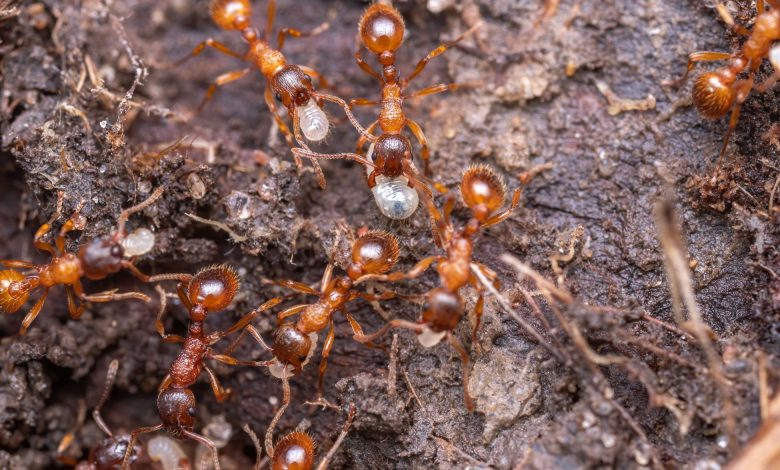
The ants fight back with antibiotics. On their exoskeletons, particularly on the underside of the head and thorax, they culture strains of Pseudonocardia bacteria that produce antifungal compounds active against Escovopsis. Young workers appear chalky white when the bacterial coat is dense. When infection breaks out in a garden chamber, the ants apply the antimicrobial directly, essentially spraying their crop with a pesticide they grow on their own bodies.
The full symbiotic web inside a single colony involves at least four organisms in tight coevolution: the ants, the cultivar fungus, the parasitic Escovopsis, and the antibiotic-producing bacteria. Recent work has added yeasts and additional bacterial partners to the picture, and the bacterial community shifts depending on which plants the colony has been harvesting.
Sixty-six million years, and a specific starting point
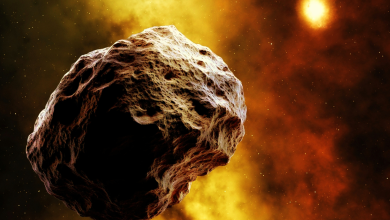
The Schultz team’s 2024 analysis pinned the origin of ant agriculture to the immediate aftermath of the Chicxulub impact — the asteroid strike that ended the Cretaceous and killed the non-avian dinosaurs. In the darkened, dust-choked years that followed, fungi thrived on the enormous quantities of dead plant matter. Some ancestral ant lineage began scavenging in those fungal mats, and a partnership took root.
For roughly the first 40 million years, this early ant farming was a modest affair. The ants tended fungi that could still, in principle, live independently. Then, somewhere around 27 million years ago, in the drying climate of South America, one lineage crossed into what Schultz calls higher agriculture: the fungus became fully domesticated, the ants became fully dependent, and the two species could no longer be separated.

The leafcutters — genera Atta and Acromyrmex — are the most recent and most elaborate expression of this lineage. They emerged only in the last several million years and pushed the system to its industrial extreme. A single Atta nest can move more soil than a large mammal and consume more vegetation per hectare than any grazing animal in the same forest.
A caste system built around the crop
The farm requires specialists. Atta workers come in a size range that spans two orders of magnitude by weight, and each caste has a role tied to the fungus. The largest soldiers, with mandibles that can draw blood from a human finger, defend the colony. Medium-sized foragers cut and carry leaves. Smaller workers process the pulp. The very smallest — sometimes called minims — patrol the garden itself, weeding out contaminating microbes and tending the hyphae with what looks, under a microscope, unmistakably like animal husbandry.
Some minims also hitchhike on the leaf fragments being carried home, riding shotgun to fend off parasitic flies that try to lay eggs on the foragers’ exposed necks. The whole column is a moving defended supply line.
The queen carries the farm with her
When a virgin queen leaves her natal colony on her mating flight, she takes a pellet of fungus with her, tucked into a small pouch beneath her mouthparts called the infrabuccal pocket. She mates in the air, lands, sheds her wings, digs a chamber, and spits out the fungal pellet. That tiny inoculum is the seed of a new farm.
For the first weeks she tends it alone, feeding it with her own fecal droplets while laying the first eggs. If the fungus dies, the colony dies. She has effectively carried a piece of a 66-million-year-old cultivar out of her mother’s nest and planted it in the dark, the way a subsistence farmer might carry seed grain to a new field. The cultivar in a colony in Costa Rica today is a genetic descendant, through unbroken vegetative propagation, of the fungus its ancestors were tending when mammals were still small and nocturnal.
What the fungus provides that the leaves can’t
Recent metabolomic work has clarified exactly what the ants are getting from the arrangement. The fungus supplies amino acids — including several the ants cannot synthesize — along with lipids and enzymes that the ants incorporate into their own digestion. Public lectures at institutions like the University of Texas at Austin have highlighted how deeply the ants’ nutrition is outsourced to the crop. The ants are, in a real biochemical sense, eating processed leaf — just processed by a partner organism rather than in their own guts.
This is the same trick ruminants pull with the microbes in their stomachs, and the same trick humans pull with sourdough starters and cheese cultures. The leafcutters just externalized it into a room.
A farming system older than flowers dominated the Earth
Set the timescales side by side. Humans domesticated wheat around 10,000 years ago. Rice, about 9,000. Maize, roughly 9,000. The plow, about 6,000. Industrial fertilizers, about 120. The oldest continuously cultivated human crop is a blink in the geological record.
Leucoagaricus gongylophorus, meanwhile, has been under continuous cultivation since before the Andes finished rising. It has passed from queen to queen, in unbroken vegetative lineage, through the extinction of the ground sloths, the arrival of humans in the Americas, the rise and fall of Tenochtitlan, and last week’s rain in the Panama canopy. Somewhere under the leaf litter tonight, a minim worker is weeding a garden that was already old when our species learned to walk.
The American Chemical Society’s coverage of ongoing research puts it plainly: the ants got there first, and they got there by a margin so large that human civilization fits inside the rounding error.