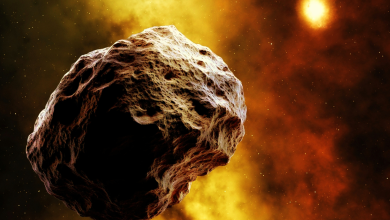
A single teaspoon of neutron star material would weigh about four billion tonnes on Earth — roughly the mass of a mountain — because the star has crushed the equivalent of the Sun into a sphere the width of a city

PSR B1919+21, the first neutron star ever detected, was picked up by Jocelyn Bell Burnell in Cambridge in 1967 as a metronome-steady radio pulse arriving every 1.3 seconds from a source no larger than a small city. That pulse came from a collapsed stellar core so dense that a single teaspoon of its material would weigh around four billion tonnes on Earth — roughly the mass of a mountain packed into the volume of a sugar cube.
The star did this by taking something with more mass than the Sun and squeezing it into a ball about 20 kilometres across.
What actually happens when a star collapses
A neutron star is what remains after a massive star runs out of fuel and its core caves in on itself. Gravity wins so completely that atoms stop behaving like atoms.
In ordinary matter, an atom is mostly empty space. The nucleus sits at the centre like a fly in a cathedral, with electrons orbiting far out at the walls. Compress a star hard enough and those electrons get shoved into the protons, fusing into neutrons and collapsing the cathedral down to the fly.
What is left is a fluid of neutrons packed shoulder to shoulder at nuclear density. As SpaceNews described it, the result is a star roughly twice the mass of the Sun crushed to the size of Manhattan — one of the densest objects anywhere in the known universe.
The teaspoon number, worked out honestly
The density inside a neutron star is around 1017 kilograms per cubic metre. A standard teaspoon holds about 5 millilitres, or 5 cubic centimetres.
Multiply those together and the teaspoon comes out to somewhere between 500 million and 5 billion tonnes depending on where inside the star you scoop. Four billion tonnes is the figure physicists usually quote for the deep interior.
Four billion tonnes is the mass of about 1,000 Great Pyramids of Giza. It is the mass of every car and truck built worldwide in a decade. It is the mass of a small mountain range, sitting in a spoon.

Why the star does not simply collapse further
What stops a neutron star from continuing to shrink into a black hole is a quantum effect called neutron degeneracy pressure. Neutrons, like electrons, refuse to occupy the same quantum state as their neighbours. Push them close enough and they push back with a force that has nothing to do with heat or motion.
That pressure holds the star up against a gravitational field so intense that the surface gravity is billions of times Earth’s. A marshmallow dropped from a metre above the surface would hit the ground with the energy of an atomic bomb.
Above a critical mass — somewhere around 2.2 to 2.5 solar masses — even neutron degeneracy fails. Anything heavier than that ceiling becomes a black hole instead.
The Manhattan-sized star that spins 700 times a second
Because the collapsing core conserves angular momentum, the finished neutron star spins fast. Really fast. The fastest ones known rotate hundreds of times per second, their equators moving at roughly a quarter of the speed of light.
The magnetic fields are similarly extreme. A class of neutron stars called magnetars carries fields of around 1011 tesla — a trillion times stronger than a fridge magnet, and strong enough to disrupt the chemistry of atoms from a thousand kilometres away.
In 2004, a magnetar released a starquake burst that briefly ionised the upper atmosphere of our planet and saturated satellites designed to watch gamma-ray bursts across the entire visible universe. It was among the brightest events ever recorded from beyond the solar system.
What the interior might actually look like
Nobody knows what sits at the very centre of a neutron star. The pressure is so extreme that neutrons themselves may stop being the fundamental unit — they might dissolve into a soup of free quarks, or form exotic particles, or crystallise into structures with no analogue in ordinary matter.
Researchers at Michigan State University have been running simulations of how neutrinos travel through this material, using the way spin and density correlate in the neutron fluid as a probe of what lies deeper in. Neutrinos are one of the few things that can escape the interior carrying information about it.
Ars Technica has covered a stranger line of work still: physicists using ultracold atoms in laboratories on Earth as scaled-down analogues of the fluid inside a neutron star, because the mathematics of both systems turns out to be remarkably similar.
Where the gold in your ring came from
Neutron stars matter for reasons that go beyond exotic physics. In August 2017, the LIGO and Virgo gravitational wave detectors picked up a signal called GW170817 — two neutron stars in the galaxy NGC 4993 spiralling into each other and merging in a burst that lit up telescopes across every wavelength.
The collision produced, among other things, substantial amounts of gold and platinum, flung outward at a fraction of the speed of light. Similar mergers, occurring across billions of years before the Sun formed, are where most of Earth’s heavy elements came from.
The gold in a wedding band was, quite literally, made in the collision of two of these city-sized corpses.

The surface, if you could stand on it
The surface of a neutron star is not remotely like the surface of a planet. It is a crust of iron nuclei arranged in a crystal lattice, compressed to millions of tonnes per cubic centimetre, sitting on top of the neutron fluid below.
Mountains on this crust exist, but they cannot be tall. The surface gravity flattens them considerably. A neutron star is smoother than any billiard ball humans have ever polished.
Occasionally the crust cracks. When it does, the star releases the energy of a stellar flare in fractions of a second, and its rotation rate abruptly changes in an event pulsar astronomers call a glitch.
Dark matter, and the strangest guess of all
Because neutron stars are so extreme, they double as natural laboratories for physics that cannot be tested any other way. A recent paper covered by Science Daily suggested that neutron stars might be key to understanding dark matter — the invisible material that makes up most of the mass of galaxies but has never been directly detected.
If dark matter particles interact even weakly with ordinary matter, they should accumulate inside neutron stars over billions of years, subtly changing how the stars cool, spin, and vibrate. Precision measurements of those properties are one of the few practical ways to hunt for particles that pass through Earth without noticing it is there.
Four billion tonnes, in a spoon, forever
The teaspoon test is a useful piece of intuition because it collapses the whole strange story into something a human hand can hold. A teaspoon is familiar. Four billion tonnes is not. Putting the two together is where the wonder lives.
If a fragment of neutron star material somehow reached Earth intact, it would not stay in the spoon. Without the crushing gravity holding it together, it would explode outward with roughly the energy of a nuclear weapon, unbinding back into ordinary matter in microseconds.
The stuff only exists because a whole star’s worth of gravity is pressing down on it from every direction at once.
PSR B1919+21 is still out there, still pulsing every 1.3 seconds the way it was when Jocelyn Bell Burnell first noticed it on a paper chart in 1967. It has been doing it for a very long time, and it will keep doing it long after every human who reads this sentence is gone.
A teaspoon of it would still weigh a mountain.