
“Hearst Magazines and Yahoo may earn commission or revenue on some items through these links.”
Here’s what you’ll learn when you read this story:
-
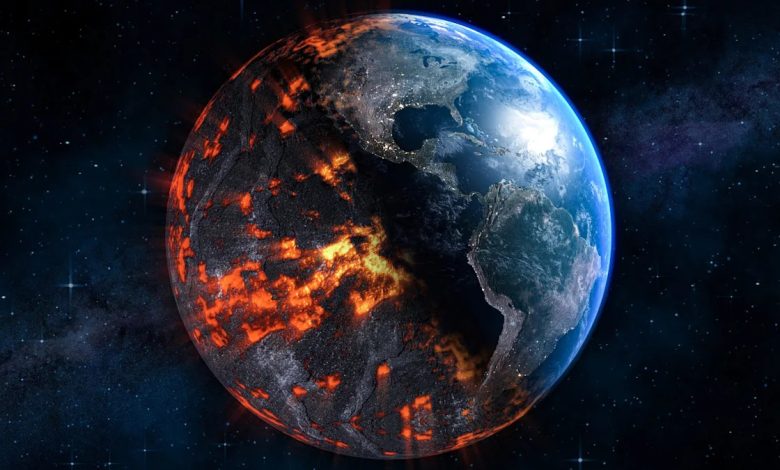
Some scientists think that in five billion years, as the Sun ages and transforms into a Red Giant, Earth will be swallowed whole, effectively ending its 10-billion-year-long existence.
-
However, due to the Sun’s increasing luminosity, life on Earth will be gone long before that celestial cataclysm takes place.
-
A new study predicts that plant life will possibly hold out on Earth more than 1.8 billion years from now—a much higher estimate than past studies have suggested.
All good things come to an end, including life on Earth. In roughly 5 billion years, the Sun will exhaust its stores of hydrogen and begin burning helium, transitioning into a Red Giant and swallowing Earth in the process (maybe). While a couple extra billion years sounds nice—that is, if humanity can even make it past a couple thousand—the planet will run into problems sustaining life long before the Sun’s transition into gianthood.
As our host star (a G-type main-sequence yellow dwarf), continues to burn hydrogen, it’s also increasing its luminosity by roughly 1 percent every 110 million years. Currently, the Sun produces roughly one-third more energy than it did at the birth of the Solar System, and that increasing luminosity will be a big problem in about 1.8 billion years, according to a new study in the journal JGR Atmospheres.
“The ultimate life span of Earth’s biosphere is limited due to the steady brightening of the sun as it progresses in age,” the authors wrote. “Earth’s long-term carbon cycle may respond by drawing carbon dioxide out of the atmosphere and into carbonate rocks, thereby reducing the greenhouse effect and offsetting the increased sunlight.”
As the authors note, previous studies have assumed that the lowering of carbon dioxide in the atmosphere will essentially doom macro-sized organisms, including plants that rely on the gas for photosynthesis. The first calculations based on this disruption of Earth’s carbonate-silicate cycle initially put the end of plant life at just 100 million years from now. Future revisions raised that number up to as much as 1.5 billion by making distinctions between different types of photosynthesis processes used by different plants.
Some 95 percent of plant life on Earth relies on C3 photosynthesis, which requires CO2 concentrations of roughly 150 parts per million. C4 photosynthesis plants on the other hand—like corn, grasses, and many weeds—require only 15 parts per million. Even more drastic are crassulacean acid metabolism (CAM) photosynthesis plants like cacti and orchids, which require CO2 levels as low as 1 part per million
For this new study, the team created 29 climate models, which ran various scenarios that could impact Earth’s vegetative biosphere far into the future (the models’ two key parameters being carbon dioxide levels and temperature). Two of the most extreme scenarios modeled an Earth that’s too hot for life: one in which the CO2 levels remain unchanged (a process known as “weak weathering”), and in the other in which there isn’t enough CO2 to support life but the temperature remains stable (“strong weathering”).
In the weak-weathering scenario, plants that utilize CAM photosynthesis survive until roughly 1.87 billion years from now, while the strong-weathering model ends plant life at around 1.35 billion years in the future. However, using CAM photosynthesis as a threshold, even the strong-weathering scenario raises survivability up to 1.84 billion years from now. Regardless of which timeline plays out, this plant apocalypse will occur around the same time that the Earth’s oceans will be lost to space (also due to the Sun’s increased luminosity). The authors also note that one limitation of the study is that it only assesses how photosynthesis works today, and not as how it might one day evolve.
“Life on Earth is resilient, and limits posed by thermal stress or starvation may only reflect our observations of the biosphere today rather than hard limits on how the biosphere may evolve,” the authors wrote. “We acknowledge that the results of this study should be examined with other 3-D models, and that a community effort that compares model results at high insolation and low would be the best way to constrain these timescales.”
If nature has shown us anything in past four billion years, it’ll find a way to survive until the very end.
You Might Also Like